










iValue retains FY27 guidance despite 8.1% H1 sales decline
Key highlights
- iValue retained guidance for 20% FY27 top-line growth and 20% PAT growth.
- H1 FY27 gross sales declined 8.1% year on year to Rs 1,372.8 crore.
- The tracked funnel increased to Rs 6,900 crore from Rs 6,149 crore in the prior quarter.
- H1 FY27 annuity sales rose 16.1% year on year to Rs 734.2 crore, or 53.5% of gross sales.
powered by IRIS
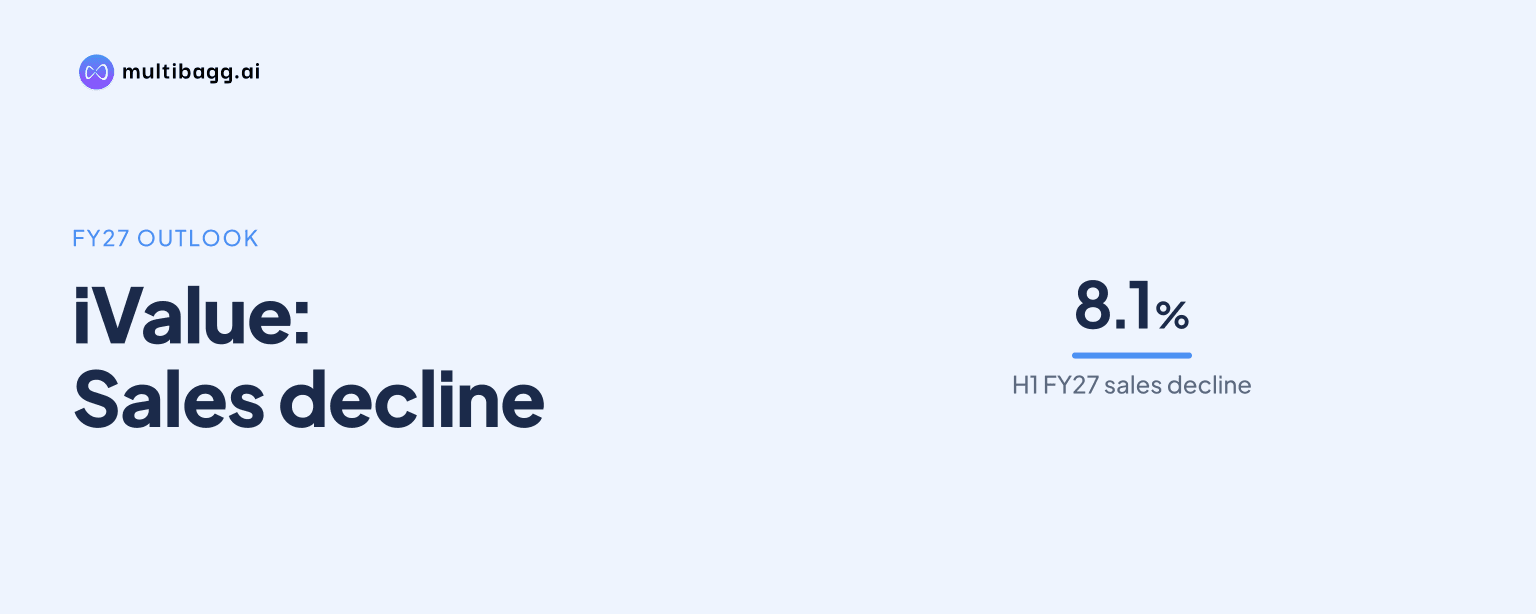
iValue Infosolutions Limited retained its FY27 guidance for 20% top-line and profit after tax growth after H1 gross sales fell 8.1% year on year to Rs 1,372.8 crore. iValue management cited a Rs 6,900 crore tracked funnel, large opportunities nearing conversion and a sales cycle historically weighted towards the second half.
Know Ivalue Infosolutions inside out
Results, valuation, peers and who's buying, in one view.
Why did iValue retain FY27 guidance?
iValue retained its directional FY27 target because management said its tracked funnel reached Rs 6,900 crore at the end of Q2 FY27, up from Rs 6,149 crore in the preceding quarter. Management said several large opportunities discussed in the prior call had moved closer to conversion, while stressing that a funnel is not booked business and must still be converted and executed.
Management also based its outlook on the timing of enterprise purchases. It said large-customer decisions are budget-led and closures are usually concentrated in H2, with its historical mix at about 40% of annual sales in H1 and 60% in H2. On that pattern, management said H1 gross sales of Rs 1,372.8 crore would imply about Rs 3,430 crore for FY27 and nearly Rs 2,000 crore in H2.
For Q3 FY27, management said October billings and bookings expected to turn into billings in the next two months had already exceeded the gross sales reported for all of Q3 FY26. This was an early operating indicator rather than a reported Q3 result, and management said roughly 45 days remained in the quarter excluding the festival period.
How did iValue perform in H1 FY27?
iValue reported H1 FY27 gross sales of Rs 1,372.8 crore, down 8.1% from Rs 1,494.2 crore a year earlier, while profit after tax, or PAT, declined 2.4% to Rs 39.1 crore. Management said the comparison included an unusually high base because Q2 FY26 included a large transaction of about Rs 150 crore.
Q2 FY27 gross sales rose from Rs 641.2 crore in Q1 FY27 to Rs 731.6 crore, but were 17.6% below Q2 FY26. Operating earnings before interest, tax, depreciation and amortisation, or operating EBITDA, increased 54.7% sequentially to Rs 31.3 crore, while gross profit rose 35.0% sequentially to Rs 70.2 crore.
Reported H1 gross profit increased 7.8% to Rs 122.3 crore, with gross margin at 8.9% against 7.6% in H1 FY26. Management said Q2's reported 9.6% margin included a one-time benefit from a high-margin deal; excluding that impact, it put Q2 gross margin at 8.9% and H1 gross margin at 8.6%.
Which iValue segments changed in H1 FY27?
iValue's annuity business grew 16.1% year on year to Rs 734.2 crore in H1 FY27 and represented 53.5% of gross sales. Q2 annuity sales were Rs 437 crore, up 17.8% year on year and equal to about 59% of quarterly gross sales, supported by renewals and software-as-a-service offerings.
Cybersecurity remained iValue's largest segment, contributing about 48% of H1 revenue, but sales in that business fell 8.7% year on year. Data centre infrastructure, at 19% of H1 revenue, grew 39.7%, while application lifecycle management, cloud and other businesses, also at 19%, grew 27.2%.
Information lifecycle management, or ILM, accounted for 14% of H1 revenue and declined 48.1% year on year. Management said expected deals from a large original equipment manufacturer were pushed into Q3 and Q4, partly because customers shifted budgets from ILM to data centre infrastructure.
Management expects annuity sales to be about 50% of full-year gross sales, plus or minus 1 percentage point, as large and net-new deals are added in Q3 and Q4. It said some customers chose renewals over upgrades and technology refreshes during H1 because of budget constraints, increasing annuity renewals while delaying fresh purchases.
Got a follow-up? Ask IRIS
What could affect iValue's H2 FY27 delivery?
iValue said the timing of large deals is the principal risk to its FY27 target because a relatively small number of transactions can change quarterly or half-year performance. Management said customers have sometimes identified the preferred partner and then prolonged commercial negotiations by two to three months after a deal had been structured.
Higher hardware component prices have also affected customer decisions, according to management. It said some customers that were due for technology refreshes after five or six years extended renewals instead, postponing the refresh into a subsequent year rather than committing the budget during FY27.
Management said cybersecurity incidents have led to customer discussions, but it did not expect customers to revise their budgets during the current financial year. It said the resulting demand for new cybersecurity technologies and protection measures was more likely to affect business in the next financial year.
iValue also said original equipment manufacturer consolidation could become a risk over time, although management reported no current revenue impact. It said iValue had added other manufacturers in similar areas and had already built a funnel for their offerings to provide coverage against that potential change.
How did one-offs and costs affect iValue's results?
iValue's Q2 FY27 accounts included a Rs 3.7 crore gain from the sale of vacant land, recorded as non-operating income, and a Rs 4.4 crore write-off in operating expenses. The write-off related to a single Indian partner that could not make payments and settled its receivable for a lower amount.
Management said Q2 operating expenses rose by almost 35%, but would have increased by about 18% without the Rs 4.4 crore write-off. It described the settlement as a one-off case and said the balance receivable was not collectible.
H1 FY27 employee costs rose 15% to Rs 40.9 crore from about Rs 35.5 crore in H1 FY26. Management attributed the increase to hiring for growth roles, investment of about Rs 1 crore to Rs 1.5 crore in ASEAN operations, and annual appraisals from July 1 averaging 8% to 10%.
Net working capital stood at 48 days on September 30, 2026, compared with 46 days in September 2025, while cash adjusted for debt was Rs 124 crore. iValue reported return on capital employed of 24.7% for Q2 FY27 and 22.9% for H1 FY27, alongside management's stated focus on margin and working-capital discipline.
Conclusion
iValue's retained 20% FY27 growth guidance depends on an H2 recovery from the 8.1% H1 gross-sales decline, supported by the Rs 6,900 crore funnel, higher annuity sales and expected conversion of large transactions. The segment picture was mixed: data centre infrastructure and application lifecycle management, cloud and other businesses grew, while cybersecurity and ILM declined.
The next point to watch is Q3 FY27, when management expects delayed ILM opportunities and other large deals to convert into billings. Investors will also need to track whether hardware-price-related deferrals, extended customer negotiations and the expected 60% H2 sales weighting allow iValue to maintain its stated full-year target.