








ixigo AI resolves 94% of chat queries without human intervention

Find your next multibaggerBe a Pro Investor
Research stocks and track your picks on the go. Download the app.
Key highlights
- ixigo said TARA handled 43 lakh pre- and post-booking queries in Q2 FY27.
- TARA resolved 94% of chat queries without human intervention and completed 82% of customer calls end-to-end.
- AI-handled queries more than doubled year on year while customer-service costs did not rise in proportion, according to management.
- ixigo reported Q2 FY27 GTV of Rs 5,304.47 crore, up 22% year on year.
powered by IRIS
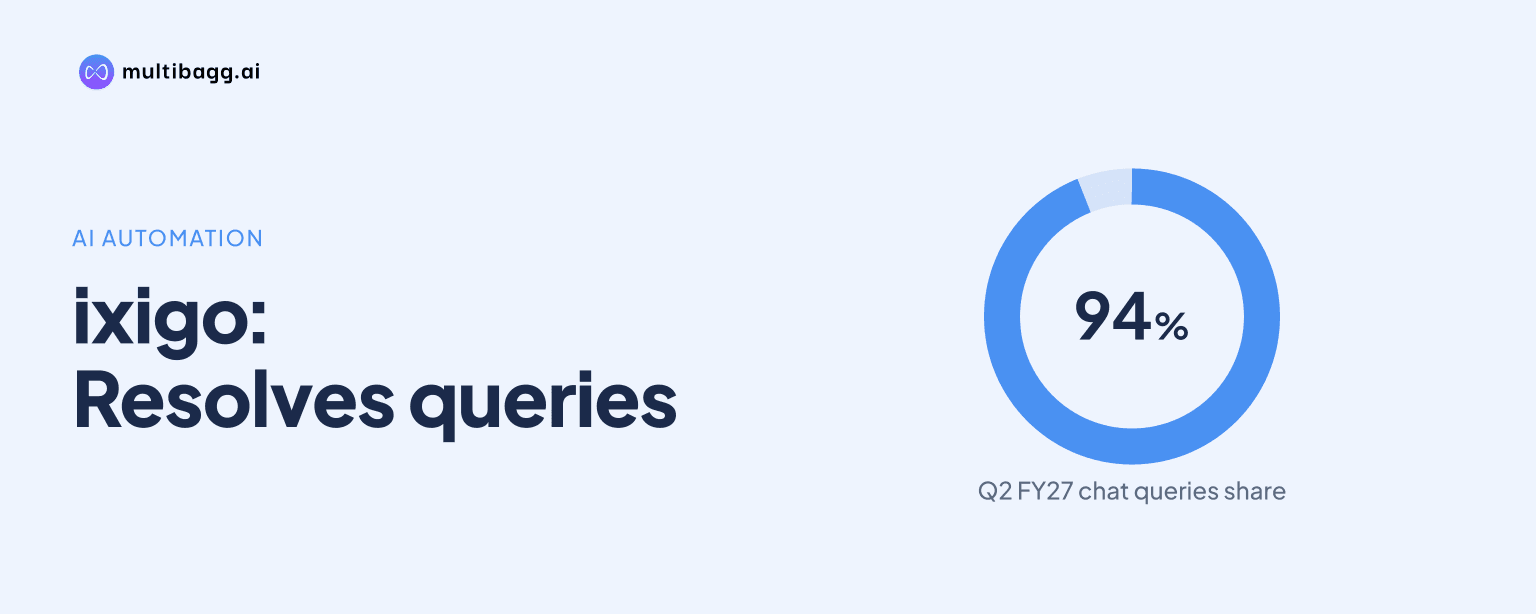
Le Travenues Technology, also known as ixigo, said TARA resolved 94% of chat queries without human intervention and completed 82% of customer calls end-to-end in Q2 FY27, after handling 43 lakh queries before and after booking. Management said AI-handled queries more than doubled year on year while customer-service costs did not rise in proportion.
Know Le Travenues Technology inside out
Results, valuation, peers and who's buying, in one view.
How much customer support does ixigo's AI handle?
ixigo said TARA handled 43 lakh customer queries before and after bookings in Q2 FY27, resolving 94% of chat queries without a human agent and completing 82% of customer calls end-to-end. The metrics cover written and voice-based service interactions rather than only booking assistance.
The 94% chat-resolution rate means that 6% of chat queries did not reach the stated automated outcome. Similarly, 18% of calls were outside the 82% end-to-end automated completion rate. ixigo did not disclose the split of the 43 lakh queries between chats and calls, or the number referred to human support teams.
TARA’s role includes questions before and after a traveller makes a booking. This can cover travel search, bookings, changes and post-purchase issues across ixigo’s train, bus, flight and hotel offerings. The company did not provide separate Q2 FY27 automation rates for individual travel segments.
Management said AI-handled query volumes more than doubled year on year in Q2 FY27. It did not disclose the prior-year volume, the exact growth rate, or whether chats, calls, trains or another category accounted for most of the increase. The 43 lakh total is therefore the company’s clearest measure of TARA’s operating scale.
What did AI automation mean for ixigo's support costs?
ixigo said AI-handled queries more than doubled year on year while customer-service costs did not rise in proportion, increasing its capacity to serve travellers as the business grows. Management did not disclose a rupee support-cost figure, cost per query or savings attributed to TARA in Q2 FY27.
The disclosure coincided with passenger-segment growth of more than 11% to 3.98 crore and gross transaction value, or GTV, growth of 22% to Rs 5,304.47 crore in Q2 FY27. Revenue from operations increased 13% year on year to Rs 320.96 crore. Management’s position was that AI capacity supported this higher activity without a matching rise in customer-service costs.
Overall spending was also affected by investment decisions outside customer support. Adjusted earnings before interest, tax, depreciation and amortisation, or adjusted EBITDA, fell 17% year on year to Rs 23.58 crore from Rs 28.48 crore. Management said it prioritised people and technology spending for hotels during the quarter.
Hotels received management-estimated investment of slightly more than Rs 11 crore in Q2 FY27, including about Rs 10 crore in people and technology costs below contribution margin. That hotel expenditure is not an AI support cost. It does show that ixigo is funding product and technology development while reporting AI-led service capacity in its established travel operations.
Got a follow-up? Ask IRIS
Which AI products is ixigo building beyond TARA?
ixigo said in its Q2 FY27 call that its platforms are available as natively integrated apps on ChatGPT, and that it is continuing work on ixigo NEXT, agentic AI products and voice-first experiences. Management linked these products to the possibility that consumer AI agents could eventually make travel bookings for customers, but gave no launch date or financial target.
On the Q2 FY27 call, ixigo said it had demonstrated a fully agentic booking flow with payments at the GFF conference in Mumbai. Management said it was awaiting regulatory clarity before launching the flow. The company did not identify the regulator or provide a planned launch date.
ixigo also highlighted Smart Lock, a flight product it described as agentic AI. A traveller gives a route, budget and preferences, and Smart Lock scans airfares 24/7 before locking the first flight that meets those criteria. If no match is found when the scanning period ends, ixigo said the customer receives the full premium back in ixigo money.
Smart Lock was introduced during a difficult Q2 FY27 flight market. Flight GTV increased 37% year on year, supported by higher fares, but flight revenue fell 8% to Rs 82.66 crore and contribution margin declined 10% to Rs 35.68 crore. Management attributed the conditions partly to capacity constraints and fares that were about 30% higher year on year on several routes.
How does AI support ixigo's wider travel strategy?
ixigo said it aims to use AI to solve practical traveller problems and build what management calls peace-of-mind products, while improving service and productivity. Its Q2 FY27 examples were TARA for customer support and Smart Lock for flight-price monitoring, not a separately disclosed AI revenue contribution.
The strategy covers segments that showed different trends in Q2 FY27. Train passenger segments rose about 7% year on year to 2.9 crore, while train revenue increased 16% to Rs 149.14 crore. Bus GTV grew 32% to Rs 752.65 crore, and international flight GTV rose 59% year on year despite pressure in the wider flight market.
Hotels are another segment where support, fulfilment and reliability are part of the stated plan. Hotel GTV grew 2.6 times year on year to Rs 111.34 crore, with about 4.7 lakh room nights in Q2 FY27 and a contribution loss of Rs 1.21 crore. Management said direct supply, better fulfilment and support when things go wrong remain work to be done.
More than 86% of hotel bookings came from travellers already on ixigo’s platforms, according to management. The company also said 94% of its transactions involve travel to or from Tier 2 and Tier 3 cities, while more than nine out of 10 trips it sells are by train or bus. These figures underpin management’s plan to pair its existing customer base with investments in hotel supply, service and technology.
Conclusion
ixigo’s Q2 FY27 disclosure provides operating measures for its AI service effort: 43 lakh pre- and post-booking queries handled, 94% chat resolution without human intervention and 82% of calls completed end-to-end. Management said AI-handled query volumes more than doubled year on year without customer-service costs rising proportionately, while passenger segments exceeded 3.98 crore and GTV reached Rs 5,304.47 crore.
Next, investors can watch for any disclosure on support costs or cost per query, segment-level service measures, and regulatory clarity for the agentic booking flow with payments. Management has said it will continue investing in AI platforms, while its hotel plan calls for expanded direct supply and an ambition to become the largest player in its target hotel market over the next four to five years.

