








ixigo Aims for Budget and Mid-Market Hotel Market Leadership

Find your next multibaggerBe a Pro Investor
Research stocks and track your picks on the go. Download the app.
Key highlights
- ixigo hotel GTV reached Rs 111.34 crore in Q2 FY27, up 2.6 times year on year.
- More than 86% of ixigo hotel bookings came from existing platform users in Q2 FY27.
- ixigo had direct tie-ups with over 12,000 hotels across about 1,100 towns, up from 10,000 in the prior quarter.
- Management estimated total hotel investment at slightly more than Rs 11 crore in Q2 FY27.
powered by IRIS
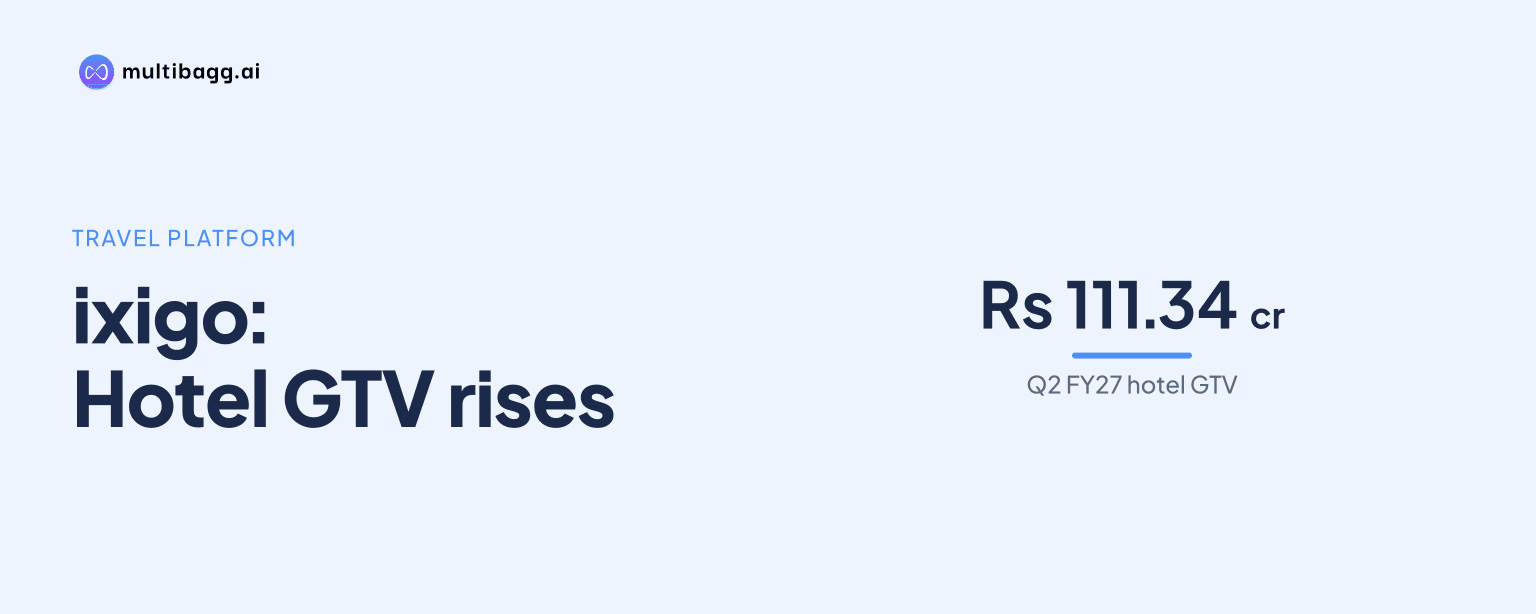
Le Travenues Technology Limited, known as ixigo, aims to become the largest player serving India’s budget, mid-market and independent-hotel market within four to five years. Management’s ambition follows Q2 FY27 hotel gross transaction value, or GTV, of Rs 111.34 crore, 4.70 lakh room nights and more than 86% of bookings from existing platform users.
Know Le Travenues Technology inside out
Results, valuation, peers and who's buying, in one view.
What is ixigo’s hotel leadership target?
ixigo’s target is to become the largest player serving the budget, mid-market and independent-hotel portion of India’s hotel market over the next four to five years. Management described this as an aspiration rather than a revenue, profit or market-share forecast, saying product-market fit is emerging after hotel GTV rose 2.6 times year on year in Q2 FY27.
The strategy focuses on lower-priced stays and independent properties rather than the entire lodging market. Management cited a VIDEC industry report stating that about 60% of hotel room nights in India are sold below Rs 2,000 a night and independent hotels account for 73% of rooms. ixigo said these segments have relatively low online penetration and require reliable fulfilment and customer support.
Why does ixigo see an advantage in Tier 2 and Tier 3 hotel demand?
ixigo believes its existing traveller base gives it a hotel distribution channel because more than 86% of Q2 FY27 hotel bookings came from users already on its platforms. Management said this captive-user mix creates scope to sell accommodation alongside a transport booking, while adding that it will continue to invest in hotels as a strategic category.
The company’s travel mix overlaps with its hotel focus: 94% of transactions involve travel to or from Tier 2 and Tier 3 cities, while more than nine out of 10 trips sold are by train or bus. In Q2 FY27, ixigo handled 3.98 crore passenger segments, up more than 11% year on year, and total GTV rose 22% to Rs 5,304.47 crore.
Hotel volume has expanded alongside this transport base. ixigo recorded more than 5,100 hotel room nights a day after cancellations, equalling about 4.70 lakh room nights during Q2 FY27. This was 3.9 times the prior-year volume and more than 50% above the comparable Q1 level, which management cited when beginning separate hotel-segment reporting.
How is ixigo building direct hotel supply?
ixigo had direct tie-ups with more than 12,000 hotels across about 1,100 towns at the end of Q2 FY27, up from 10,000 in the preceding quarter. The company sells inventory from 70,000 hotels in India overall, meaning directly contracted properties are a growing part of its wider hotel supply.
Management said direct supply, better fulfilment and support when bookings go wrong are key work areas before the business can establish repeat demand at scale. Those priorities are particularly relevant to independent hotels, which represented 73% of rooms in the VIDEC data cited by management. ixigo also said it needs to develop hotel-specific products that provide travellers with greater peace of mind.
The company began consolidating Brevistay in Q2 FY27, so management said part of reported hotel growth was inorganic. Hotels are now reported separately, while food-on-train services have moved into the trains segment and earlier periods have been restated on a comparable basis. This makes future comparisons more directly focused on ixigo’s lodging operations.
Got a follow-up? Ask IRIS
What is ixigo spending on the hotel expansion?
ixigo estimated total hotel investment at slightly more than Rs 11 crore in Q2 FY27, including about Rs 10 crore of people and technology spending recorded below segment contribution margin. The hotel segment itself reported a contribution loss of Rs 1.21 crore, compared with a Rs 0.71 crore loss in Q2 FY26, so that reported loss does not capture all hotel-related spending.
Management said it deliberately prioritised hotel people and technology during the quarter and will calibrate further spending against progress and expected long-term returns. Hotel gross take rate exceeded 12%, the highest across ixigo’s businesses, while contribution margin improved from negative 55% of revenue a year earlier to negative 15% in Q2 FY27.
The company said its established operations provide capacity to fund this investment. Group revenue from operations increased 13% year on year to Rs 320.96 crore in Q2 FY27, although adjusted earnings before interest, tax, depreciation and amortisation, or EBITDA, fell 17% to Rs 23.58 crore as investment increased. Cash and cash equivalents, including fixed deposits and mutual funds and net of borrowings, stood at about Rs 1,831.71 crore.
How large is the hotel market ixigo is targeting?
India’s hotel market was estimated at Rs 1,57,000 crore in FY26 and is projected to reach Rs 1,94,000 crore by FY28, according to VIDEC estimates cited by ixigo. The same estimates project online travel agency, or OTA, hotel bookings to grow by around 19% annually from Rs 40,200 crore to Rs 57,000 crore over that period.
Management said hotels are already the second-largest OTA category and about three times the size of the OTA rail market. This contrasts with ixigo’s current revenue mix: train revenue was Rs 149.14 crore in Q2 FY27, compared with hotel revenue of Rs 8.10 crore. Rail contribution margin was Rs 47.23 crore, while hotels remained in a contribution-loss position during expansion.
Buses illustrate the scale ixigo has achieved in another travel category, with Q2 FY27 GTV up 32% year on year to Rs 752.65 crore and revenue up 24% to Rs 81.04 crore. Management’s hotel thesis is that its experience in rail and bus distribution, combined with a Tier 2 and Tier 3 customer base, can be applied to a lodging market that it says remains substantially offline.
Conclusion
ixigo’s four-to-five-year hotel leadership ambition is supported by early operating momentum rather than current segment profitability. Q2 FY27 brought Rs 111.34 crore of hotel GTV, 4.70 lakh room nights and a captive-booking share above 86%, while the company expanded direct hotel relationships from 10,000 to more than 12,000 properties.
The next indicators are whether ixigo continues increasing direct supply beyond 12,000 hotels, improves repeat bookings and fulfilment, and contains investment as the hotel business grows. Management said it will calibrate spending based on progress and long-term returns, after estimating hotel investment at slightly more than Rs 11 crore in Q2 FY27.

