










J. Kumar targets Rs 10,000 crore revenue by FY30, 15%-16% margin
Key highlights
- J. Kumar targets Rs 10,000 crore of revenue by FY30 and a 15%-16% operating-margin range.
- Q2 FY27 revenue rose 15% to Rs 1,539 crore, while EBITDA margin increased to 14.9% from 14.5%.
- J. Kumar's order book stood at Rs 22,711 crore on September 30, 2026, with elevated corridors accounting for 47%.
- Management plans Rs 3,000 crore to Rs 5,000 crore of H2 FY27 orders, taking full-year inflow to Rs 8,000 crore to Rs 10,000 crore.
powered by IRIS
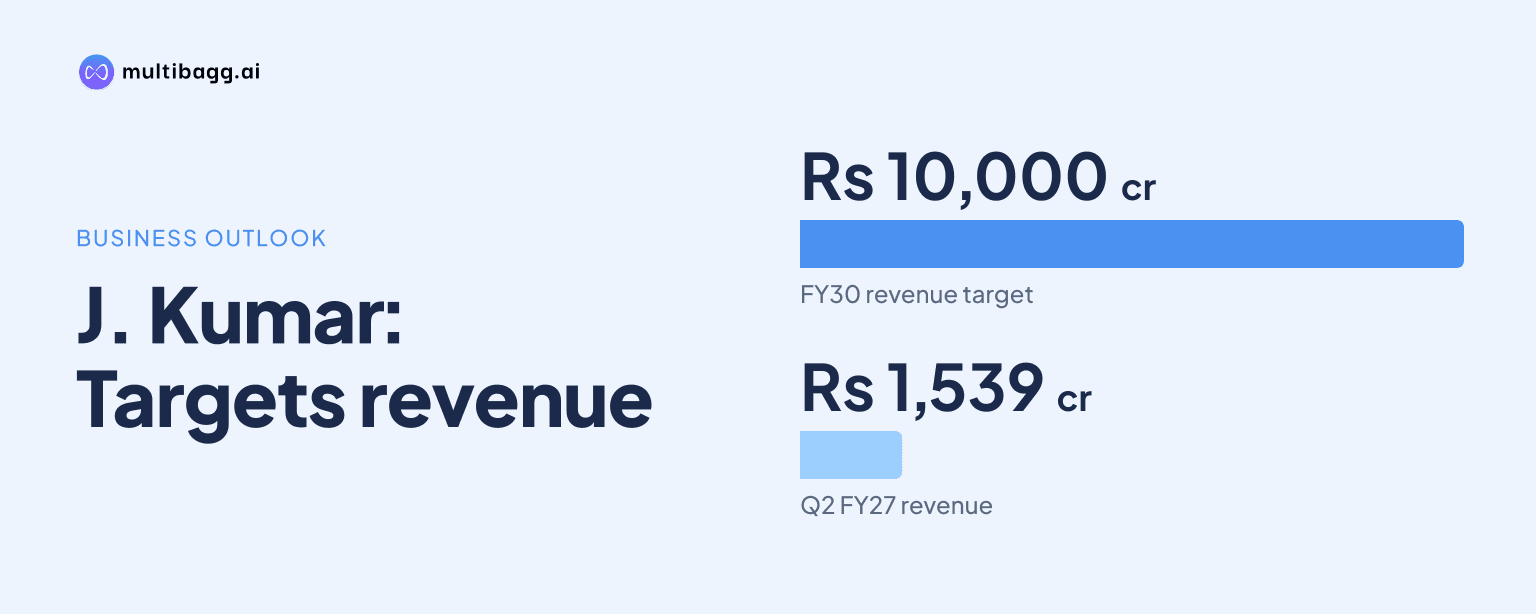
J Kumar Infraprojects Limited is targeting Rs 10,000 crore of revenue by FY30 and a 15%-16% operating-margin range, after reporting 15% year-on-year revenue growth to Rs 1,539 crore in Q2 FY27. Management said the plan requires a faster H2 FY27 execution pace and continued selection of projects at its required margins.
Know J Kumar Infraprojects inside out
Results, valuation, peers and who's buying, in one view.
How does J. Kumar plan to reach Rs 10,000 crore by FY30?
J. Kumar plans to reach Rs 10,000 crore of revenue by FY30 through growth of about 15%, management said on the November 16, 2026 earnings call. In response to an analyst who referred to approximately Rs 7,500 crore of FY28 revenue, management said that indication remained intact while setting the FY30 target.
The near-term starting point is the FY27 objective of 15% revenue growth, following H1 FY27 revenue growth of 8% to Rs 3,050 crore. Management said Q1 had a flat top line, while Q2 revenue increased 15%, so Q3 and Q4 must grow by more than 15% year on year for J. Kumar to meet the full-year target.
J. Kumar had an order book of Rs 22,711 crore as of September 30, 2026, providing the disclosed execution base for the longer-term revenue plan. Elevated corridors accounted for 47% of that backlog, compared with 26% for other projects, 19% for road tunnels and 7% for metro projects.
The difference between Q2's 15% revenue increase and H1's 8% increase explains management's emphasis on second-half delivery. J. Kumar also told an analyst that Q3 revenue should be sequentially higher than Q2, although it did not provide a formal quarterly revenue estimate.
Is J. Kumar on track for 15% FY27 revenue growth?
J. Kumar said it remains confident of achieving 15% FY27 revenue growth, but its H1 result means the outcome depends on stronger execution in Q3 and Q4. Q2 revenue was Rs 1,539 crore, and management said both subsequent quarters must perform better than the prior year to close the gap from H1's 8% growth.
At the GMLR project, one tunnel had progressed more than 300 metres by the call, while the second tunnel-boring machine had entered the ground by about 8 metres. Management said the project had an original five-year completion period but land was handed over around two years late; it now expects completion before the end of 2029.
At the Chennai elevated-corridor project, J. Kumar had completed about 70%-75% of foundation work and cast around 2,900 precast segments. Management expects Chennai completion in December 2028 or January 2029, giving the company a defined multiyear execution schedule for one of its larger ongoing works.
J. Kumar also said it had started mobilising at Vadhavan, where service-road work, excavation, ground clearing and surveys were under way. Management expects the project to begin contributing revenue from December or January, though it did not quantify the expected contribution for FY27.
What order inflow is J. Kumar seeking in FY27?
J. Kumar plans to add Rs 3,000 crore to Rs 5,000 crore of orders in H2 FY27, taking full-year order inflow to Rs 8,000 crore to Rs 10,000 crore. The company had already secured Rs 5,540 crore of orders by H1 FY27, according to management's clarification during the call.
The bidding pipeline comprises around Rs 30,000 crore of projects that J. Kumar expects to bid for within six months, in addition to approximately Rs 3,000 crore of bids already submitted. Management split the prospective six-month opportunities into Rs 15,000 crore of metro work, Rs 10,000 crore of elevated corridors, roads and flyovers, and Rs 5,000 crore of building work.
A Delhi Metro order previously expected to convert was cancelled because of project changes that were likely to increase the project cost. Management said a fresh tender should be issued within 10 to 15 days and would be restricted to bidders that had participated in the earlier process.
J. Kumar said competition remains high, but management expects larger planned opportunities in Maharashtra over the next 10 to 12 months. It cited projects worth approximately Rs 50,000 crore to Rs 1,00,000 crore planned in the state and said tighter Ministry of Road Transport and Highways prequalification and net-worth conditions could reduce competition in some specialised projects.
Got a follow-up? Ask IRIS
How does J. Kumar expect to raise operating margin?
J. Kumar is targeting a 15%-16% operating margin, compared with the 14%-15% range management cited as its current level. Management said it was seeking an improvement of about 100 basis points, with one basis point equal to one-hundredth of a percentage point, and expects to achieve the range within one to two years.
The latest reported quarterly margin was an EBITDA margin of 14.9% in Q2 FY27, up from 14.5% in the preceding-year quarter. EBITDA rose 18% year on year to Rs 229 crore, while profit after tax increased 25% to Rs 113 crore; management said FY27 margins should remain around current levels before improvement in later periods.
Management linked the margin path to project selection, stating that J. Kumar does not quote for contracts at any rate and seeks its required margins. It said complex metro projects, large-diameter tunnels and elevated corridors generally receive five to six bids, while the Rs 22,711 crore order book means the company is not dependent on winning every opportunity.
J. Kumar may selectively explore hybrid annuity model projects where management finds the economics acceptable, but said engineering, procurement and construction remains its primary business. Management described hybrid annuity model work as involving deferred payment and said any equity commitment would depend on the type and nature of an individual project.
Which project and financial milestones should readers track?
J. Kumar expects to complete the Worli-Sewri connector, the Sewri-to-Navi Mumbai Airport connection and the Metro Line 2B stretch from Andheri to Bandra at Lucky Junction in FY27. Those completions make new order conversion relevant because the company will need projects to replace work finishing during the fiscal year.
The company also cited a Rs 1,600 crore cable-stayed Lagoon Bridge project in Malad, with a pylon exceeding 125 metres and 800 tonnes of cable stay. Management additionally identified the Goregaon-Malad Coastal Road, GMLR and the Anand Nagar-Saket Chennai Elevated Corridor as complex projects in execution.
On September 30, 2026, J. Kumar reported net cash of Rs 69 crore and working-capital days of 100, compared with 99 days for FY26. Management said it intends to operate within a 100-120-day working-capital band and keep debt-to-equity around 0.23 to 0.24 times.
Management said more than Rs 900 crore of roughly Rs 1,500 crore of payments due as of September 30 had been collected by the call date, leaving about Rs 600 crore pending. Mobilisation advances stood at Rs 627 crore, unbilled revenue at Rs 572 crore and security deposits at Rs 490 crore, while annual capital expenditure was expected to remain broadly around Rs 150 crore.
Conclusion
J. Kumar's FY30 revenue and margin objectives combine a Rs 10,000 crore revenue target with a plan to lift operating margin by about 100 basis points to 15%-16%. The Q2 FY27 result showed a faster pace than H1, but management's own 15% FY27 growth objective depends on execution accelerating beyond the first-half run rate.
The next disclosed milestones are Rs 3,000 crore to Rs 5,000 crore of targeted H2 FY27 order additions, expected Vadhavan revenue from December or January, and the FY27 completion of three Mumbai projects. Management's stated one-to-two-year timetable for the 15%-16% margin range will depend on the project selection and execution discipline it outlined.