










JAYDEE conductor revenue rose 68% in FY26, ahead of cables
Key highlights
- JAYDEE’s aluminium-conductor revenue rose about 68% to Rs 81.5235 crore in FY26 from Rs 48.3931 crore in FY25.
- JAYDEE’s cables-and-wires revenue increased about 25% to Rs 252.5632 crore in FY26 from Rs 202.1327 crore.
- Aluminium conductors represented about 24% of JAYDEE’s Rs 334.0867 crore disclosed FY26 product revenue, up from about 19% in FY25.
- JAYDEE reported FY26 capacity utilisation of 82.43% at Unit I and 84.56% at Unit II.
powered by IRIS
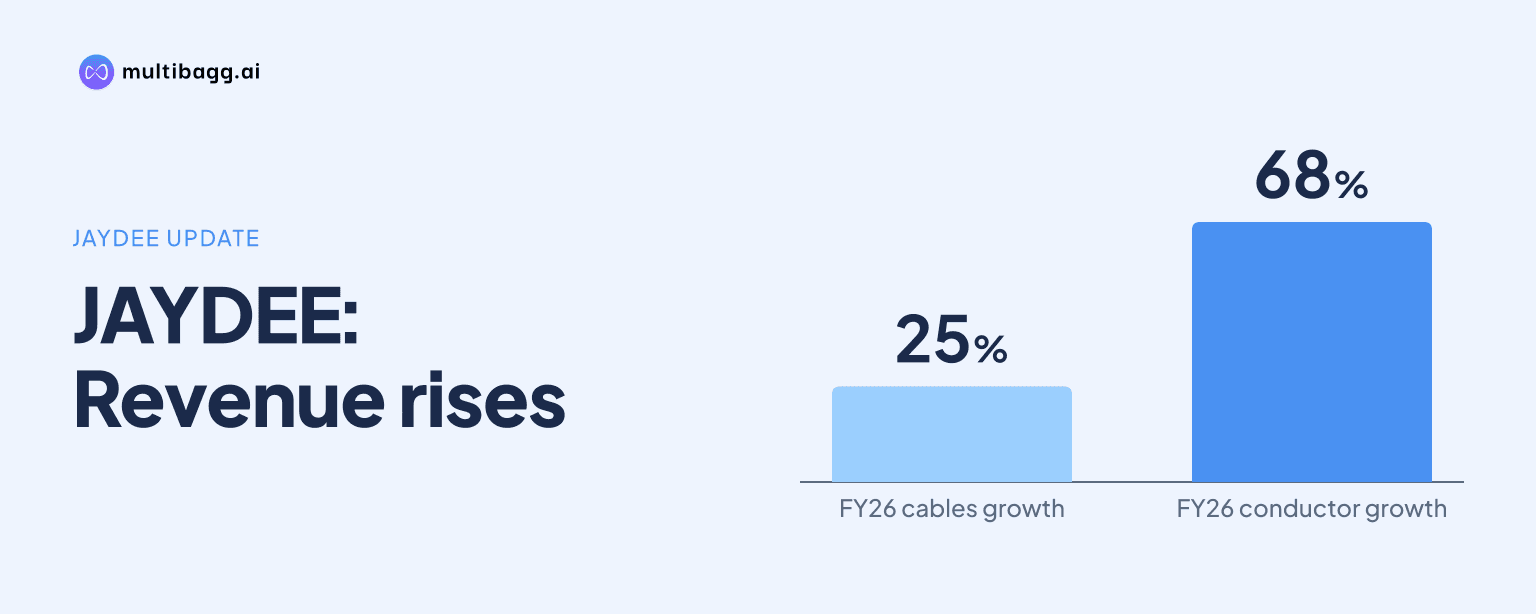
JAYDEE’s aluminium-conductor revenue rose 68% to Rs 81.5235 crore in FY26, ahead of the 25% increase in cables-and-wires revenue to Rs 252.5632 crore. The change lifted conductors’ share of the two disclosed product categories to about 24% from about 19% in FY25.
Know JD Cables inside out
Results, valuation, peers and who's buying, in one view.
How did JAYDEE’s product revenue change in FY26?
JAYDEE reported Rs 252.5632 crore of cables-and-wires revenue in FY26, compared with Rs 202.1327 crore in FY25, an increase of Rs 50.4305 crore. The category grew by about 25% and remained the larger of the two disclosed product businesses, generating more than three times the FY26 revenue of aluminium conductors.
Aluminium-conductor revenue increased by Rs 33.1304 crore, from Rs 48.3931 crore in FY25 to Rs 81.5235 crore in FY26. That increase equates to about 68%, roughly 43 percentage points above the cables-and-wires growth rate. The presentation discloses these as separate categories, rather than providing revenue for individual products within each range.
The two categories together generated Rs 334.0867 crore in FY26, against Rs 250.5258 crore in FY25. Although conductors were the smaller business, their Rs 33.1304 crore increase represented about 40% of the Rs 83.5609 crore rise across the disclosed categories, reflecting the higher percentage growth from a lower FY25 base.
What changed in JAYDEE’s FY26 revenue mix?
Aluminium conductors accounted for about 24% of JAYDEE’s Rs 334.0867 crore disclosed product revenue in FY26, up from about 19% of Rs 250.5258 crore in FY25. Cables and wires consequently represented about 76% of the FY26 total, compared with about 81% a year earlier.
The mix movement does not indicate lower cable-and-wire sales because cables and wires added Rs 50.4305 crore in FY26, a larger absolute increase than the Rs 33.1304 crore added by conductors. Instead, the share change reflects conductor revenue growing about 68% from Rs 48.3931 crore, versus about 25% growth in the Rs 202.1327 crore cable-and-wire base.
JAYDEE’s disclosure supports a revenue-mix comparison but does not explain the cause of the FY26 conductor increase. It provides no product-level volumes, selling prices, margins, order intake or customer-level revenue for the Rs 81.5235 crore conductor category, so it cannot establish whether volume, pricing, product selection or another factor drove the change.
Which products are included in JAYDEE’s two revenue categories?
JAYDEE lists four cables-and-wires products and six aluminium-conductor products, while reporting FY26 revenue only at the two-category level. Its cables-and-wires range comprises low-tension, or LT, cross-linked polyethylene and polyvinyl chloride insulated power cables, LT control cables, LT aerial bunch cables and single-core service wires.
The aluminium-conductor range includes Aluminium Conductor Steel Reinforced, or ACSR, All Aluminium Alloy Conductor, or AAAC, All Aluminium Conductor, or AAC, AL59 conductor, Multi Voltage Covered Conductor, or MVCC, and High Temperature Low Sag, or HTLS, conductor. The presentation does not split the Rs 81.5235 crore FY26 aluminium-conductor revenue among these six products.
The disclosed Rs 334.0867 crore FY26 product total therefore cannot be allocated between individual cable, wire or conductor designs. Similarly, the presentation does not state output, revenue or utilisation for HTLS, MVCC and AL59 separately, despite identifying all three among its conductor offerings.
Got a follow-up? Ask IRIS
What does JAYDEE disclose about capacity and utilisation?
JAYDEE reported combined FY26 installed capacity of 28,000 kilometres across Unit I and Unit II for cables and conductors, with combined production of 23,549 kilometres. Unit I had 6,000 kilometres of capacity and produced 4,946 kilometres, while Unit II had 22,000 kilometres of capacity and produced 18,603 kilometres.
Both facilities increased production from FY25, when Unit I produced 4,750 kilometres and Unit II produced 17,860 kilometres. Unit I’s reported utilisation rose to 82.43% in FY26 from 79.17% in FY25, while Unit II’s rose to 84.56% from 81.18%.
JAYDEE also states that it expanded installed production capacity by an additional 28,000 kilometres per annum and highlights HTLS, MVCC and AL59 in that context. However, the FY25 and FY26 capacity table shows 28,000 kilometres in each year for the two combined units and does not specify the timing of the additional capacity, its earlier base or its allocation between cables and conductors.
Where does JAYDEE identify customers and geographic coverage?
JAYDEE names private clients including SG Infraprojects, Jakson, Polycab, Sterling & Wilson, Ashoka Buildcon and Bajel, alongside government clients such as Punjab State Power Corporation Limited, West Bengal State Electricity Distribution Company Limited, APDCL, MSPDCL and MePDCL. The presentation does not assign any part of FY26 revenue of Rs 252.5632 crore for cables and wires or Rs 81.5235 crore for conductors to a customer.
JAYDEE’s geographic-presence page lists 16 states, including Punjab, Rajasthan, Bihar, Madhya Pradesh, West Bengal, Odisha and Andhra Pradesh. A separate manufacturing page says it serves more than 15 states and is an approved vendor for multiple State Electricity Boards, but gives no state-level split for the FY26 product revenue figures.
Conclusion
JAYDEE’s FY26 figures show that aluminium conductors became a larger part of its disclosed product revenue as the category rose about 68% to Rs 81.5235 crore. Cables and wires remained the principal category at Rs 252.5632 crore and added more revenue in absolute terms, but their growth rate of about 25% was lower than that of conductors.
The next reported period will indicate whether the mix shift continues alongside the stated additional 28,000-kilometre-per-annum capacity expansion and FY26 utilisation of 82.43% at Unit I and 84.56% at Unit II. The presentation leaves unresolved how capacity is divided between cables and conductors and how much revenue comes from conductor products such as HTLS, MVCC and AL59.