










JAYDEE debt-to-equity falls to 0.39 in FY26 as net worth rises
Key highlights
- JAYDEE reported FY26 debt-to-equity of 0.39 times, down from 1.53 times in FY25.
- JAYDEE's FY26 net worth rose to Rs 146.1705 crore from Rs 29.9861 crore in FY25.
- Inventories and trade receivables increased by a combined Rs 77.5241 crore in FY26.
- JAYDEE's FY26 current ratio rose to 2.25 times from 1.25 times in FY25.
powered by IRIS
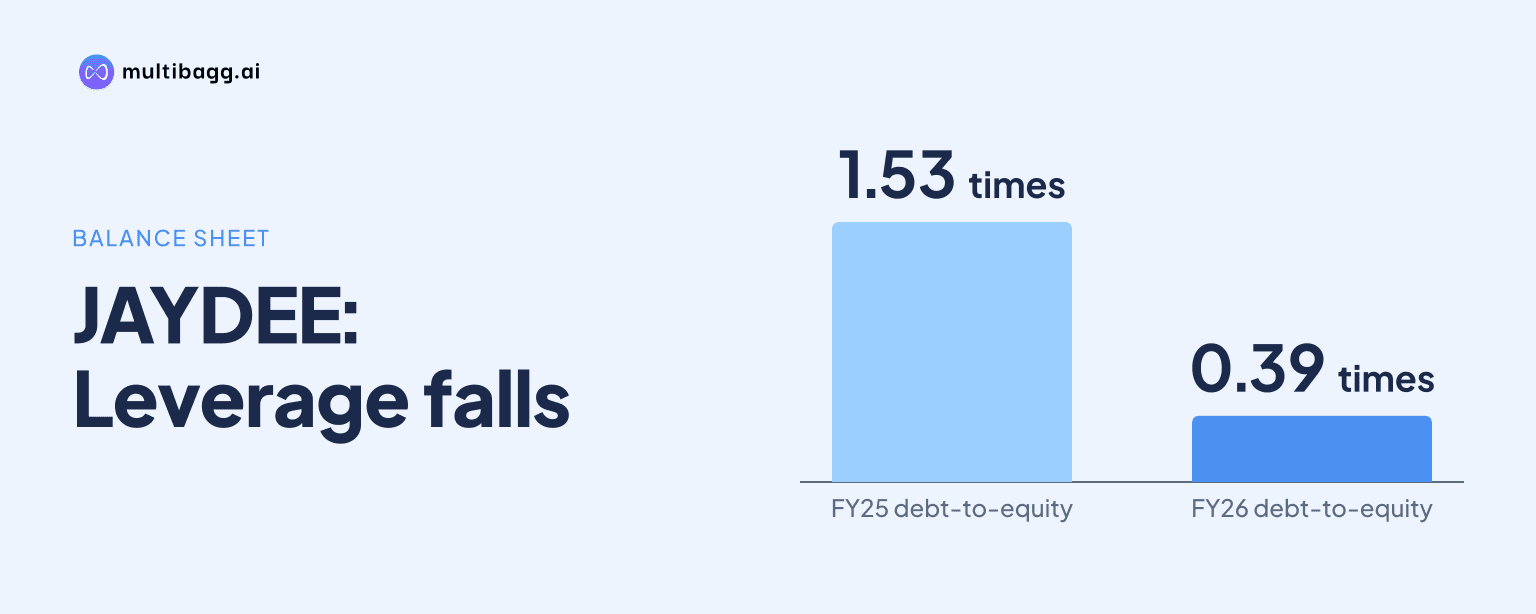
JAYDEE reported debt-to-equity of 0.39 times in FY26, down from 1.53 times in FY25, as net worth rose to Rs 146.1705 crore. Inventories and trade receivables increased by a combined Rs 77.5241 crore from FY25, while the current ratio rose to 2.25 times from 1.25 times.
Know JD Cables inside out
Results, valuation, peers and who's buying, in one view.
How did JAYDEE's debt-to-equity change in FY26?
JAYDEE's reported debt-to-equity ratio fell to 0.39 times in FY26 from 1.53 times in FY25 and 2.27 times in FY24. Net worth increased to Rs 146.1705 crore from Rs 29.9861 crore in FY25 and Rs 7.8295 crore in FY24. Share capital rose to Rs 22.5511 crore from Rs 0.05 crore, while reserves and surplus increased to Rs 123.6194 crore from Rs 29.9361 crore.
The balance sheet reports no long-term borrowings in FY26, compared with Rs 1.3101 crore in FY25 and Rs 0.2994 crore in FY24. Short-term borrowings nevertheless increased to Rs 56.6255 crore in FY26 from Rs 44.6017 crore in FY25, a rise of Rs 12.0238 crore. The reported debt-to-equity decline therefore occurred alongside a much larger increase in net worth than in short-term borrowings.
Which working-capital assets increased at JAYDEE?
JAYDEE's inventories rose to Rs 78.8634 crore in FY26 from Rs 36.0492 crore in FY25 and Rs 12.2639 crore in FY24. The FY26 increase was Rs 42.8142 crore. Trade receivables increased to Rs 95.5615 crore from Rs 60.8516 crore in FY25, adding Rs 34.7099 crore, and were above the Rs 25.4284 crore reported for FY24.
Inventories and trade receivables together totalled Rs 174.4249 crore in FY26, against Rs 96.9008 crore in FY25. Their Rs 77.5241 crore increase accounted for much of the Rs 99.1137 crore rise in total current assets, which reached Rs 203.6816 crore. Short-term loans and advances rose to Rs 28.7166 crore from Rs 3.8085 crore, while cash and bank balance declined to Rs 0.5401 crore from Rs 3.8585 crore.
The current-asset increase was consequently concentrated in inventory, customer receivables and short-term advances rather than cash. JAYDEE reported FY26 revenue of Rs 364.5915 crore, compared with Rs 250.5258 crore in FY25. The presentation does not disclose the ageing of receivables, inventory composition, or the nature and terms of short-term loans and advances.
Did JAYDEE's current ratio improve in FY26?
JAYDEE reported a current ratio of 2.25 times in FY26, compared with 1.25 times in FY25 and 1.10 times in FY24. Total current assets rose to Rs 203.6816 crore from Rs 104.5679 crore, while total current liabilities rose to Rs 90.6148 crore from Rs 83.7904 crore. The difference between current assets and current liabilities was Rs 113.0668 crore in FY26, compared with Rs 20.7775 crore in FY25.
Current-liability movements differed by category. Trade payables fell to Rs 22.4491 crore in FY26 from Rs 31.9299 crore in FY25, and short-term provisions declined to Rs 1.0101 crore from Rs 3.9659 crore. These reductions were partly offset by higher short-term borrowings of Rs 56.6255 crore and other current liabilities of Rs 10.5301 crore, against Rs 44.6017 crore and Rs 3.293 crore respectively in FY25.
Got a follow-up? Ask IRIS
What operating results accompanied JAYDEE's FY26 balance-sheet changes?
JAYDEE reported total income of Rs 365.1936 crore in FY26, up from Rs 250.6951 crore in FY25 and Rs 100.8544 crore in FY24. Profit after tax rose to Rs 31.7246 crore from Rs 22.025 crore in FY25 and Rs 4.5798 crore in FY24. Earnings per share increased to Rs 14.07 in FY26 from Rs 13.31 in FY25 and Rs 4.60 in FY24.
Profitability ratios moved differently from debt-to-equity. Return on equity, or ROE, declined to 21.70% in FY26 from 73.45% in FY25, while return on capital employed, or ROCE, declined to 23.11% from 43.84%. Earnings before interest, tax, depreciation and amortisation, or EBITDA, margin was 13.17%, below FY25's 13.68% but above FY24's 7.16%; profit after tax margin was 8.69%, versus 8.79% and 4.54% respectively.
The profit-and-loss statement lists FY25 EBITDA of Rs 34.2944 crore, compared with Rs 48.1101 crore in FY26. However, the key-financial-highlights page lists FY25 EBITDA as Rs 24.2944 crore while showing the same FY26 figure of Rs 48.1101 crore. JAYDEE does not explain this internal difference in the presentation.
What plans are relevant to JAYDEE's working-capital position?
JAYDEE states that its growth strategy includes a diversified supplier base for copper, aluminium, polyvinyl chloride and cross-linked polyethylene. Management says advanced inventory systems and distribution networks are intended to support real-time tracking, cost optimisation and timely delivery. These plans are relevant to FY26 inventories of Rs 78.8634 crore, which were more than double FY25's Rs 36.0492 crore.
Management also says it is pursuing manufacturing efficiency through process optimisation, customised systems and ongoing policy reviews intended to identify bottlenecks. JAYDEE employed about 70 professionals as of March 31, 2026. The presentation identifies power transmission, telecom, construction and industrial sectors as end markets, but does not provide segment revenue or customer-level receivables data for FY26.
Conclusion
JAYDEE's FY26 disclosures show lower reported leverage and a higher current ratio alongside a substantially larger working-capital base. Net worth rose by Rs 116.1844 crore from FY25, while inventories and receivables increased by Rs 77.5241 crore and cash and bank balance fell by Rs 3.3184 crore.
The next balance-sheet disclosure will indicate whether the FY26 inventory, receivables and short-term advances convert into cash or remain elevated. Management's disclosed plans for diversified material sourcing, advanced inventory systems and process optimisation are the stated initiatives relevant to that working-capital movement.