








Jindal Steel maintains 11 million tonne FY27 production target
Max Plan at ₹4,999/yr₹8,999

Find your next multibaggerBe a Pro Investor
Research stocks and track your picks on the go. Download the app.
Key highlights
- Jindal Steel reported 4.79 million tonnes of production in H1FY27 and is targeting about 11 million tonnes for FY27.
- Jindal Steel reported record Q2FY27 steel sales of 2.38 million tonnes, with domestic sales contributing about 92% of volume.
- Consolidated gross revenue rose 44% year on year to Rs 19,448 crore in Q2FY27, while adjusted EBITDA increased 34% to Rs 2,504 crore.
- Jindal Steel's Roida mine remained shut pending a forest-department right-of-way clearance expected by December 2026 or January 2027.
powered by IRIS
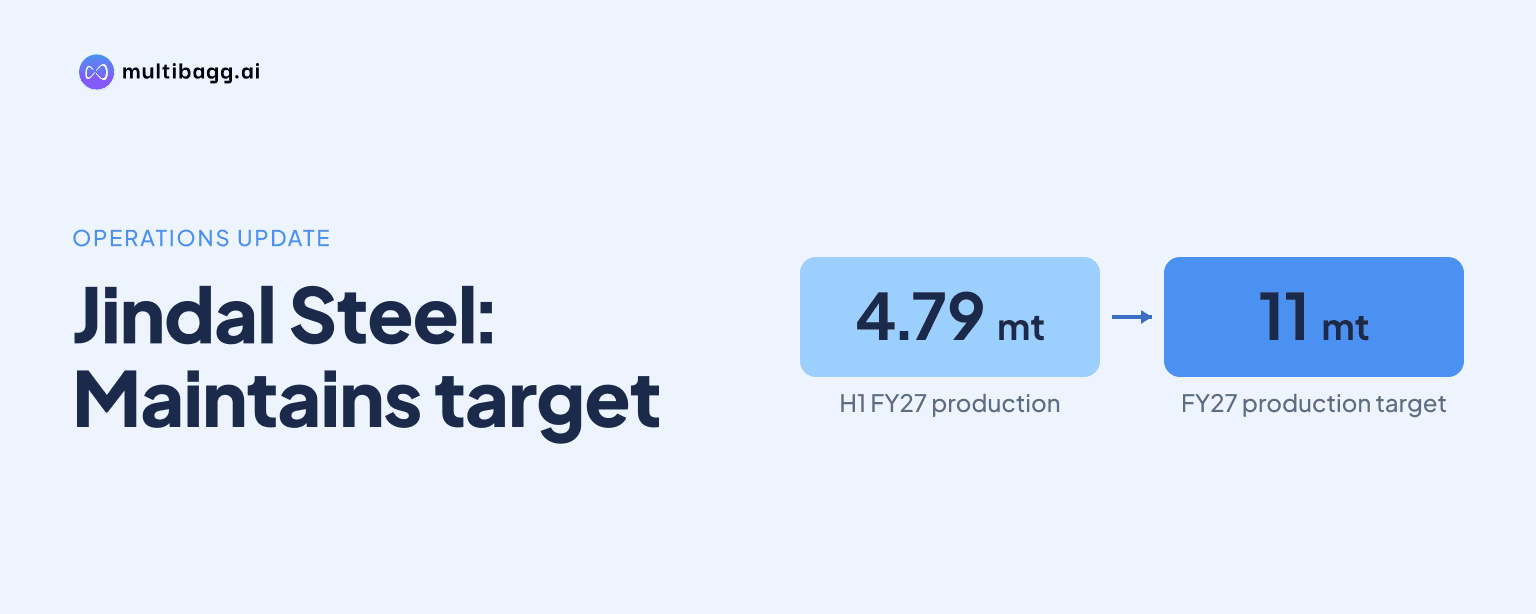
Jindal Steel Limited is maintaining its target of about 11 million tonnes of FY27 production after reporting 4.79 million tonnes in H1FY27. Management plans 6 million tonnes in H2FY27, supported by four operating blast furnaces, restored iron-ore logistics after monsoon disruption and a 192-kilometre slurry pipeline expected to save Rs 700 per tonne.
Know Jindal Steel inside out
Results, valuation, peers and who's buying, in one view.
Can Jindal Steel meet its FY27 production target?
Jindal Steel says it is confident of meeting its about 11 million tonne FY27 production target, with 4.79 million tonnes completed in H1FY27 and 6 million tonnes planned in H2FY27. The second-half plan requires a marked acceleration after heavy rainfall in Odisha affected mine operations during the first half.
Management quantified the H2FY27 requirement at about 3 million tonnes a quarter, or 1 million tonnes a month. It also described the detailed monthly production plan as 0.96 million tonnes, equivalent to 2.88 million tonnes a quarter. The difference between the rounded quarterly requirement and monthly plan was not reconciled during the October 23, 2026 call.
Management referred to the 6 million tonne H2FY27 objective as net steel and said gross steel could be about 11 million tonnes, so the call did not provide a full reconciliation between gross and net production measures. Management expects Q3FY27, which ends in December 2026, to set a production record and expects Q4FY27 to be higher still; these are management expectations, not reported results.
What will support Jindal Steel's second-half output ramp?
Jindal Steel's production plan depends on all four blast furnaces operating, including the newer Angul furnace, which was producing about 10,000 tonnes a day on October 23, 2026. Management expected this furnace to reach 10,500 tonnes a day within seven days, 11,000 tonnes a day in November and 12,000 tonnes a day in December.
The company has two blast furnaces at Angul and two at Raigarh, all of which management said were operating well. Its direct reduced iron plant was also using syngas, or synthesis gas, produced through coal gasification. Management said this enabled reheating furnaces, galvanising lines and colour-coating lines to keep operating during shortages of natural gas and propane.
Iron-ore logistics have improved after monsoon-related disruption. Management said water had receded from Odisha Mining Corporation's eight mines, while rail movement from National Mineral Development Corporation had resumed after a landslide disrupted the route to Angul. Jindal Steel has a 13.5 million tonne long-term agreement with Odisha Mining Corporation and said that supplier, National Mineral Development Corporation and its own mines were meeting requirements.
Jindal Steel's Kasia mine was producing 22,000 tonnes a day and management plans to lift this to 30,000 tonnes a day. Roida, however, was not operating because a forest-department right-of-way for a road was pending. Management expected clearance by the end of December 2026 or in January 2027, making Roida an unresolved element of the wider raw-material plan.
Got a follow-up? Ask IRIS
How will Jindal Steel's slurry pipeline lower costs?
Jindal Steel expects its 192-kilometre Barbil-to-Angul slurry pipeline to save Rs 700 per tonne on 20,000 tonnes a day of iron-ore movement. Management said the pipeline had been commissioned, trials had been completed and the first iron slurry batch had been dispatched and received before the October 23, 2026 call.
Commercial supplies were expected to start within two to three days of the call, followed by continuous operation. The saving comes from moving ore through the pipeline instead of road transport. Management said more than 700 trucks a day were bringing iron ore to Angul and expected at least 500 daily truck movements to be eliminated.
The Barbil grinding station, pumping house and water arrangements were in place, according to management, which said it did not expect additional ramp-up costs. Slurry water is to be recovered, filtered and recycled at Angul under the company's zero-liquid-discharge policy. Management said Angul was using 31 million litres a day against a cited sanctioned level of 59.1 million litres a day.
Management expects water use at Angul to fall by at least 15% next year because water arriving with slurry can be recovered. Ore located closer to Angul will continue to move directly to the plant rather than first travelling to Barbil. The pipeline's cost benefit therefore applies to ore that can be processed at the Barbil grinding and pumping facility.
What product mix and sales base support the plan?
Jindal Steel is targeting a 65:35 mix of flat products to long products, including plates within flats, compared with about 60:40 at the time of the call. Management said it was not targeting a 70:30 mix in FY28 and attributed the planned shift to higher value addition in plates.
Plate production exceeded 220,000 tonnes a month across the two locations, management said. It cited demand associated with defence spending, merchant vessels, shipbuilding and windmills. In hot-rolled coils, management said production was focused on high-carbon, medium-carbon and other niche grades rather than standard products.
The company reported record Q2FY27 steel sales volume of 2.38 million tonnes, with domestic sales accounting for about 92% of volume. Consolidated gross revenue rose 44% year on year to Rs 19,448 crore, while net revenue increased 43% to Rs 16,704 crore. Management attributed these outcomes to sales volume, higher average selling prices and a higher proportion of flat products.
Adjusted earnings before interest, tax, depreciation and amortisation, or EBITDA, rose 34% year on year to Rs 2,504 crore in Q2FY27. Adjusted EBITDA per tonne increased 5% year on year to Rs 10,529 per tonne, while profit after tax was Rs 771 crore, below Rs 844 crore in the preceding quarter. Management attributed the sequential EBITDA moderation to higher coking-coal, power, fuel and ocean-freight costs despite better volume and mix.
Conclusion
Jindal Steel's FY27 production objective relies on a substantial second-half increase from 4.79 million tonnes in H1FY27 to a planned 6 million tonnes in H2FY27. The expanded Angul blast furnace, resumed ore supply routes, Kasia mine ramp-up and Barbil-to-Angul pipeline are the disclosed mechanisms behind that plan, while the 65:35 flat-to-long product target is intended to alter the mix of output.
The next disclosed milestones are the Angul furnace reaching 11,000 tonnes a day in November 2026 and 12,000 tonnes a day in December 2026, alongside management's expectation of record Q3FY27 production. Investors will also watch the start of continuous pipeline operations, progress toward 30,000 tonnes a day at Kasia, and the expected Roida right-of-way clearance by December 2026 or January 2027.

