








Jindal Steel Q2 FY27 Revenue Rises 43% to ₹16,679 Crore
Max Plan at ₹4,999/yr₹8,999

Find your next multibaggerBe a Pro Investor
Research stocks and track your picks on the go. Download the app.
Key highlights
- Jindal Steel’s consolidated Q2 FY27 revenue from operations rose 42.72% year-on-year to ₹16,678.54 crore.
- Consolidated net profit increased 21.35% year-on-year to ₹770.64 crore but fell 8.67% sequentially.
- Q2 FY27 steel sales volume reached 2.38 million tonnes, with domestic sales accounting for approximately 92% of total volume.
- Net debt to EBITDA stood at 1.51 times on a trailing-12-month basis in Q2 FY27, compared with 1.48 times a year earlier.
powered by IRIS
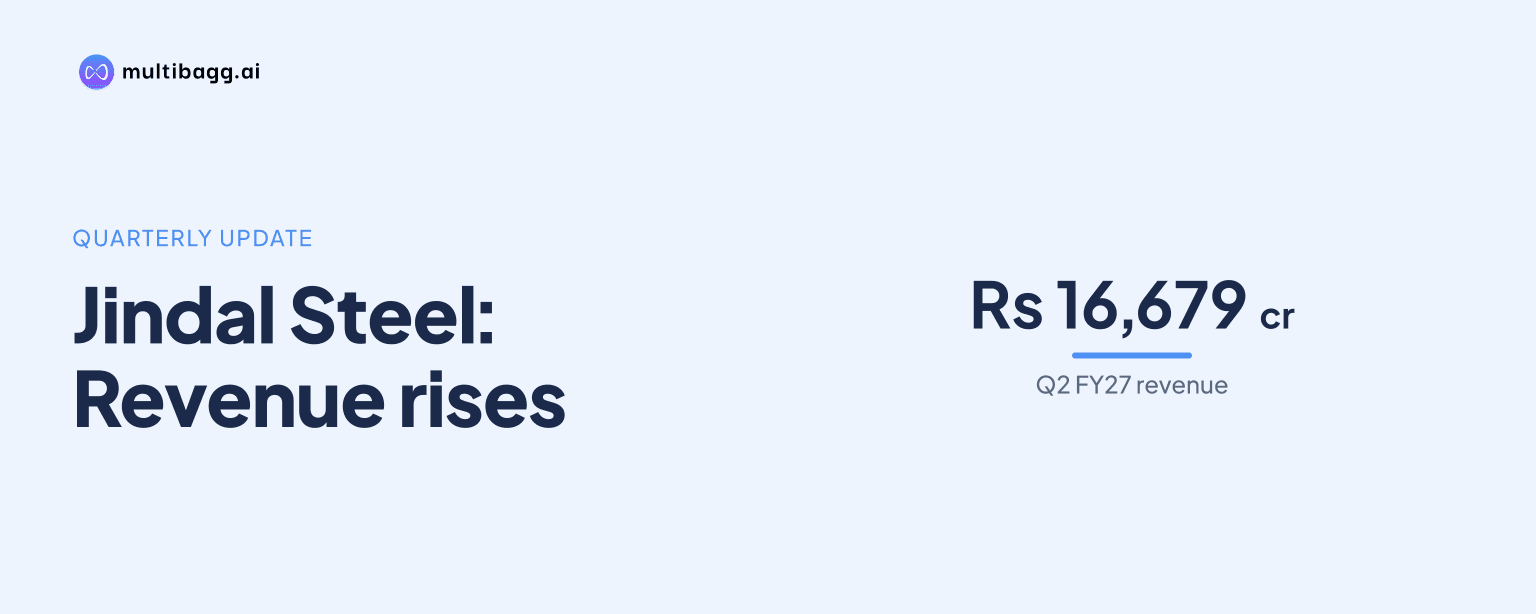
Jindal Steel Limited reported consolidated revenue from operations of ₹16,678.54 crore in Q2 FY27, up 42.72% year-on-year and 7.73% sequentially. The company recorded net profit of ₹770.64 crore, 21.35% higher than a year earlier, although profit declined 8.67% from the preceding quarter.
Know Jindal Steel inside out
Results, valuation, peers and who's buying, in one view.
What did Jindal Steel report for Q2 FY27?
Jindal Steel reported higher sales and revenue for the quarter ended September 30, 2026, with consolidated gross value of sales and services reaching ₹19,483.27 crore. After deducting ₹2,744.33 crore of GST recovered and ₹60.40 crore of captive sales for own projects, consolidated revenue from operations stood at ₹16,678.54 crore.
The company’s quarterly revenue increase was supported by record sales volume and higher average selling prices, according to comments attributed to Chief Financial Officer Sandeep Mody in the earnings-call material. The reported sales volume was 2.38 million tonnes, while domestic sales accounted for about 92% of total volume.
The company said its sales mix also changed during the quarter. A higher share of flat products and a lower proportion of TMT within long products supported average realisations. These product-mix details provide context for the revenue growth alongside the higher sales volume.
How did Jindal Steel’s profit and operating metrics change?
Jindal Steel’s consolidated net profit was ₹770.64 crore in Q2 FY27, compared with ₹843.80 crore in Q1 FY27 and a figure 21.35% lower in the corresponding quarter of the previous year. The sequential decline in profit occurred despite the quarter-on-quarter rise in revenue.
Operating profit stood at ₹2,571.45 crore, down 3.33% from ₹2,660.02 crore in the previous quarter, but up 23.56% year-on-year. Profit before depreciation and tax, or PBDT, was ₹2,030.23 crore, down 4.73% sequentially and up 17.23% from a year earlier.
The quarterly summary also showed gross profit of ₹1,625 crore, down 6.25% from the prior quarter and up 22.08% year-on-year. Consolidated basic and diluted earnings per share were ₹7.61 for the quarter on a face value of ₹2 per share.
What drove Jindal Steel’s revenue growth?
Jindal Steel’s revenue growth was driven by record Q2 sales volume, higher average selling prices and the change in product mix described by management. The company reported adjusted EBITDA of ₹2,504 crore, up 34% year-on-year, and adjusted EBITDA per tonne of ₹10,529, up 5% year-on-year.
Its investor presentation reported steel production of 2.40 million tonnes in Q2 FY27, compared with 2.00 million tonnes in Q2 FY26. This production data, together with the 2.38 million-tonne sales volume cited in the earnings-call material, indicates the scale of operations behind the quarter’s revenue increase.
Jindal Steel’s reported gross-revenue figures vary slightly across the supplied materials. The audited consolidated result states gross sales and services of ₹19,483.27 crore, while the investor presentation cited ₹19,448 crore and the call material cited ₹19,438 crore. The audited revenue-from-operations figure of ₹16,678.54 crore is the detailed consolidated result provided for the quarter.
Got a follow-up? Ask IRIS
How did the quarterly result compare with standalone performance?
Jindal Steel’s standalone revenue from operations was ₹15,270.45 crore in Q2 FY27, while standalone net profit was ₹860.65 crore. Standalone gross sales and services were ₹17,759.15 crore before GST recovered and captive sales deductions.
Standalone profit was lower than ₹1,085.97 crore in Q1 FY27 and ₹920.67 crore in Q2 FY26. For the first half of FY27, standalone revenue from operations reached ₹30,545.93 crore, up 24.53% from ₹24,529.02 crore in H1 FY26.
The difference between standalone and consolidated results reflects the inclusion of group-level operations in the consolidated accounts. Investors assessing the group’s quarterly operating performance can use the consolidated revenue, profit and EBITDA figures, while the standalone statement provides the parent company’s separate financial outcome.
What does the result mean for investors and the steel sector?
Jindal Steel’s results show strong year-on-year growth in revenue, operating profit and net profit, supported by volumes, prices and product mix. However, the quarter-on-quarter fall in operating profit, PBDT and net profit shows that higher revenue did not translate into sequential profit growth across the reported measures.
The company’s business remained primarily domestic, with approximately 92% of sales volume sold in India. This makes domestic demand, selling prices and the company’s product mix important factors in understanding its quarterly financial performance.
The investor presentation reported net debt to EBITDA of 1.51 times on a trailing-12-month basis, compared with 1.48 times in Q2 FY26. This data point is relevant alongside earnings growth because it indicates the reported relationship between debt and operating earnings.
Conclusion
Jindal Steel delivered a 42.72% year-on-year increase in consolidated revenue to ₹16,678.54 crore in Q2 FY27 and a 21.35% rise in net profit to ₹770.64 crore. Record sales volume, higher average selling prices and a changed product mix supported the revenue outcome, while profits declined sequentially from Q1 FY27.
The next disclosed reference point is the company’s subsequent quarterly financial update. Investors will be able to track whether sales volumes, adjusted EBITDA per tonne, domestic sales share and the reported net debt-to-EBITDA ratio change from the Q2 FY27 levels.

