








Jindal Steel’s Angul slurry line targets Rs 700 freight saving
Max Plan at ₹4,999/yr₹8,999

Find your next multibaggerBe a Pro Investor
Research stocks and track your picks on the go. Download the app.
Key highlights
- Jindal Steel commissioned a 192-kilometre Barbil-Angul slurry pipeline with initial capacity of 20,000 tonnes a day.
- The pipeline is expected to save Rs 700 per tonne in freight and replace at least 500 daily iron-ore truckloads.
- Angul’s water use was 31 million litres a day, with consumption expected to fall at least 15% next year through slurry-water recycling.
- Jindal Steel produced 4.79 million tonnes in H1FY27 and is targeting 6 million tonnes in H2FY27.
powered by IRIS
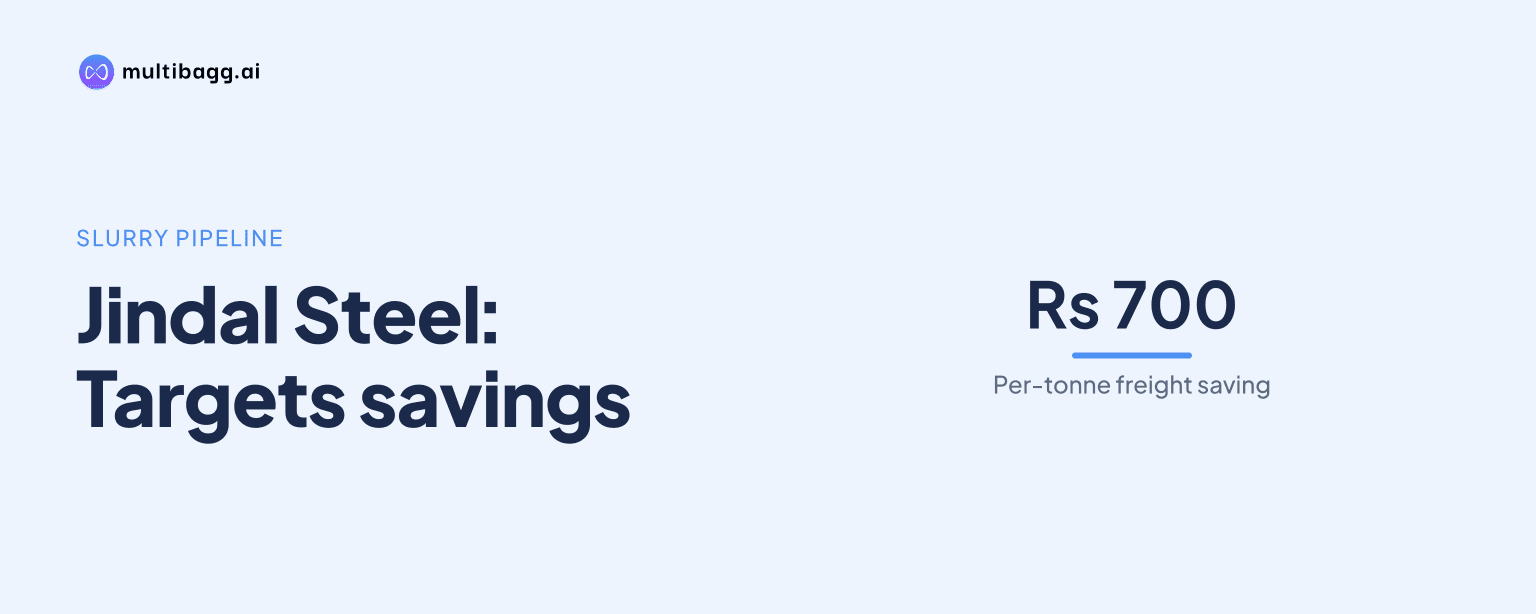
Jindal Steel Limited has commissioned its 192-kilometre Barbil-Angul slurry pipeline and said commercial supplies would begin immediately after its October 23, 2026 earnings call. Management expects the line to carry 20,000 tonnes of iron-ore slurry a day, save Rs 700 per tonne in freight and replace at least 500 daily truckloads without additional ramp-up expense.
Know Jindal Steel inside out
Results, valuation, peers and who's buying, in one view.
What has Jindal Steel commissioned between Barbil and Angul?
Jindal Steel has commissioned a 192-kilometre slurry pipeline connecting Barbil with its Angul operations. At the October 23, 2026 earnings call, management said trials had been completed, the first batch of iron slurry had been dispatched and received, and commercial supplies were due to start within two to three days.
The project includes a grinding station and pumping house at Barbil, with filtering facilities at Angul. Management said the grinding machines, pumping station and water arrangements were already in place, leaving daily continuous operation as the principal task after the commercial start.
Jindal Steel said the ore slurry is maintained at a specific gravity of 1.8 to 2 during transport. At Angul, the company filters and recycles the transported water rather than discharging it, under its stated zero-liquid-discharge policy.
How much freight saving does Jindal Steel expect from the pipeline?
Jindal Steel expects to save Rs 700 per tonne on initial pipeline throughput of 20,000 tonnes a day. Management described the saving as a direct benefit and said no additional expense was expected because the pumping, grinding and water systems had already been installed.
The disclosed saving comes after higher freight, power and fuel costs affected Q2FY27. Consolidated adjusted earnings before interest, tax, depreciation and amortisation, or EBITDA, reached Rs 2,504 crore in Q2FY27, while adjusted EBITDA per tonne rose 5% year on year to Rs 10,529 but moderated sequentially as raw-material and operating costs increased.
Management did not provide a full-year freight-savings estimate. It said, however, that the full 20,000-tonne daily volume would begin flowing from commercial operations, pointing to a benefit during the second half of FY27 rather than only from FY28.
How many trucks will the Barbil-Angul pipeline replace?
Jindal Steel expects the pipeline to eliminate at least 500 of more than 700 daily iron-ore truckloads travelling from the Barbil and Keonjhar area to Angul. About 200 trucks will remain because ore from locations nearer Angul can be delivered directly to the plant at a cost similar to first moving it to Barbil.
The pipeline will therefore replace much, but not all, road-based ore transport. Management said about 2,000 trucks associated with the logistics chain, including vehicles on roads and at loading points, could be removed from the broader arrangement through the project.
Management also cited lower diesel consumption, accident exposure, air pollution and noise as associated public benefits. It did not quantify those effects, leaving the Rs 700-per-tonne freight reduction on 20,000 tonnes a day as the disclosed financial measure.
Got a follow-up? Ask IRIS
How does the pipeline affect Jindal Steel’s Angul water use?
Jindal Steel said water transported with the ore slurry will reduce Angul’s local water requirement because the plant filters and recycles it. Management said Angul was using 31 million litres a day, or MLD, rather than the 59.1 MLD cited by an analyst, and expects usage to be at least 15% lower next year.
The water mechanism supports a planned production increase in H2FY27. Jindal Steel produced 4.79 million tonnes in H1FY27 and is targeting 6 million tonnes in H2FY27, with management specifying a production plan of 960,000 tonnes a month.
Ore availability at Barbil remains relevant to pipeline utilisation. Jindal Steel said its Kasia mine was producing 22,000 tonnes a day and was being ramped towards 30,000 tonnes a day, while supply from Odisha Mining Corporation, or OMC, and NMDC had improved after monsoon-related mine flooding and a railway disruption.
What does the pipeline change in Jindal Steel’s cost plan?
Jindal Steel’s pipeline addresses an internal iron-ore freight cost while coking coal, power and fuel remain variable cost items. Management said freight expenses, including ocean freight, increased sequentially in Q2FY27, and identified the Rs 700-per-tonne pipeline benefit as a contributor to cost competitiveness in H2FY27.
The company has also shifted certain downstream operations from propane to coal-derived syngas. Management said propane had risen to about Rs 100 per kilogram, compared with about Rs 30 per kilogram for equivalent syngas, giving a Rs 70-per-kilogram advantage in reheating furnaces, cold-rolling mills, galvanising lines and colour-coating lines; it did not quantify the saving per tonne of steel.
The cost project arrives as Jindal Steel changes its product mix toward flat steel. Q2FY27 sales volume was 2.38 million tonnes, and management said it aimed to move from about 60% flat products and 40% long products to 65% flats and 35% longs, supported by plates and hot-rolled coils while reducing TMT bar output.
Conclusion
The 192-kilometre Barbil-Angul pipeline is a logistics-cost project with an immediate operating target of 20,000 tonnes of iron-ore slurry a day and a disclosed freight saving of Rs 700 per tonne. It is also intended to cut reliance on at least 500 daily truckloads, recycle water at Angul and support Jindal Steel’s higher H2FY27 production plan.
The next measures to watch are whether the pipeline sustains its 20,000-tonne daily flow and whether Kasia reaches its 30,000-tonne daily target. Management is targeting 6 million tonnes of production in H2FY27 after 4.79 million tonnes in H1FY27, while Roida’s restart remains dependent on right-of-way approvals expected by December-end or January.

