








Jindal Steel redirects 100,000 tonnes monthly into flats
Max Plan at ₹4,999/yr₹8,999

Find your next multibaggerBe a Pro Investor
Research stocks and track your picks on the go. Download the app.
Key highlights
- Jindal Steel reduced monthly TMT output by 100,000 tonnes, from 220,000 tonnes to 120,000 tonnes.
- The company redirected the 100,000 tonnes of monthly TMT volume into plates and HRC, without disclosing the split between the two products.
- HRC prices rose from about Rs 51,000 to Rs 60,000 per tonne during Q2, while TMT prices moved from about Rs 52,000 to Rs 59,000 per tonne.
- Jindal Steel expects monthly saleable sales of 900,000 to 950,000 tonnes as its plants ramp up after the monsoon.
powered by IRIS
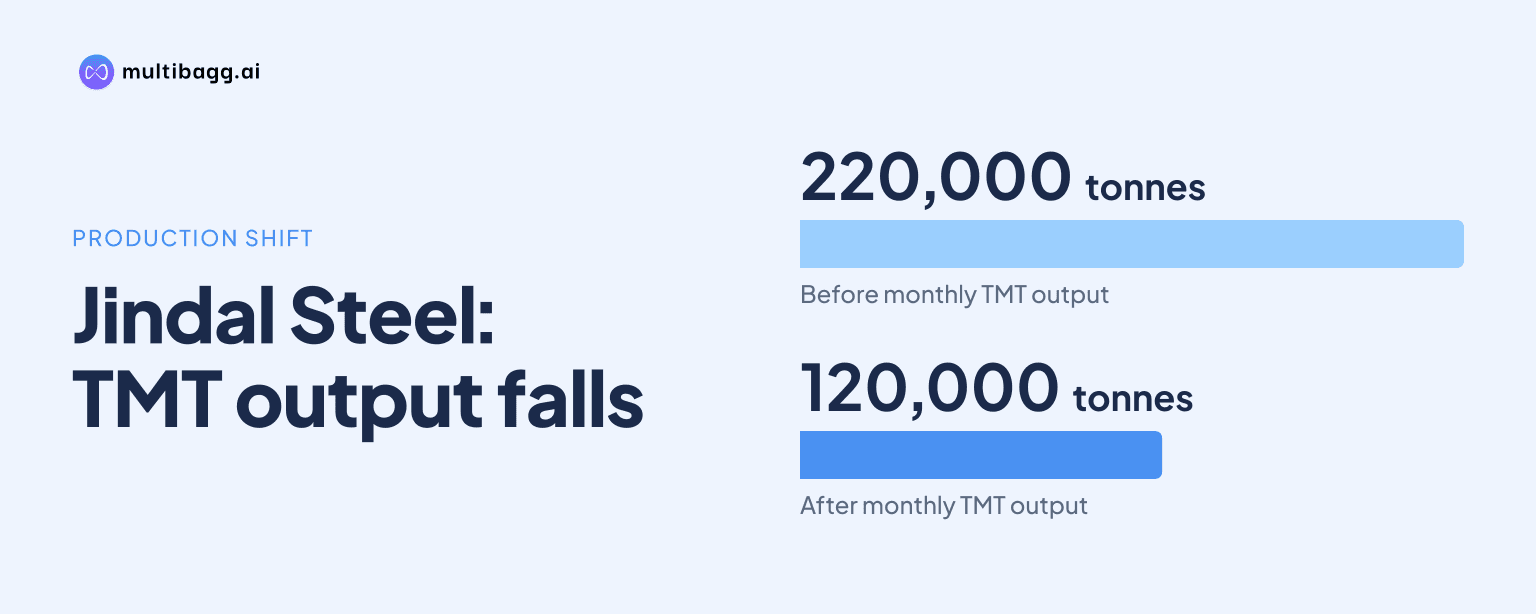
Jindal Steel has reduced monthly thermo-mechanically treated, or TMT, steel output to 120,000 tonnes from 220,000 tonnes and redirected 100,000 tonnes into plates and hot-rolled coil, or HRC. Management said the change followed weak TMT conditions in Q2, while HRC prices strengthened late in the quarter and were expected to affect Q3 realisations more fully.
Know Jindal Steel inside out
Results, valuation, peers and who's buying, in one view.
Why did Jindal Steel cut TMT production?
Jindal Steel cut TMT production because monsoon conditions weakened construction activity and TMT realisations in Q2. Management said TMT had historically accounted for about 20% of total production, but the company increased HRC volumes and reduced TMT volumes after TMT did not perform well during the quarter. It now sells TMT principally to major projects rather than serving the retail market at its earlier scale.
The decision reallocates steel rather than removing volume from production. Jindal Steel said all 100,000 tonnes per month previously intended for TMT are now used in flat products, specifically plates and HRC. Management described the rerouted material as a move from lower-priced TMT into higher-priced other products, but did not disclose separate net sales realisation or earnings before interest, tax, depreciation and amortisation, or EBITDA, by product.
Management linked the Q2 TMT weakness to the annual monsoon pattern, saying construction activity is normally low in the rainy season. It said Q3 and Q4 should be better than Q2 because the monsoon had passed, building construction was expected to pick up and the festival season had started. Those comments describe management's market outlook, not a commitment to restore the earlier 220,000-tonne monthly TMT run rate.
How much TMT steel has Jindal Steel redirected?
Jindal Steel has redirected 100,000 tonnes of TMT-designated steel each month, reducing TMT output by about 45% from the earlier 220,000-tonne monthly level. Current TMT output is 120,000 tonnes a month, and management said the entire displaced volume is going to plates and HRC. It did not provide the split of the 100,000 tonnes between those two flat-product categories.
Jindal Steel also discussed the shift when asked about its value-added product mix. Management put the comparable value-added mix at 57% for the quarter, while an analyst cited 66% for the prior quarter. Management separately said the mix exceeded 65% when the movement from lower-priced TMT to higher-priced products was included, indicating that the 57% and more-than-65% measures were not directly comparable calculations.
What happened to TMT and HRC prices in Q2?
Jindal Steel said TMT realisations declined during Q2, while HRC pricing strengthened in August and September, near the quarter's end. Its marketing chief said the late HRC increase would have a better impact on Q3 realisations than it had on Q2. At the time of the call, management said spot prices for HRC and TMT were around Rs 60,000 per tonne, with HRC slightly above that level.
Management described HRC as moving from about Rs 51,000 per tonne to Rs 60,000 per tonne during Q2, while TMT moved from about Rs 52,000 per tonne to Rs 59,000 per tonne. In another comparison, it said TMT had started around Rs 56,000 per tonne, fell to Rs 45,000 per tonne and then recovered to around Rs 60,000 per tonne. The different TMT ranges were provided in separate responses and were not presented as an average-price series.
Jindal Steel said construction steel and HRC were almost similarly priced, with a difference of about Rs 1,000 per tonne in either direction. That narrower gap provides the market context for diverting steel from TMT into plates and HRC. However, management did not quantify how much additional revenue, realisation or EBITDA per tonne the mix change would produce.
Got a follow-up? Ask IRIS
Will Jindal Steel continue to prioritise flat products?
Jindal Steel's disclosed near-term action is to retain TMT sales for major projects while using the 100,000-tonne monthly balance for plates and HRC. Management did not set a permanent TMT production target, a target share for flat products or a timetable for changing the 120,000-tonne monthly TMT level. Its explanation focused on current TMT conditions rather than a stated long-term exit from retail TMT sales.
The company's volume plan is expressed as saleable sales rather than as a TMT-to-flat-product mix target. Management said saleable sales of 900,000 to 950,000 tonnes a month should enable it to achieve the lower end of its guidance, and said it expected to reach the midrange as plants were fully ramped up after the monsoon. That target leaves the eventual TMT share dependent on construction demand and the company's operating allocation.
Jindal Steel also said its pellet plants were producing about 33,000 tonnes a day across Barbil and Angul, with all output consumed in-house. The company said it does not sell merchant pellets and sometimes buys pellets in the market, citing difficulty in mining iron ore during heavy rainfall in the preceding month. This supports steel production continuity but does not establish a product-specific production target for plates, HRC or TMT.
What cost changes could affect the product-mix outcome?
Jindal Steel said it had replaced propane with coal-derived synthesis gas, or syngas, in reheating furnaces used by cold-rolling mills, galvanising lines and colour-coating lines. Management put propane at about Rs 100 per kilogram and equivalent coal gas at about Rs 30 per kilogram, implying a Rs 70-per-kilogram difference. It did not quantify the resulting saving per tonne of steel or the financial effect on the flat-product mix.
Management said it does not intend to return to propane because it has modified burner and automation systems to accommodate syngas. It also said Q2 other expenses rose partly because of freight, power and fuel, with monsoon-related consumption contributing to the increase. Management expected those costs to normalise in subsequent quarters after the monsoon, but did not provide a quarterly cost target.
Conclusion
Jindal Steel has made a defined production reallocation, cutting TMT output by 100,000 tonnes a month from 220,000 tonnes to 120,000 tonnes and sending the volume to plates and HRC. The move followed weak Q2 construction-linked TMT conditions, while HRC pricing strengthened late in the quarter. Management's 57% comparable value-added mix and separate more-than-65% observation show that the shift is relevant to its assessment of sales composition.
The next indicators are whether saleable sales reach the management-stated 900,000 to 950,000 tonnes per month, whether late-Q2 HRC price gains affect Q3 realisations and whether construction demand changes the TMT allocation. Management also expects Q3 and Q4 conditions to improve after the monsoon, but has not disclosed a target or timetable for returning TMT production to 220,000 tonnes per month.

