










Jindal Supreme (India) Q2 FY27 profit reaches ₹9.90 crore
Key highlights
- Jindal Supreme reported Q2 FY27 revenue from operations of ₹216.22 crore.
- Jindal Supreme posted Q2 FY27 net profit of ₹9.90 crore and profit before tax of ₹14.37 crore.
- Jindal Supreme reported earnings per share of ₹2.40 for the quarter ended September 30, 2026.
- Jindal Supreme's BSE shares were listed on September 23, 2026, under scrip code 544935.
powered by IRIS
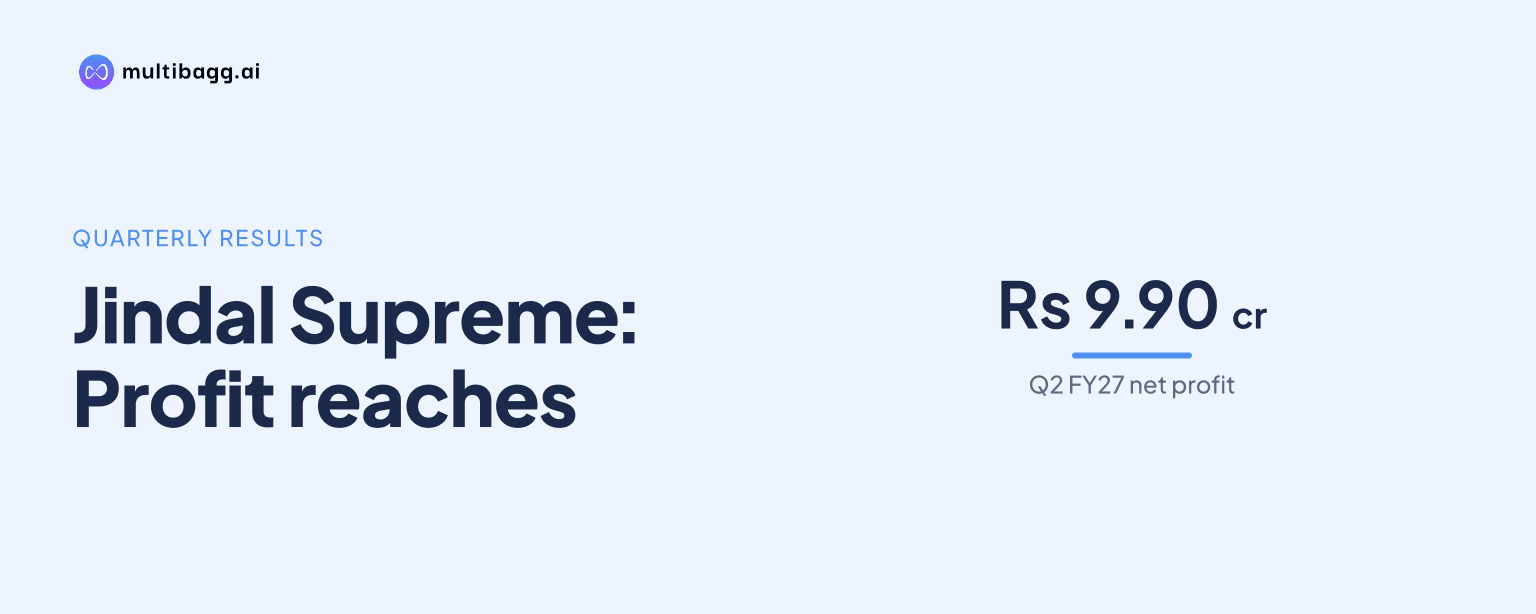
Jindal Supreme (India) Limited reported a net profit of ₹9.90 crore in Q2 FY27 on revenue from operations of ₹216.22 crore, with profit before tax of ₹14.37 crore and earnings per share of ₹2.40. The results cover the quarter ended September 30, 2026, and were approved by the board on November 14, 2026.
Know Jindal Supreme (India) inside out
Results, valuation, peers and who's buying, in one view.
What did Jindal Supreme report for Q2 FY27?
Jindal Supreme reported standalone revenue from operations of ₹216.22 crore for the September quarter of FY27 and a standalone net profit of ₹9.90 crore. Its profit before tax for the period stood at ₹14.37 crore, while earnings per share were ₹2.40.
The company announced the results after a board meeting on November 14, 2026. The board considered and approved the unaudited standalone financial results for the quarter and half year ended September 30, 2026, along with the limited review report referred to in the board-meeting intimation.
The disclosed numbers provide a current operating snapshot for the steel-products manufacturer following its recent stock-market listing. The source does not provide comparative Q2 FY26 figures, sequential quarterly data, margins, debt, or order-book details, so a year-on-year or quarter-on-quarter performance comparison cannot be established from the available information.
What does Jindal Supreme manufacture and where are its products used?
Jindal Supreme is a steel-products manufacturer with more than five decades of experience. Its product range includes MS black pipes and tubes, galvanized pipes, metal crash barriers, and GI tubular poles for infrastructure and industrial applications.
The company supplies products used in water supply and plumbing, construction, roads and highways, bridges, oil and gas, agriculture, and rural electrification. This end-market mix links its operations to both public infrastructure activity and private-sector industrial and construction demand.
MS black pipes and tubes and galvanized pipes are used across construction and plumbing-related requirements, while crash barriers are associated with road-safety infrastructure. GI tubular poles have applications that include rural electrification. The available disclosure does not provide product-wise sales, customer concentration, plant capacity, or the geographic split of revenue.
For investors, the breadth of these end-use sectors is relevant because demand conditions can differ across construction, transport infrastructure, energy and agricultural activity. However, the reported quarterly figures do not identify which product categories or customer segments contributed most to the ₹216.22 crore revenue base.
How did Jindal Supreme's IPO and listing unfold?
Jindal Supreme's equity shares were listed on the Bombay Stock Exchange on September 23, 2026, under scrip code 544935, and were admitted to dealings in the exchange's T Group securities list. The company is also identified with NSE symbol JSIPLBE and ISIN INE1DLO01028 in the supplied market information.
The source contains two IPO-related disclosures with different issue details. One states that a ₹124.88 crore IPO comprised a fresh issue of 1.07 crore shares worth ₹99.89 crore and an offer for sale of 26.87 lakh shares worth ₹24.99 crore. A separate disclosure says the company completed an IPO of 13.42 lakh equity shares at ₹93 per share, raising approximately ₹12.48 crore.
The available material does not explain whether these figures refer to different offerings, a revised issue structure, or separate corporate actions. Therefore, the two sets of IPO figures should not be treated as directly comparable without clarification from the company or the relevant exchange filings.
The reported issue price in the smaller disclosed offer was ₹93 per share, with each equity share carrying a face value of ₹10. The listing information confirms the September 23 market debut, but the source does not provide the listing-day closing price, subscription data, allotment details, or post-listing shareholding pattern.
Got a follow-up? Ask IRIS
What do the quarterly results mean for investors and operations?
The Q2 FY27 results give investors the first reported quarterly profit and revenue markers in the supplied information after Jindal Supreme's September listing. Revenue of ₹216.22 crore and net profit of ₹9.90 crore show that the company remained profitable during the quarter ended September 30.
Profit before tax of ₹14.37 crore was higher than reported net profit, consistent with tax and other post-PBT charges affecting the final profit figure. But the source does not disclose the tax expense, finance costs, depreciation, exceptional items, or operating profit, limiting any assessment of the factors behind the difference.
No share-price movement or market capitalisation is provided with the financial result. The source lists an all-time high of ₹214.96, an all-time low of ₹120.00, and 20-day average volume of 305,427 shares, but does not state the dates for those market measures or connect them to the Q2 announcement.
For the wider steel-products sector, the results are relevant because the company's products serve infrastructure-linked markets such as roads, water supply and electrification. Still, the company has not disclosed in the provided material whether government orders, commodity costs, capacity utilisation, or export activity influenced the quarter.
Why is the September-quarter update important after the listing?
The September-quarter update is important because it places reported operating performance alongside the company's entry into the listed market. Jindal Supreme's BSE listing took effect on September 23, 2026, while the quarter closed a week later on September 30, making this result a closely timed financial disclosure after the debut.
The company operates in product categories that are closely tied to physical infrastructure and industrial spending. Pipes, tubes, crash barriers and tubular poles address different project requirements, but the available data does not quantify the contribution of any one business line to revenue or profit.
The two differing IPO references are also material for investors reviewing the company's capital-raising history. The disclosed ₹124.88 crore issue structure and the separate ₹12.48 crore IPO completion statement require reconciliation through official offer documents, exchange filings, or company clarification before either figure is used to assess proceeds or dilution.
The next reported financial update will be important for establishing a longer earnings record as a listed company. Investors will also need additional disclosures on comparative revenue, profitability, cash flows, debt, capacity, order flow, and the final IPO structure to evaluate the business more fully.
Conclusion
Jindal Supreme reported Q2 FY27 revenue of ₹216.22 crore, net profit of ₹9.90 crore, profit before tax of ₹14.37 crore and earnings per share of ₹2.40. The figures provide a reported financial baseline shortly after the company's September 2026 BSE listing and reflect operations across infrastructure and industrial steel-product categories.
Investors should watch for the next scheduled financial disclosure and for official clarification of the differing IPO figures included in the available material. Further company filings on comparative earnings, costs, cash flows, product mix and capital raised would provide a clearer basis for assessing performance after listing.