










Jindal Supreme value-added mix reaches 57.5% in H1 FY27
Key highlights
- Jindal Supreme reported a 57.5% value-added-product mix in H1 FY27, up from 50.8% in FY24.
- EBITDA per tonne rose to ₹5,832 in H1 FY27 from ₹2,149 in FY24.
- The cost-of-conversion ratio declined to 90.1% in H1 FY27 from 96.7% in FY24.
- Total H1 FY27 capacity utilisation was 65.46% across 85,500 tonnes of half-year capacity.
powered by IRIS
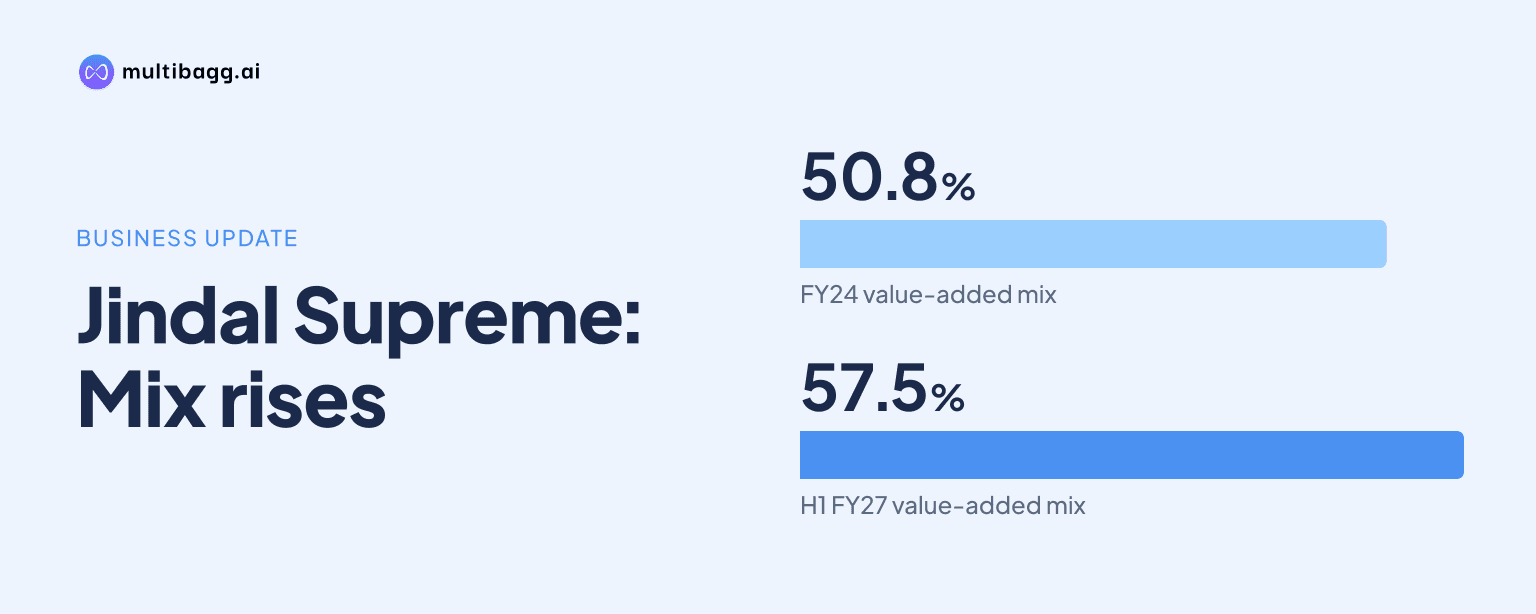
Jindal Supreme (India) Limited reported a 57.5% value-added-product mix in H1 FY27, while EBITDA per tonne was ₹5,832, versus 50.8% and ₹2,149 in FY24. The reported mix shift coincided with the cost-of-conversion ratio declining to 90.1% from 96.7%, alongside capacity across pipes, crash barriers and tubular poles.
Know Jindal Supreme (India) inside out
Results, valuation, peers and who's buying, in one view.
How did Jindal Supreme’s product mix change?
Jindal Supreme increased the value-added share of product mix to 57.5% in H1 FY27 from 50.8% in FY24, a gain of 6.7 percentage points. Base products declined to 42.5% from 49.2% over the same period, showing a gradual movement away from the base-product category.
The change was spread across the disclosed periods. Value-added products accounted for 53.7% in FY25 and 57.0% in FY26 before reaching 57.5% in H1 FY27. Base products moved from 46.3% in FY25 to 43.0% in FY26 and 42.5% in H1 FY27. The presentation does not provide a volume or profitability split within the two mix categories.
Jindal Supreme’s portfolio comprises MS black pipes, galvanised pipes, metal beam crash barriers and GI tubular poles. Galvanised pipes are classified as a value-added product and represented 25.05% of revenue share on the portfolio page. Crash barriers, classified as value-added infrastructure, represented 15.40%, while GI tubular poles, a line introduced from April FY25, represented 6.40%; MS black pipes represented 45.43%.
The categories serve distinct uses. Galvanised pipes have zinc coatings of 40 to 100 microns for corrosion-resistant plumbing and threaded fittings. Crash barriers include W-beam and Thrie-beam profiles for highway and bridge safety systems, while GI tubular poles are used in swaged galvanised poles for street and highway lighting.
Why did Jindal Supreme’s EBITDA per tonne rise?
Jindal Supreme reported EBITDA per tonne of ₹5,832 in H1 FY27, up ₹3,683 from ₹2,149 in FY24, but the presentation does not quantify the separate effects of mix, pricing, raw materials or production efficiency. The measure rose in each reported period, reaching ₹2,689 in FY25 and ₹3,949 in FY26 before the H1 FY27 result.
The cost-of-conversion ratio declined to 90.1% in H1 FY27 from 96.7% in FY24, a reduction of 6.6 percentage points. It was 95.6% in FY25 and 93.8% in FY26. The presentation displays this declining ratio alongside the increase in value-added-product mix and EBITDA per tonne, without assigning a specific contribution to any one factor.
Jindal Supreme operates a 16-acre integrated site in Hisar, Haryana, with in-house coil slitting, cold forming, high-frequency electric resistance welding, hot-dip galvanising, finishing and testing. The site includes three galvanising plants, an in-house testing laboratory and a 4,440 kilowatt-peak rooftop solar installation alongside 2,336 kilowatts of sanctioned grid supply.
The presentation reported a 7.5% EBITDA margin on H1 FY27 revenue from operations of ₹407.16 crore. Separately, it reported a 7.20% EBITDA margin in 3M FY27, compared with 3.27% in FY24. As H1 FY27 and 3M FY27 cover different periods, those two margin figures are not directly comparable.
Got a follow-up? Ask IRIS
What capacity is available for Jindal Supreme’s product mix?
Jindal Supreme reported total installed capacity of 1,71,000 metric tonnes per annum in FY26 at 61.66% utilisation, while its H1 FY27 table shows 85,500 tonnes of half-year capacity at 65.46% utilisation. The H1 figure is a partial-period presentation of capacity rather than a reduction in the annual installed base.
Utilisation differed by product line in H1 FY27. MS black pipes and tubes operated at 70.68%, compared with 65.13% for MS galvanised pipes and tubes, 56.78% for metal beam crash barriers and 44.87% for GI tubular poles. The crash-barrier and tubular-pole lines therefore had more unused disclosed capacity than the two pipe categories during the half year.
Crash-barrier utilisation increased from 35.78% in FY25 to 65.20% in FY26, before standing at 56.78% in H1 FY27. GI tubular poles were not listed as a capacity line in FY25, then recorded 12,000 tonnes of capacity at 33.48% utilisation in FY26 and 6,000 tonnes at 44.87% utilisation in H1 FY27. This reflects the more recent introduction of the poles line in FY25.
Jindal Supreme sold 1,01,100 metric tonnes in FY26, compared with 96,400 tonnes in FY25, while FY26 product-sales revenue was ₹675.39 crore. Management says capacity expansion has been substantially completed through internal accruals and that the company is positioned to increase utilisation, but it provides no dated volume, revenue or utilisation target for the existing lines.
What expansion plans has Jindal Supreme disclosed?
Jindal Supreme has disclosed that an 18,000-metric-tonne-per-annum galvanising unit is underway. Management also says it plans medium-term tube-mill capacity expansion and intends to double crash-barrier output for highway and industrial-corridor demand. The presentation does not disclose a completion date, project cost, financing mix or base period for the planned increase in crash-barrier output.
Jindal Supreme entered crash-barrier manufacturing in 2024, when the presentation cited 24,000 tonnes of crash-barrier capacity, and started GI tubular poles in 2025. These categories were added to a pipes-and-tubes business established in 1974, and their separate FY26 and H1 FY27 utilisation figures show that their operating ramp-up differs from the established pipe lines.
Jindal Supreme reported 53 active dealers in H1 FY27, up from 34 in FY24, with dealers contributing 19.70% of revenue in the half year. It served 20 states, Haryana was the largest region at 24.66% of H1 FY27 revenue, and the top 10 customers accounted for 21.0% of revenue.
Conclusion
Jindal Supreme’s disclosed operating data show a clear mix change: value-added products rose from 50.8% in FY24 to 57.5% in H1 FY27, EBITDA per tonne increased from ₹2,149 to ₹5,832, and the cost-of-conversion ratio declined from 96.7% to 90.1%. The data move together, although the presentation does not apportion the EBITDA improvement among products, pricing, costs and manufacturing efficiency.
The next disclosures to watch are utilisation of the crash-barrier and GI tubular-pole lines, which stood at 56.78% and 44.87%, respectively, in H1 FY27, and progress on the 18,000-metric-tonne-per-annum galvanising unit. Management’s medium-term tube-mill expansion and plan to double crash-barrier output also remain dependent on undisclosed timing and project economics.