










Jonnagiri Starts Commercial Production, Targets 400 Kg FY27
Key highlights
- Jonnagiri began commercial operations on 24 June 2026 and produced 135 kg of gold in Q2 FY27.
- Lloyds Enterprises has an approximately 31% economic stake in Jonnagiri through a 50% interest in Prakar Estate and Promoters LLP.
- Jonnagiri targets approximately 400 kg of gold in FY27, versus stated peak annual capacity of approximately 1,000 kg.
- Jonnagiri has received Rs 405 crore of investment, holds a 597.82-hectare lease and has Environmental Clearance until 2043.
powered by IRIS
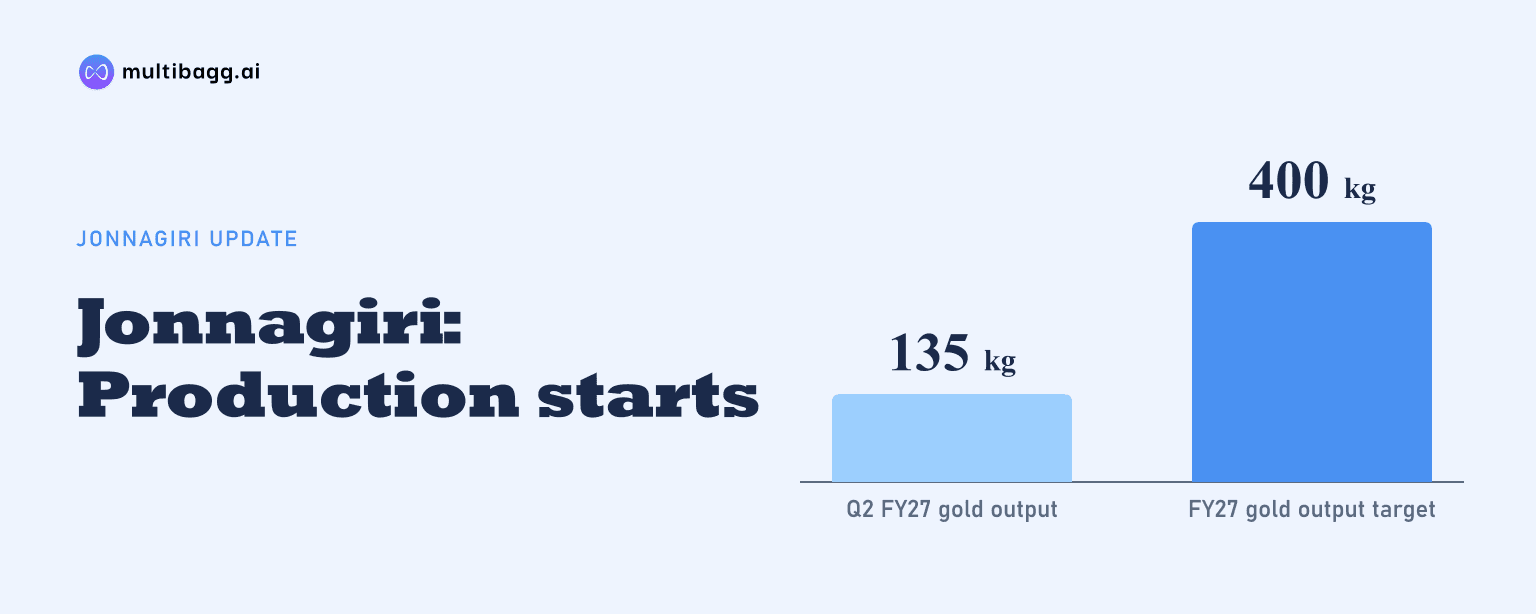
Thriveni Lloyds Swarnagiri Private Limited, referred to as Jonnagiri, began commercial operations on 24 June 2026, produced 135 kg of gold in Q2 FY27 and is targeting approximately 400 kg in FY27. Lloyds Enterprises Limited has an approximately 31% economic stake in Jonnagiri, which has stated peak capacity of approximately 1,000 kg per year.
Know Lloyds Enterprises inside out
Results, valuation, peers and who's buying, in one view.
When did Jonnagiri begin commercial production?
Jonnagiri launched commercial operations on 24 June 2026 in an inauguration by the Andhra Pradesh Chief Minister. The presentation says Jonnagiri village was renamed Swarnagiri at the launch and reports 135 kg of gold production in Q2 FY27, the first operating output disclosed for the project.
The presentation describes Jonnagiri as India’s first private primary gold mine since Independence. Lloyds Enterprises’ interest is held through a 50% interest in Prakar Estate and Promoters LLP, which gives Lloyds Enterprises an approximately 31% economic stake in Jonnagiri.
This ownership structure distinguishes the mine interest from a wholly owned operating division of Lloyds Enterprises. The presentation does not disclose Jonnagiri’s revenue, profit, cash flow or net asset value contribution to Lloyds Enterprises, despite the 135 kg Q2 FY27 production disclosure.
What gold output is Jonnagiri targeting in FY27?
Jonnagiri is targeting approximately 400 kg of gold in FY27 after producing 135 kg in Q2 FY27. Management also states peak gold capacity of approximately 1,000 kg per year and says planned expansion could raise output to as much as approximately 2,000 kg annually.
The reported output and stated capacity pathway are set out below. The 135 kg Q2 FY27 figure is actual production, whereas the FY27 target and the larger capacity figures are management-stated targets or potential capacity levels.
The 135 kg produced in Q2 FY27 equals 33.75% of the approximately 400 kg FY27 target, but the presentation gives no quarterly production schedule. It also does not provide the timing, funding requirement, throughput or recovery assumptions for the planned expansion from approximately 1,000 kg to as much as approximately 2,000 kg annually.
What permits and resources support Jonnagiri’s operations?
Jonnagiri has Environmental Clearance and Consent to Operate, with its Environmental Clearance valid until 2043. The mine lease spans 597.82 hectares in Tuggali mandal, Kurnool district, and the presentation describes the project’s metallurgy as simple.
The project reports Joint Ore Reserves Committee, or JORC, resources of approximately 17.5 million tonnes at 1.46 grams per tonne, containing approximately 12 tonnes of gold. Jonnagiri identifies further drilling as a potential source of resource upside, but the presentation does not provide a reserve estimate or a mine-life production schedule.
The approximately 12-tonne in-ground gold resource and approximately 400 kg FY27 production target measure different parts of the project profile. The resource estimate describes mineralised material, while the FY27 number is a one-year output target; the presentation does not disclose gold recovery rates, processing costs, realised prices or all-in sustaining costs.
Got a follow-up? Ask IRIS
How much has Jonnagiri invested and contributed locally?
Jonnagiri has received Rs 405 crore of investment to date and created around 700 jobs, with roughly 80% filled locally. The presentation does not separate the Rs 405 crore between mine development, plant construction, infrastructure, working capital or the expansion that could lift output above approximately 1,000 kg annually.
Andhra Pradesh receives a 4% royalty from Jonnagiri, while the Andhra Pradesh District Trust fund receives 30% of the royalty amount. The presentation does not disclose the royalty base, royalty paid to date or the amount received by the District Trust fund from the 4% royalty arrangement.
The 597.82-hectare lease, Environmental Clearance through 2043 and around 700 jobs place the project’s operating footprint alongside its production plans. However, Jonnagiri does not disclose future capital expenditure needed to achieve the approximately 1,000 kg peak-capacity level or the potential approximately 2,000 kg expansion level.
Why does Jonnagiri matter to Lloyds Enterprises?
Jonnagiri gives Lloyds Enterprises exposure to a producing gold asset through its approximately 31% economic stake, following the 135 kg of production reported in Q2 FY27. The asset combines a 24 June 2026 commercial start, Environmental Clearance until 2043 and a management target of approximately 400 kg in FY27.
The Jonnagiri stake sits among other investments disclosed by Lloyds Enterprises rather than as a wholly owned mining business. For comparison, the presentation identifies Lloyds Enterprises’ 4.13% stake in Lloyds Metals & Energy Ltd, while its Jonnagiri exposure is the approximately 31% economic interest held through Prakar Estate and Promoters LLP.
The disclosed production progression runs from 135 kg in Q2 FY27 toward approximately 400 kg in FY27, then to approximately 1,000 kg of peak annual capacity. The further potential of up to approximately 2,000 kg annually depends on a planned expansion for which the presentation does not specify a completion date, capital budget or additional approvals.
Conclusion
Jonnagiri has moved from development into commercial production, reporting 135 kg in Q2 FY27 after its 24 June 2026 launch. Lloyds Enterprises’ approximately 31% economic stake provides exposure to a gold project with Rs 405 crore invested to date, a 597.82-hectare lease and Environmental Clearance valid until 2043.
The next disclosed operating measure is progress against the approximately 400 kg FY27 target. Management’s subsequent plan is to scale toward approximately 1,000 kg of annual capacity, with up to approximately 2,000 kg possible through planned expansion; the presentation leaves the timing, funding and execution details of that expansion unresolved.