










Lloyds Enterprises Limited H1 EBITDA fell 39% as total income rose
Key highlights
- Lloyds Enterprises’ H1 FY27 consolidated EBITDA fell 39% to Rs 224.82 crore.
- Lloyds Enterprises’ consolidated EBITDA margin contracted 1,802 basis points to 16.74% in H1 FY27.
- Lloyds Enterprises’ H1 FY27 consolidated total comprehensive income rose 542% to Rs 1,411.84 crore.
- Lloyds Enterprises’ consolidated expenses increased 62% to Rs 1,118.38 crore, versus 27% total-income growth.
powered by IRIS
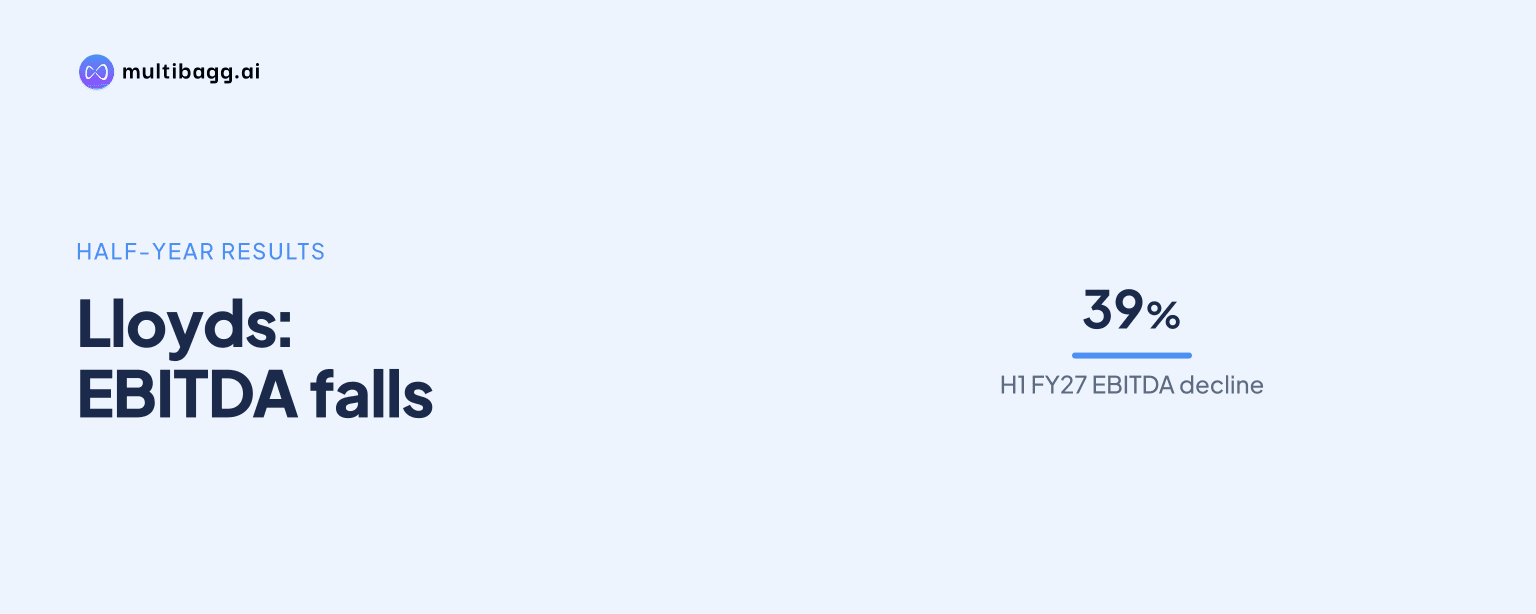
Lloyds Enterprises reported H1 FY27 consolidated earnings before interest, tax, depreciation and amortisation (EBITDA) of Rs 224.82 crore, down 39% year on year, despite a 27% rise in total income to Rs 1,343.20 crore. Total comprehensive income increased 542% to Rs 1,411.84 crore, while EBITDA margin contracted by 1,802 basis points to 16.74%.
Know Lloyds Enterprises inside out
Results, valuation, peers and who's buying, in one view.
Why did Lloyds Enterprises’ H1 comprehensive income rise while EBITDA fell?
Lloyds Enterprises’ H1 FY27 figures show total comprehensive income and EBITDA moving in opposite directions, with comprehensive income rising by Rs 1,192.09 crore from Rs 219.75 crore while EBITDA fell by Rs 143.50 crore from Rs 368.32 crore. The presentation reports the 542% increase in consolidated total comprehensive income but does not provide a line-by-line reconciliation from profit before tax to that measure.
The operating measures reported by Lloyds Enterprises declined despite higher consolidated income. Total income rose to Rs 1,343.20 crore in H1 FY27 from Rs 1,059.67 crore in H1 FY26, while total expenses increased 62% to Rs 1,118.38 crore from Rs 691.35 crore. The faster increase in expenses coincided with the EBITDA decline and a margin reduction from 34.76% to 16.74%.
The divergence was more pronounced in the standalone accounts. Standalone total comprehensive income rose 3,189% to Rs 3,775.68 crore in H1 FY27, while standalone EBITDA declined 91% to Rs 27.85 crore. Management attributed the standalone comprehensive-income result to value movement in the strategic investment portfolio.
How did Lloyds Enterprises’ consolidated operating performance change in H1 FY27?
Lloyds Enterprises’ consolidated EBITDA margin fell to 16.74% in H1 FY27 from 34.76% in H1 FY26, a contraction of 1,802 basis points, or 18.02 percentage points. Income increased by Rs 283.53 crore, but expenses rose by Rs 427.03 crore, exceeding the income increase by Rs 143.50 crore.
The lower operating result also extended below EBITDA. Depreciation and amortisation increased 109% to Rs 19.40 crore from Rs 9.28 crore, and finance costs increased 85% to Rs 33.20 crore from Rs 17.97 crore. Profit before tax consequently fell 50% to Rs 172.22 crore, despite a Rs 28.07 crore share of associates, up 18% from Rs 23.79 crore.
The quarterly income sequence showed growth through Q2 FY27, although the presentation does not disclose quarterly EBITDA. Consolidated Q2 FY27 income was Rs 738 crore, compared with Rs 605 crore in Q1 FY27 and Rs 447 crore in Q2 FY26. Consolidated Q2 total comprehensive income was Rs 211 crore, below Rs 1,201 crore in Q1 FY27 but above a negative Rs 528.70 crore a year earlier.
What do Lloyds Enterprises’ costs say about the margin contraction?
Lloyds Enterprises’ reported cost increase was the central operating change in H1 FY27, with consolidated expenses rising 62% against a 27% increase in income. Expenses represented about 83% of H1 FY27 consolidated income, compared with about 65% in H1 FY26, based on the presentation’s reported figures.
The increase in consolidated expenses exceeded the increase in income by Rs 143.50 crore. Income expanded by Rs 283.53 crore and expenses rose by Rs 427.03 crore, matching the reported reduction in EBITDA from Rs 368.32 crore to Rs 224.82 crore. The presentation does not split the Rs 1,118.38 crore expense line into individual operating-cost categories.
Finance costs and depreciation added to the decline in profit before tax after EBITDA. Finance costs increased by Rs 15.23 crore and depreciation and amortisation by Rs 10.12 crore, while tax declined 41% to Rs 32.08 crore from Rs 54.35 crore. Lloyds Enterprises reported no exceptional items in either H1 FY27 or H1 FY26.
Got a follow-up? Ask IRIS
What does the standalone result reveal about the comprehensive-income increase?
Lloyds Enterprises’ standalone result indicates that the largest reported comprehensive-income movement came alongside a lower operating outcome. Standalone total income declined 64% to Rs 176.19 crore from Rs 489.50 crore, while EBITDA fell to Rs 27.85 crore from Rs 300.84 crore.
Standalone expenses fell 21% to Rs 148.34 crore from Rs 188.66 crore, a smaller decline than the reduction in income. This resulted in a 4,565-basis-point decline in standalone EBITDA margin, to 15.81% from 61.46%. Standalone finance costs also rose 73% to Rs 20.17 crore, while profit before tax declined 97% to Rs 7.42 crore.
The Q2 figures also show volatility in comprehensive income across both reporting scopes. Standalone Q2 FY27 total comprehensive income was Rs 660 crore, compared with a negative Rs 991 crore in Q2 FY26, while consolidated Q2 FY27 total comprehensive income was Rs 211 crore after a negative Rs 528.70 crore a year earlier. Standalone Q2 FY27 total income was Rs 122 crore, compared with Rs 54 crore in Q1 FY27.
How does Lloyds Enterprises’ H1 result fit its reported portfolio structure?
Lloyds Enterprises describes itself as a diversified holding platform spanning trading, real estate and strategic investments, with trading in steel, allied products and iron ore pellets. Its disclosed investments include a 4.13% stake in Lloyds Metals & Energy Ltd and a 17.88% stake in Steel Infra Solutions Company Ltd acquired in June 2026.
The presentation also reports developments in its engineering and gold-related interests. Lloyds Engineering Works Limited’s pro forma platform delivered H1 EBITDA of Rs 359 crore and income of Rs 2,550 crore, while the group order book stood at Rs 10,355 crore at 30 September. The Jonnagiri gold mine entered commercial production in June 2026 and produced 135 kilograms in Q2 FY27, against a stated FY27 target of about 400 kilograms.
Real estate is another disclosed part of the portfolio through Lloyds Realty Developers Limited, a wholly owned subsidiary with a pipeline of about 1.75 crore square feet. The subsidiary reported more than 30 lakh square feet delivered across 19 projects, while two projects totalling 8.69 lakh square feet were identified as new in Q2 FY27.
Lloyds Enterprises plans to merge Lloyds Realty Developers Limited and Indrajit Properties into itself before separating the real-estate business into Lloyds Realty Limited. Under the proposed scheme, the resulting real-estate company would be separately listed, subject to approvals, while Lloyds Enterprises would retain the trading and investment business.
Conclusion
Lloyds Enterprises’ H1 FY27 results show a clear divergence between reported comprehensive income and consolidated operating profitability. Total comprehensive income rose to Rs 1,411.84 crore, while EBITDA, profit before tax and EBITDA margin declined to Rs 224.82 crore, Rs 172.22 crore and 16.74%, respectively. The presentation shows expenses growing faster than income and does not provide a detailed bridge for the consolidated comprehensive-income movement.
The next disclosed structural milestone is National Company Law Tribunal sanction for the proposed real-estate demerger, after National Stock Exchange and BSE approvals. If the scheme becomes effective, eligible Lloyds Enterprises shareholders would receive one fully paid Lloyds Realty Limited share of Rs 1 for every two Lloyds Enterprises shares of Rs 1 held on the record date.