










JTEKT India Q2 FY27 Revenue Rises 31% as Profit Falls 4%
Key highlights
- JTEKT India reported Q2 FY27 revenue from operations of Rs 834.74 crore, up 30.6% year on year.
- Q2 FY27 net profit after tax declined 4.1% to Rs 17.48 crore from Rs 18.23 crore.
- First-half FY27 operating cash flow rose to Rs 126.17 crore from Rs 23.06 crore a year earlier.
- The board approved an investment of up to Rs 2.40 crore for a 26% stake in a captive solar power SPV.
powered by IRIS
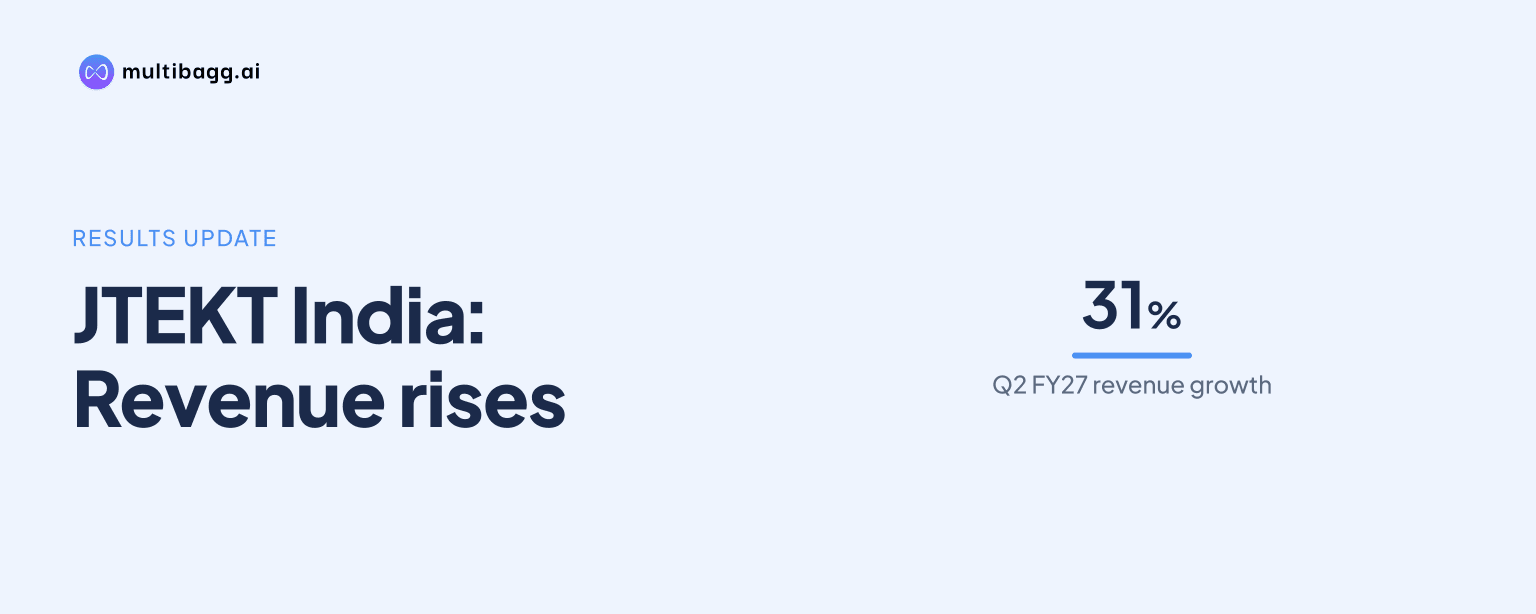
JTEKT India Limited reported revenue from operations of Rs 834.74 crore in Q2 FY27, up 30.6% year on year, while net profit after tax fell 4.1% to Rs 17.48 crore as costs rose. The July-September results show strong sales growth but lower profitability on the higher revenue base.
Know JTEKT India inside out
Results, valuation, peers and who's buying, in one view.
What did JTEKT India report for Q2 FY27?
JTEKT India reported revenue from operations of Rs 834.74 crore for the quarter ended 30 September 2026, compared with Rs 639.11 crore in the corresponding quarter a year earlier. This represented year-on-year growth of 30.6%, or about 31% on a rounded basis.
Including other income, total income increased to Rs 837.50 crore from Rs 642.72 crore. Other income, however, declined to Rs 2.76 crore from Rs 3.61 crore. The company published its unaudited financial results after the board approved them on 4 November 2026.
The results cover the second quarter of FY27, spanning July to September 2026. They were subsequently published in Business Standard on 5 November 2026. JTEKT India's reported standalone figures were also filed with the NSE.
Why did JTEKT India's profit decline despite higher revenue?
JTEKT India's net profit after tax declined because material costs, finance charges, depreciation and other costs increased during the quarter. Net profit after tax stood at Rs 17.48 crore, down from Rs 18.23 crore in Q2 FY26, despite the Rs 195.63 crore increase in revenue from operations.
Profit before tax declined 4.5% to Rs 23.85 crore from the year-earlier level. Basic and diluted earnings per share, which were not annualised, fell to Rs 0.63 from Rs 0.68. The figures indicate that cost growth affected earnings even as sales expanded substantially.
On a sequential basis, net profit improved from Rs 6.22 crore in the June 2026 quarter. Reported EBITDA for Q2 FY27 was Rs 58 crore, compared with Rs 46 crore in Q2 FY26 and Rs 38 crore in Q1 FY27. The cited EBITDA measure represents revenue from operations less operating costs, before other income.
How did JTEKT India perform in the first half of FY27?
JTEKT India's first-half net profit after tax fell 18.4% to Rs 23.70 crore from Rs 29.04 crore in the corresponding period of FY26. Profit before tax for the six months declined to Rs 32.47 crore from Rs 39.52 crore.
Basic and diluted earnings per share for the first half were Rs 0.85, compared with Rs 1.10 in the prior-year period. Operating cash flow, however, improved sharply to Rs 126.17 crore from Rs 23.06 crore a year earlier.
The difference between the half-year profit movement and operating cash flow movement is relevant for investors assessing the company's reported financial position. The filing provides the cash-flow comparison but does not attribute the increase to specific operating or working-capital factors.
Got a follow-up? Ask IRIS
What does the solar power investment involve?
JTEKT India's board approved an equity investment of up to Rs 2.40 crore in a special purpose vehicle for a captive solar power project. The investment would give JTEKT India a 26% stake in the vehicle established for captive solar power generation.
The announcement confirms the investment limit and intended ownership stake. It does not provide a commissioning timeline, project capacity, location, total project cost or an estimate of the financial impact from the solar project.
Captive power arrangements can be relevant to manufacturing businesses because energy is an operating input. In this case, the disclosed information is limited to the approved equity commitment and the proposed stake, so the operational impact cannot yet be quantified from the available filing.
How does the quarter compare with JTEKT India's recent performance?
JTEKT India's Q2 FY27 sales of about Rs 835 crore were higher than Rs 718 crore reported in Q1 FY27 and Rs 639 crore in Q2 FY26. EBITDA of Rs 58 crore also exceeded the Rs 38 crore reported in the June quarter and Rs 46 crore reported a year earlier.
The company's FY26 investor presentation had stated that revenue grew 11%, ahead of industry growth of 9%, supported by the start of production of new models where JTEKT India was a complete system supplier. That presentation also reported an FY26 EBITDA margin of 7.5%, down 10 basis points from 7.6% in the preceding year.
The Q2 FY27 outcome continues the pattern of revenue expansion, but the quarterly profit decline shows that sales growth did not translate into year-on-year net-profit growth. Investors will therefore be focused on the relationship between future revenue growth, operating costs and reported profitability.
Conclusion
JTEKT India's Q2 FY27 results showed a 30.6% rise in revenue from operations to Rs 834.74 crore, alongside a 4.1% decline in net profit to Rs 17.48 crore. Higher material, finance, depreciation and other costs weighed on profit, while first-half operating cash flow rose to Rs 126.17 crore.
The next disclosed areas to watch are the company's subsequent quarterly results and further details on the captive solar power project, including its capacity, timeline and expected operational implications. The board has approved an investment of up to Rs 2.40 crore for a 26% stake in the solar project vehicle.