










JTEKT India H1 revenue rose 28.8%, ahead of industry growth
Key highlights
- H1 FY 2026-27 revenue rose 28.8% to Rs 1,552.7 crore, versus 23% industry growth cited by management.
- CVJ represented 6.0% of H1 FY-27 product revenue, up from 3.6% in H1 FY-26.
- JTEKT India supplied CVJ for four Maruti and Toyota models and planned one further model supply during the current financial year.
- H1 FY 2026-27 EBITDA margin was 6.1%, compared with 6.3% a year earlier.
powered by IRIS
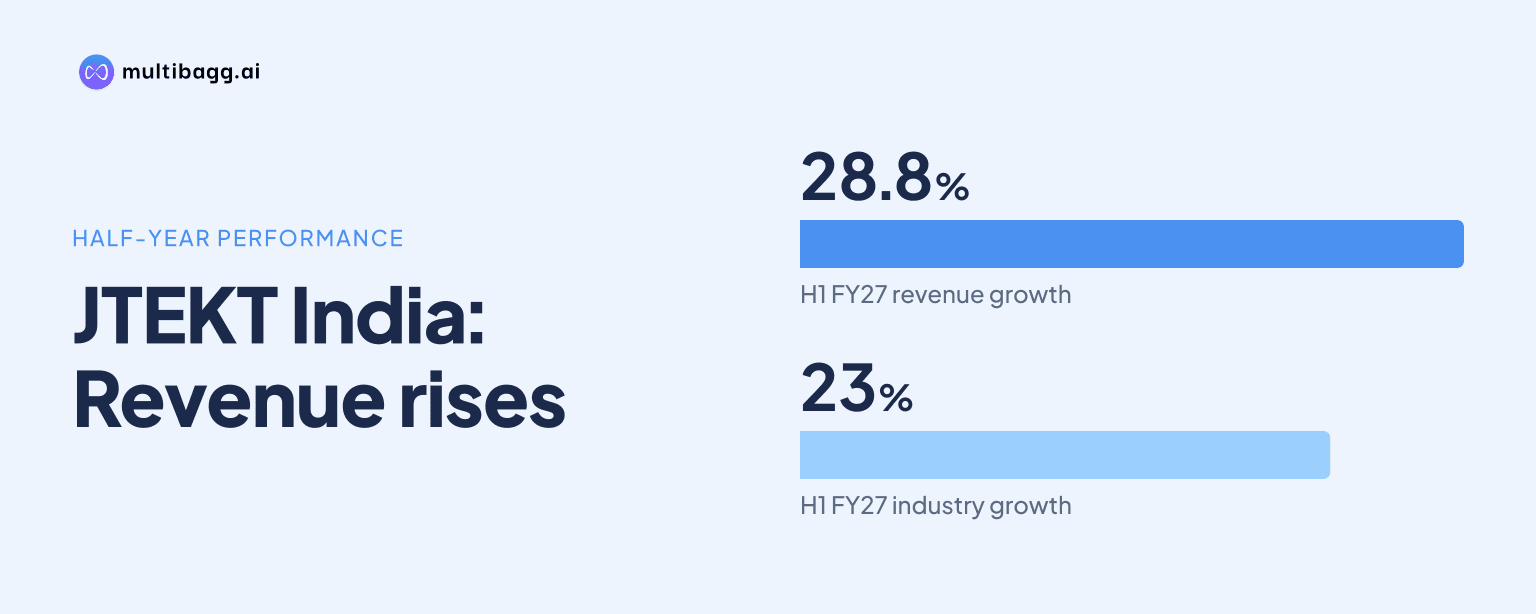
JTEKT India Limited reported H1 FY 2026-27 revenue of Rs 1,552.7 crore, up 28.8% from Rs 1,205.1 crore and ahead of the 23% industry growth cited by management. Management attributed the outperformance to better-performing vehicle models, models started in FY 2025-26 and additional drive shaft, or CVJ, supplies for four Maruti and Toyota models.
Know JTEKT India inside out
Results, valuation, peers and who's buying, in one view.
Why did JTEKT India outpace industry revenue growth?
JTEKT India outpaced the stated industry growth rate by 5.8 percentage points in H1 FY 2026-27, as revenue rose 28.8% to Rs 1,552.7 crore from Rs 1,205.1 crore in H1 FY 2025-26. Management said the company was present in vehicle models that performed better and in new vehicle models whose start of production took place during FY 2025-26.
Growth increased between the two quarters in the half year. Q1 FY 2026-27 revenue grew 26.8% to Rs 718 crore from Rs 566 crore a year earlier, while Q2 revenue grew 30.6% to Rs 834.7 crore from Rs 639.1 crore. Q2 therefore accounted for Rs 195.6 crore of the Rs 347.6 crore H1 revenue increase.
Management did not disclose revenue by vehicle model or quantify the contribution from new-model programmes. It did identify CVJ introduction as additional sales support, with supplies already running for four Maruti and Toyota models in H1 FY 2026-27.
How much has CVJ changed JTEKT India’s sales mix?
JTEKT India’s CVJ share of product revenue rose to 6.0% in H1 FY-27 from 3.6% in H1 FY-26, an increase of 2.4 percentage points. The share was about 1.7 times its year-earlier level, alongside the four active Maruti and Toyota model applications cited by management.
The wider driveline category increased to 7.1% of sales in H1 FY-27 from 4.6% in H1 FY-26, while steering and columns fell to 92.9% from 95.4%. Steering and columns nonetheless remained more than nine-tenths of JTEKT India’s sales mix in the latest half year.
Column electric power steering, or CEPS, remained the largest listed product category at 42.0% of revenue, but its share declined from 45.9%. Rack-and-pinion steering mechanical, or RPS M, was nearly unchanged at 27.1% from 27.2%, while hydraulic power steering, or HPS, declined to 6.5% from 6.9% and columns declined to 5.6% from 6.4%.
Management said JTEKT India was ready to start CVJ supplies for another model during the current financial year. The presentation does not identify that vehicle model or disclose expected sales from the planned supply start.
Got a follow-up? Ask IRIS
What happened to JTEKT India’s profitability as revenue rose?
JTEKT India’s earnings before interest, tax, depreciation and amortisation, or EBITDA, increased 25% to Rs 94.9 crore in H1 FY 2026-27 from Rs 76.2 crore, while EBITDA margin declined to 6.1% from 6.3%. Sales grew 28.8%, faster than EBITDA, as material costs rose as a proportion of revenue.
Material cost reached 74.2% of H1 sales, compared with 72.7% a year earlier, whereas employee cost declined to 10.3% from 11.2%. Management cited an aluminium price increase of more than 20%, steel price growth of around 4%, and higher minimum wages and process costs among the factors affecting the H1 margin.
Profit after tax fell 20% to Rs 22.7 crore from Rs 28.4 crore in H1 FY 2025-26. Depreciation increased 36% to Rs 59.7 crore, financial cost increased 77% to Rs 10.8 crore and other income declined 46% to Rs 6.7 crore, resulting in a 19% fall in profit before tax from operations to Rs 31.1 crore.
Which costs and investments should readers track?
JTEKT India reported that the key factors identified in its analysis reduced EBITDA margin by 1.39 percentage points from 7.50% in FY 2025-26 to 6.11% in H1 FY 2026-27. The stated effects included 0.51 percentage points from aluminium, 0.10 percentage points from steel, 0.24 percentage points from vendor claims for minimum wages and process costs, and 0.66 percentage points from the 35% Haryana minimum-wage increase.
Management described the aluminium and steel effects as temporary, pending settlements with customers according to the relevant schedule. It said compensation sought from customers for regulatory wage increases was not yet settled, and that a major portion of the negative cost impact remained under discussion with customers.
Net income from customers fell to Rs 5 crore in H1 FY 2026-27 from Rs 12.5 crore a year earlier, which management assigned a 0.49-percentage-point impact. Exports to the United States increased to Rs 37 crore from Rs 31.7 crore, with an estimated margin increase of Rs 1.8 crore and a 0.12-percentage-point EBITDA effect; total export share rose to 3.3% from 2.6%.
Debt equity increased to 0.35 at year-to-date September 2026 from 0.28 in FY-26, which JTEKT India attributed to capacity investment. The projects include MS Gear Line 6 and CVJ Line 3 at Dharuhera-2, MS Gear Line 4 at Chennai, CEPS Line 3 at Bawal-1 and a forging facility at Dharuhera-3; management said the capacities were not fully utilised and fixed-assets turnover was 3.26 at September 2026, unchanged from FY-26.
Conclusion
JTEKT India combined H1 FY 2026-27 revenue growth above the industry rate cited by management with a material shift in its product mix. CVJ rose to 6.0% of product revenue from 3.6%, and driveline reached 7.1% of sales, but the increase in material costs and other expenses meant EBITDA margin declined to 6.1% and profit after tax fell to Rs 22.7 crore.
The next disclosed operating milestone is the planned start of CVJ supplies for one further model during the current financial year. Readers can also monitor whether customer settlements offset aluminium and steel costs and whether JTEKT India secures the wage-cost compensation that management said remained under discussion.