










Jyoti Resins links loyalty liabilities to negative working capital
Key highlights
- Jyoti Resins said liabilities for expenses from redemption points were about 30% of revenue in FY26.
- Jyoti Resins reported FY26 ROCE of 35.5% and ROE of 27.0%.
- Jyoti Resins had Rs 165.92 crore of investments, cash in hand and bank balance in FY26.
- Jyoti Resins reported 355,000 carpenters, 61 branches and 65 distributors across 16 states.
powered by IRIS
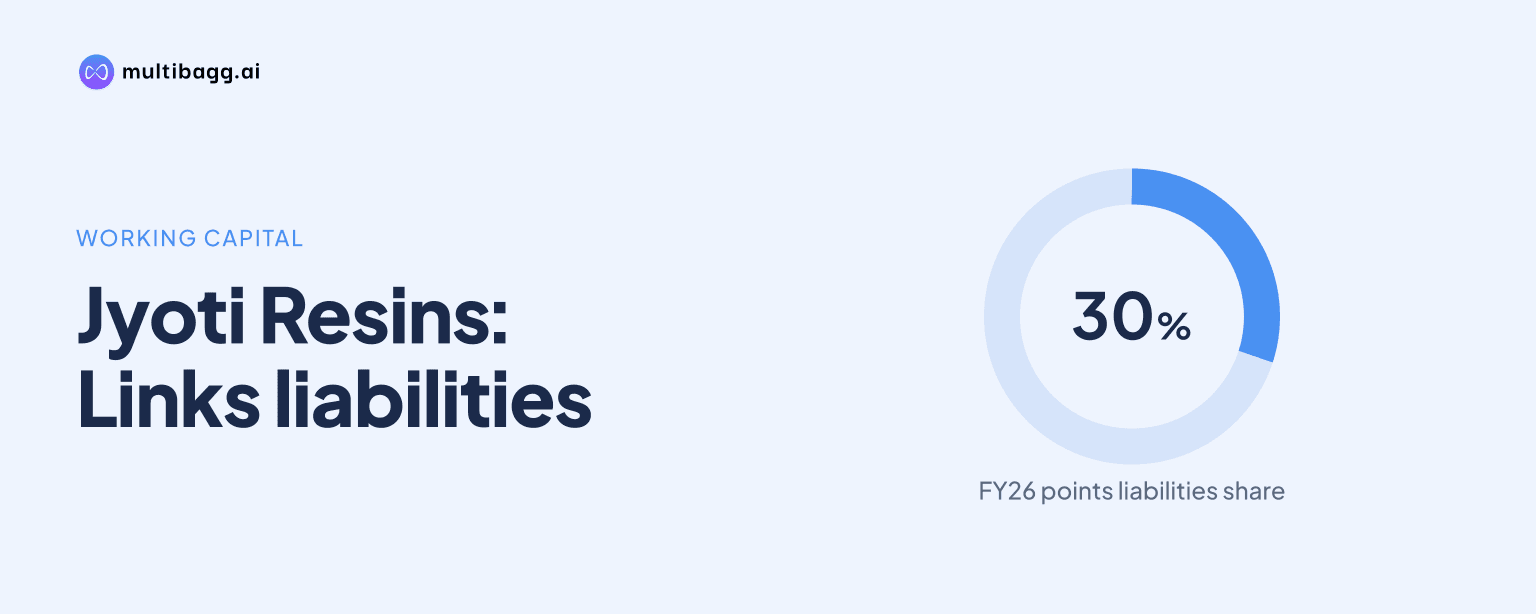
JYOTI RESINS AND ADHESIVES LTD says its carpenter redemption-point programme creates a negative working-capital-cycle advantage through liabilities for expenses, which were about 30% of FY26 revenue. Jyoti Resins links the mechanism to timely carpenter redemptions and reported FY26 return on capital employed of 35.5%, return on equity of 27.0% and investments plus cash of Rs 165.92 crore.
Know Jyoti Resins and Adhesives inside out
Results, valuation, peers and who's buying, in one view.
How does Jyoti Resins connect redemption points with working capital?
Jyoti Resins says redemption points are recorded as a liability for expenses, and that this liability creates a negative working-capital-cycle advantage. The presentation identifies the provision for redemption points as the mechanism behind its disciplined working-capital model, rather than attributing the effect to dealer credit, inventory or supplier terms.
The company’s long-term objective is to keep liabilities for expenses below 30% of revenue, while it described the FY26 level as about 30%. The loyalty programme therefore creates an obligation to provide benefits when points are redeemed, making cash availability relevant alongside the working-capital effect.
Jyoti Resins says its cash position keeps it ready for large-scale point redemptions as and when they are received. It states that timely honouring of carpenter benefits is a purpose of holding cash, rather than presenting the liability as funding with no corresponding redemption obligation.
Why are carpenters central to Jyoti Resins’ loyalty model?
Jyoti Resins identifies carpenters as end decision-makers because it says customers, contractors, architects and dealers follow carpenter preference. It reported 355,000 carpenters across 16 states, while a separate presentation page refers to a registered base of 212,000 active carpenters.
The company’s stated engagement model combines repeat usage, habit formation and growth in the active carpenter base. Jyoti Resins says this creates stickiness and pricing power, supported by on-ground programmes, meets and demonstrations for users of its Euro 7000 wood-adhesive products.
Its operating channel included 61 branches, 65 distributors, 14,000 retailers and an approximately 650-strong sales force. Jyoti Resins says the network supports prompt service, while its growth actions include continued dealer and carpenter meets and scaling the carpenter network.
What returns and margins did Jyoti Resins report in FY26?
Jyoti Resins reported FY26 return on capital employed, or ROCE, of 35.5% and return on equity, or ROE, of 27.0%, both calculated on an average basis. It also says ROCE and ROE have exceeded 25% over the last eight years, providing a comparison between the FY26 measures and its stated longer record.
The company reported sustained gross margins of more than 65% for the year and gave long-term guidance for earnings before interest, tax, depreciation and amortisation, or EBITDA, of 23% to 25%. Management describes the model as centred on premium products requiring low capital intensity, but the EBITDA range is guidance rather than a reported FY26 outcome.
Jyoti Resins says fixed-asset turnover could exceed 8 to 10 times after brownfield expansion. Its Santej, Ahmedabad plant capacity was increased from 1,000 tonnes per month to 3,500 tonnes per month, or 42,000 tonnes per annum, in October 2026, according to the presentation.
Got a follow-up? Ask IRIS
How has Jyoti Resins’ cash position changed?
Jyoti Resins reported investments, cash in hand and bank balance of Rs 165.92 crore in FY26, compared with Rs 154.49 crore in FY25. Its stated cash-and-investment measure was Rs 30.91 crore in FY23 and Rs 110.63 crore in FY24, showing that the largest increase in the disclosed period occurred before FY25.
The FY23-to-FY26 increase was Rs 135.01 crore, while the FY25-to-FY26 increase was Rs 11.43 crore. Jyoti Resins says the funds support point redemptions, brownfield and greenfield capital-expenditure plans, branding and marketing activities, and dividends.
The company reported an FY26 dividend payout ratio of 15.4%, with a dividend of Rs 9 per share, equal to 90% of face value. It also says it has continued to be net-debt negative since FY18.
What expansion plan supports Jyoti Resins’ carpenter engagement model?
Jyoti Resins plans to increase penetration and consumption per user in existing markets, expand state by state, scale its carpenter network and strengthen brand recall. The company says its top states contribute about 80% to 85% of revenue and that market share in those states ranges from 15% to 35%.
New regions take two to three years to reach break-even, according to the presentation. This distinguishes geographic expansion from established-state operations: the company has 16-state coverage, but new territories carry a disclosed period before reaching break-even.
Euro 7000 was launched in 2006, and Jyoti Resins describes it as among the top-selling white-glue brands in India’s retail segment. The listed product range includes Euro 7000 wood adhesive, WP 2in1 waterproof and fast-drying adhesive, and Euro 7000 PVC Glue.
Conclusion
Jyoti Resins presents redemption points as both a carpenter-engagement tool and an expense liability that supports a negative working-capital cycle. The model combines liabilities for expenses of about 30% of FY26 revenue with a 355,000-carpenter network and Rs 165.92 crore of investments, cash in hand and bank balance to meet redemption requirements.
What to watch next is whether management keeps liabilities for expenses below its long-term 30% revenue objective while funding promised redemptions. Other disclosed milestones are state-by-state expansion, where new regions take two to three years to break even, brownfield and greenfield capital-expenditure plans, and long-term EBITDA guidance of 23% to 25%.