










Kalyan Jewellers India Limited says 20% SSG signals volume
Key highlights
- Kalyan Jewellers said Q2 same-store growth exceeded 20% while gold-price inflation was in single digits.
- Kalyan Jewellers said the first 40 days of Q3 were excellent and included volume growth.
- Kalyan Jewellers said around 60% of business is wedding and wedding-related.
- Kalyan Jewellers planned four additional ATM showrooms in Tamil Nadu during the financial year.
powered by IRIS
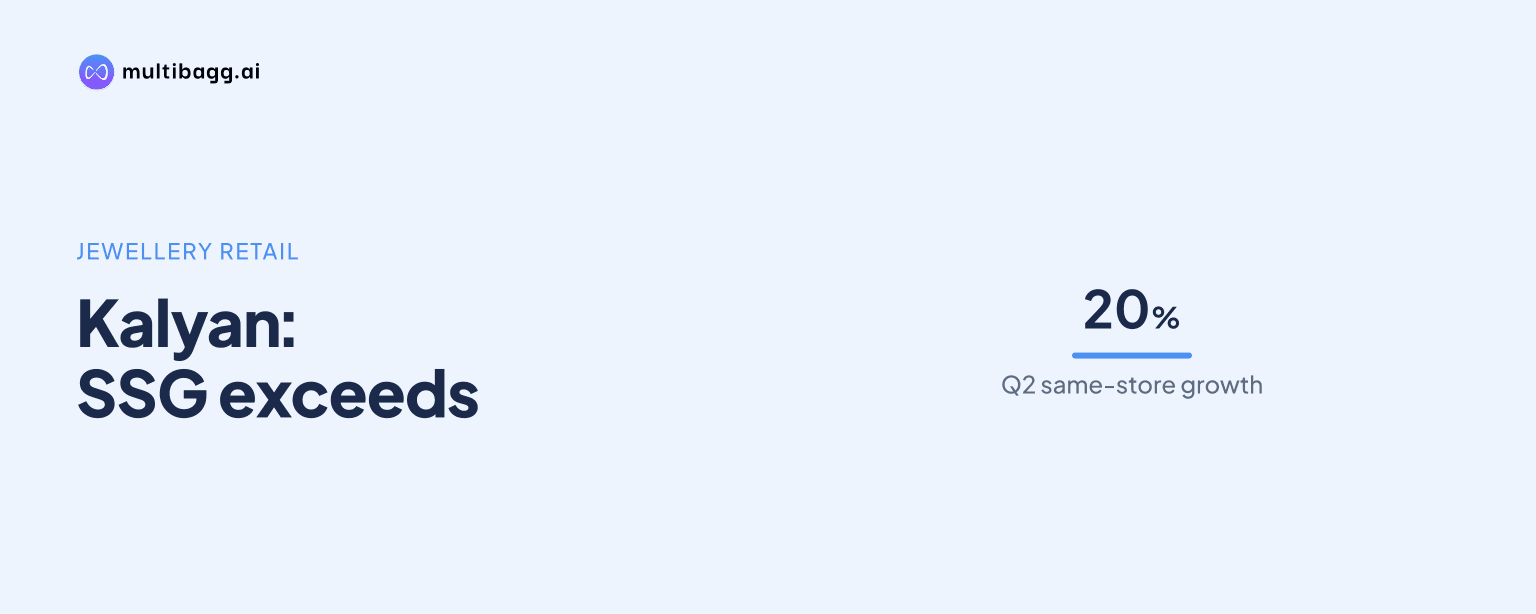
Kalyan Jewellers India Limited said Q2 same-store growth exceeded 20% while gold-price inflation was in single digits, indicating that jewellery volumes increased as customers maintained planned spending budgets. Kalyan Jewellers said the pattern continued through the first 40 days of Q3, when management described trading and volume growth as excellent.
Know Kalyan Jewellers India inside out
Results, valuation, peers and who's buying, in one view.
Why does Kalyan Jewellers see volume growth in Q2?
Kalyan Jewellers said Q2 volume growth is indicated by same-store growth, or SSG, above 20% against single-digit gold-price inflation. Management said that comparison showed that comparable-store sales were not driven only by a higher gold price, but also by customers buying more jewellery volume.
The mechanism cited by management is a fixed rupee spending budget. When gold prices are lower or inflation moderates, shoppers can buy a larger quantity of jewellery within the same budget. Kalyan Jewellers said this Q2 trend supported its confidence in Q3 and Q4 revenue momentum, although management did not issue new numerical revenue guidance.
Kalyan Jewellers said Q3 was running better than its earlier estimates, without disclosing sales for the first 40 days. Management also said Q4 has a stronger comparison base, while a heavier share of store inaugurations is planned for H2, or the second half, particularly Q4.
Are Kalyan Jewellers customers changing budgets as gold prices move?
Kalyan Jewellers said most customers retain a predetermined rupee budget despite gold-price changes. Management used purchase budgets of Rs 2 lakh, Rs 3 lakh and Rs 5 lakh to explain that buyers increasingly recall the amount spent rather than the number of sovereigns of gold purchased.
Under this behaviour, a lower gold price enables a shopper to buy more grammage for the same amount. Kalyan Jewellers said this pattern had continued in recent weeks, and linked it to Q2 SSG above 20% when gold-price inflation was single digit. The company did not disclose a separate grammage-growth percentage.
Management said sharp price volatility can delay a store visit, but wedding customers generally cannot postpone a purchase for long. It estimated that they may wait 15 to 20 days to assess gold-price direction, while about 60% of Kalyan Jewellers' business is related to weddings and wedding-linked purchases.
That mix means volatility may shift the timing of a sale rather than eliminate the occasion-led purchase. This is management's view of customer behaviour, not a forecast of quarterly sales, and it depends on wedding demand continuing to account for about 60% of business.
What is driving Kalyan Jewellers' studded jewellery demand?
Kalyan Jewellers said demand for studded jewellery reflects a multi-year shift in younger consumers' preferences rather than a recent response to gold-price movements. Management said these buyers are purchasing polki, uncut precious jewellery and diamonds alongside plain-gold products, with design taking greater importance.
The company said the migration from plain gold to studded jewellery has been visible for the last four to five years. Kalyan Jewellers added that it has increased studded-jewellery share in most existing showrooms, but it did not disclose the category's current share of sales or its revenue growth rate.
Management differentiated this preference shift from fixed-budget buying. A customer spending Rs 3 lakh can purchase more gold volume when prices moderate, while another customer may choose a design-led studded product. The transcript does not quantify either factor's contribution to Q2 SSG of more than 20%.
Kalyan Jewellers also said its sales are not primarily investment-led. Coin sales account for only a single-digit share of sales, according to management, and the company does not focus heavily on coins or bars. Its consumer commentary therefore relates mainly to ornament demand.
Got a follow-up? Ask IRIS
Is Kalyan Jewellers gaining share from organised jewellery retail?
Kalyan Jewellers said it is gaining market share, supported partly by a shift from unorganised to organised jewellery retail. Management said around 60% of the market remains unorganised, while younger consumers seek choice, service and transparency from organised retailers.
Management did not provide a market-share percentage or compare its sales with named competitors. It said Kalyan Jewellers competes with organised and semi-organised retailers as well as unorganised jewellers, and cited consistently strong SSG since the COVID period as support for its share-gain view.
The company said some price-sensitive consumers may continue to buy from unorganised retailers despite the broader channel shift. Management also said competitive intensity remains constant in jewellery retail, but did not disclose Q2 or Q3 discount rates, making-charge offers or promotional-spending changes.
A Tamil Nadu government-linked order for 1-gram gold coins on childbirth was described as small business-to-business revenue with thin margins. Kalyan Jewellers said the revenue had started but would not move the needle, and management positioned the arrangement as a brand-building activity.
How is Kalyan Jewellers preparing stores for further demand?
Kalyan Jewellers said it intends to use cash flow mainly to add inventory to existing showrooms where more stock could support higher SSG. Management also identified investments in a few flagship stores that had not been undertaken during the previous two to three years.
For its ATM format in Tamil Nadu, management said performance had exceeded expectations but withheld productivity metrics because they were competitively sensitive. Kalyan Jewellers planned four further ATM showrooms in the financial year, with two in the current quarter and two in the following quarter.
Management said it had no immediate plan to take ATM into another state because Tamil Nadu needs at least a couple of years to develop. The company said it was debt-free excluding gold-metal loans, or GML, and had sold one land parcel for Rs 86 crore to Rs 87 crore.
Kalyan Jewellers also said a further Rs 16 crore land transaction was under way and that the process to release the remaining 50% of land collateral had started. Management said it would provide a cash-flow plan for the next financial year shortly, without giving a date.
Conclusion
Kalyan Jewellers' central consumer-demand point is that fixed rupee budgets can produce higher jewellery volumes when gold-price inflation moderates. Q2 SSG above 20% against single-digit price inflation was management's main evidence, while wedding-linked demand of about 60% of business and the four-to-five-year shift toward studded designs provide separate supports.
The next developments to watch are the Q4-heavy store opening schedule, four planned ATM showrooms in Tamil Nadu and the cash-flow plan management said it would provide for the next financial year. Investors can also assess whether the excellent first 40 days of Q3 translate into disclosed comparable-store growth and whether added showroom inventory supports SSG.