










Kalyani Cast-Tech says innovations make up almost half order book
Key highlights
- Kalyani Cast-Tech said almost 50% of its Rs 133 crore FY27 order book comprises recent container innovations.
- Kalyani Cast-Tech expects its Rs 133 crore order book could rise to about Rs 170 crore.
- The Shivlakha facility has 10,000 TEUs of annual capacity and had manufactured 500 containers after production began in June.
- Kalyani Cast-Tech said its stainless-steel salt container can carry up to 33.5 tonnes.
powered by IRIS
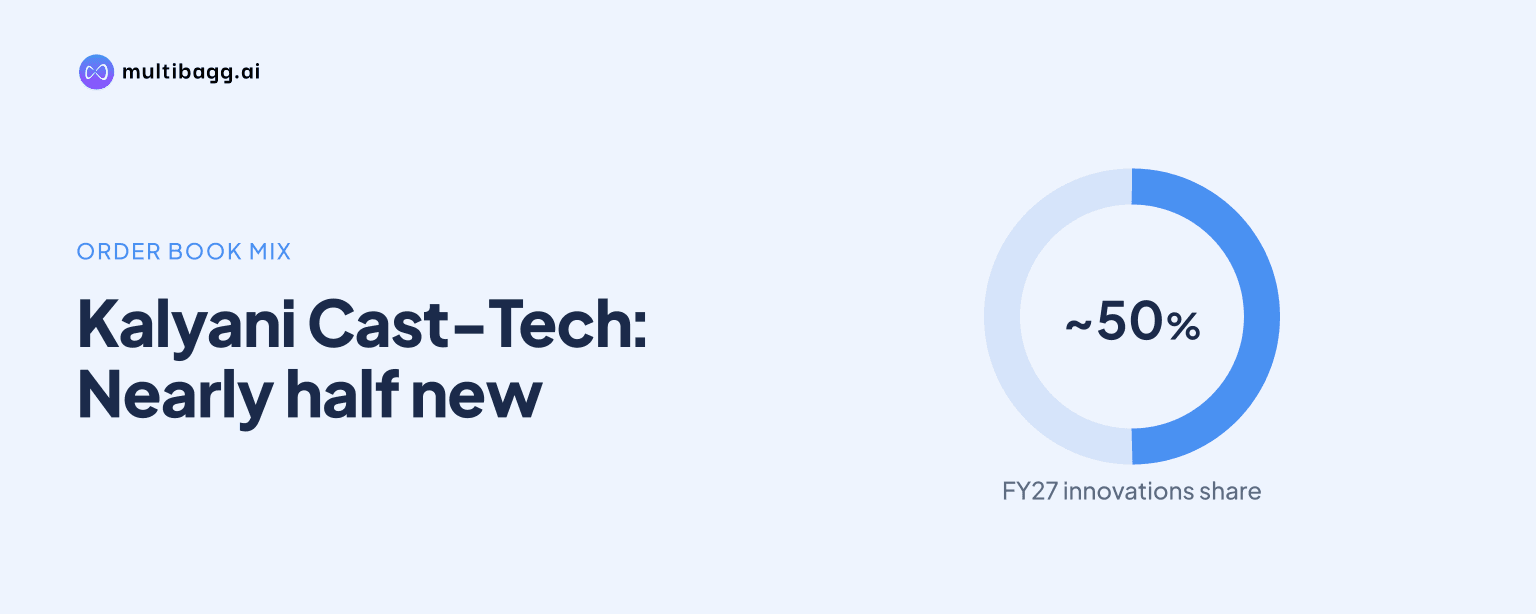
Kalyani Cast-Tech Limited said almost 50% of its Rs 133 crore FY27 order book consisted of container innovations developed in the preceding seven to nine months, making recently introduced specialised designs as significant as normal containers in booked demand. Management expects the order book to rise to about Rs 170 crore.
Know Kalyani Cast-Tech inside out
Results, valuation, peers and who's buying, in one view.
What share of Kalyani Cast-Tech’s order book comes from new container designs?
Kalyani Cast-Tech said almost 50% of its Rs 133 crore FY27 order book comprises innovations developed during the preceding seven to nine months, while normal containers account for the other 50%. Management linked this order mix to the commercial use of products developed during the recent innovation cycle.
The company did not disclose the rupee value, customer, delivery schedule or margin attached to each specialised-container order. Its expectation that the order book could reach about Rs 170 crore is management’s outlook while it negotiates further orders, rather than a confirmed order-book figure.
Management said the first half had not started as expected because of geopolitical uncertainty and supply-chain disruption, but it expected to catch up in the second half. The disclosed Rs 133 crore order book is therefore the central reported measure of demand available at the time of the Q2 FY27 call.
Which container designs are contributing to Kalyani Cast-Tech’s mix?
Kalyani Cast-Tech identified stainless-steel, wider open-roof, dwarf open-top and super high-cube containers among the designs changing its order mix. These products are intended for cargoes including salt, wheat, steel, cotton bales and two-wheelers, where management said standard containers can limit usable payload or volume.
For its stainless-steel container, Kalyani Cast-Tech said tare weight, meaning the empty container weight, was reduced from 6.5 tonnes to 4 tonnes. Management said the change allows 2.4 to 2.5 tonnes of additional payload, while the container can carry up to 33.5 tonnes of salt and has been tested in multiple conditions at the Ministry of Railways’ request.
The company said its wider 20-foot container, with an openable roof, carried up to 33 tonnes of wheat in a trial, compared with 26 to 27 tonnes in a normal container. Management calculated an increase of almost 27% and said it had already supplied almost 400 of these containers to various customers for cargoes including silica sand, salt, sponge iron and rock phosphate.
Kalyani Cast-Tech also described a 40-foot super high-cube container designed to carry 200 cotton bales, or about 34 tonnes, in two commercial lots of 100 bales each. Its triple-deck two-wheeler container was tested through a major manufacturer and is designed to carry 72 or 90 motorbikes and 84 scooters, depending on configuration.
Got a follow-up? Ask IRIS
How much container capacity does Kalyani Cast-Tech have?
Kalyani Cast-Tech said it has 17,000 twenty-foot equivalent units, or TEUs, of annual container-manufacturing capacity across its Rewari and Shivlakha facilities. Rewari in Haryana has 7,000 TEUs of capacity, while Shivlakha in Kutch, Gujarat, has 10,000 TEUs of capacity.
Rewari produced about 5,400 TEUs last year, which management described as utilisation of roughly 75% to 80% of its 7,000-TEU capacity. Shivlakha began production in June and had manufactured and delivered 500 containers by the call, adding a second operating base for the specialised products in the order book.
The Shivlakha location is part of a 144-acre platform that also includes planned wagon manufacturing and an Inland Container Depot, or ICD. Management said it received permission to construct and operate the ICD on September 10, 2026, and laid the warehouse foundation on September 14, with operations expected around the start of the next financial year.
What does the product shift mean for Kalyani Cast-Tech’s operations?
Kalyani Cast-Tech is using cargo-specific designs to address loading, corrosion, weight and empty-return requirements that management associates with standard containers. Its dwarf open-top design can carry steel slabs, steel coils, steel sheets and thermomechanically treated, or TMT, bars, while its foldable container is intended to reduce empty-direction costs by allowing units to be moved in multi-stacks.
Management compared FY25 with FY26 and said revenue rose about 7.7%, while profit after tax, or PAT, and earnings per share, or EPS, each increased about 20%. The company did not attribute the difference directly to specialised containers, but the comparison shows PAT and EPS increasing faster than revenue in that period.
The company also cited customer additions alongside its product development. Management said JSW Ports was a new customer and had received more than 1,000 containers, or around 1,500 containers, during the financial year, while Indian Navy and Central Warehousing Corporation were also new customers and the latter had recently placed orders worth almost Rs 30 crore.
Kalyani Cast-Tech said expansion spending has been funded through internal generation and warrants, while HDFC Bank has sanctioned debt of around Rs 100 crore. Management said no debt had been used so far, meaning the pace of further expansion will depend on demand, Shivlakha execution and decisions on drawing the sanctioned facility.
Conclusion
Kalyani Cast-Tech’s Rs 133 crore FY27 order book shows that recently developed container designs now account for almost half of booked demand, alongside normal containers. The mix includes products designed for higher wheat and salt payloads, corrosive cargo, steel, cotton bales and two-wheelers, supported by the June production start at Shivlakha.
The next measures to watch are whether the order book reaches management’s expected Rs 170 crore and whether the ICD starts operating around the beginning of the next financial year. Management also said it hoped to receive final approval for its wagon design by March 31, 2027, while any further container-capacity increase would depend in part on government scheme guidelines.