










Kalyani Cast-Tech sees 25%-30% EBITDA at terminals
Key highlights
- Kalyani expects ICD and trade-terminal EBITDA margins of around 25% to 30%.
- Kalyani expects container activity PAT margins of around 10% to 11%.
- Kalyani hopes its ICD and wagon factory will be operational in FY27 or FY28.
- Kalyani guided for FY27 revenue of around Rs 170 crore and reported an order book of around Rs 133 crore.
powered by IRIS
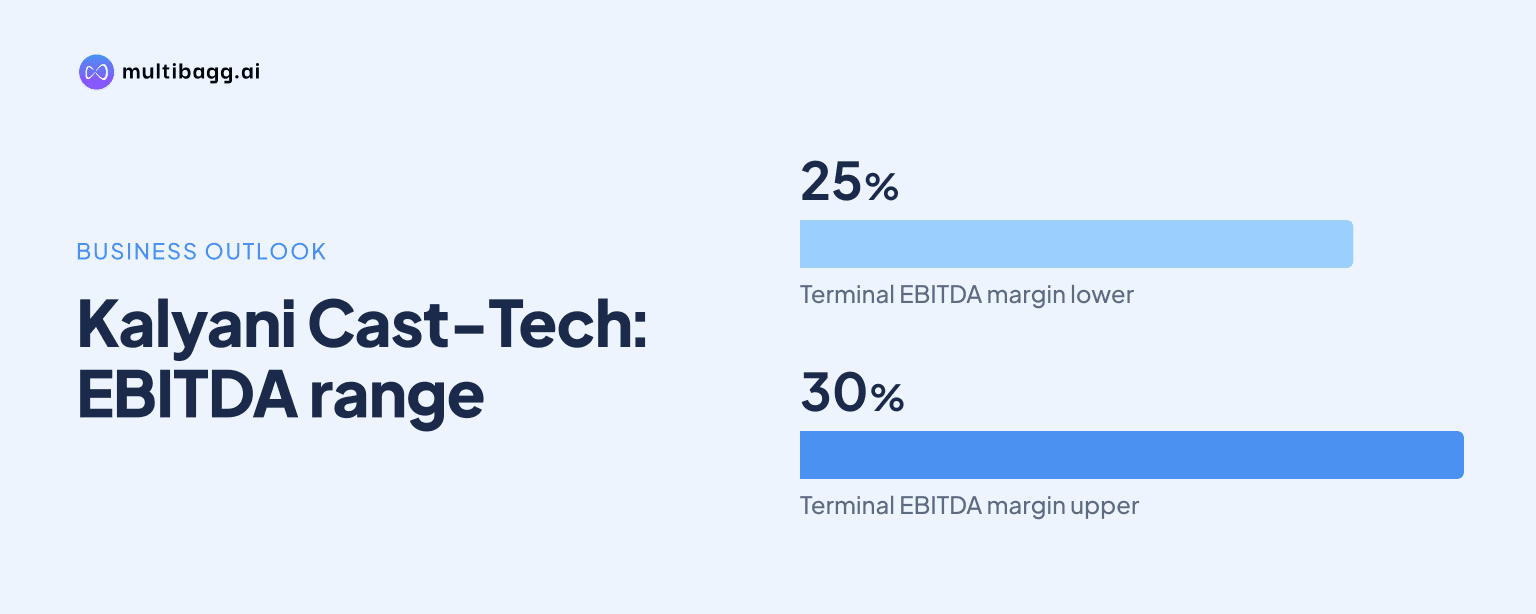
Kalyani Cast-Tech said its planned inland container depot, or ICD, and trade-terminal operations could deliver earnings before interest, tax, depreciation and amortisation, or EBITDA, margins of 25% to 30%, while container activity is expected to produce profit after tax, or PAT, margins of around 10% to 11%. Management hopes the ICD will become functional in FY27 or FY28.
Know Kalyani Cast-Tech inside out
Results, valuation, peers and who's buying, in one view.
Why does Kalyani expect higher margins from terminals?
Kalyani expects its ICD and trade-terminal operations to generate EBITDA margins of around 25% to 30%, according to Naresh Kumar’s answer to an investor question on future margins. He said these operations may not have a large top line, but their EBITDA could be higher than that of other activities in the planned manufacturing and logistics platform.
The terminal estimate is distinct from Kalyani’s container-manufacturing outlook. Kumar put container activity PAT margins at around 10% to 11% and said the business would not have a large PAT margin. The figures cannot be treated as a direct comparison because EBITDA excludes depreciation, interest and tax, whereas PAT includes those items.
Kalyani did not disclose anticipated terminal revenue, cargo throughput, tariff rates, operating costs, depreciation, interest expense or terminal PAT. The 25% to 30% range is therefore management’s operating-margin expectation, rather than a forecast of net profit or a basis for calculating a return on the planned ICD investment.
What services will Kalyani’s logistics platform provide?
Kalyani plans for the Shivlakha site in Kachchh to handle export-import cargo, domestic cargo and mineral movements. Management said export-import shipments could be customs cleared at the location, while domestic shippers could use specialised containers designed to load more cargo per container and reduce their unit transport cost.
The company cited silica sand as one intended cargo type. Management said open-hatch containers could move silica sand from its location or nearby areas to destinations across India, including Chennai. It also described the Gandhi Dham area as having substantial cargo traffic and said its aim is to shift long-distance truck movements to rail.
Kalyani’s logistics proposition depends in part on a container and wagon configuration intended to increase rail loading. Management said the configuration could carry 264 twenty-foot equivalent units, or TEUs, compared with 180 TEUs. A TEU is the standard volume measure equivalent to a 20-foot container; management said a 40-foot container equals 2 TEUs.
Management also said a wagon could carry two stacked 42-foot containers, equivalent by volume to 5.4 TEUs, while railway charges would apply for 3 TEUs. It said the configuration could reduce unit transport costs by 30% to 40%, but this is a management projection and not a reported operating outcome. The company also described capacity for 49 wagons instead of 45, an estimated 8% to 10% increase.
When could Kalyani’s ICD and wagon factory start operations?
Kalyani hopes the ICD and wagon factory will become operational in FY27 or FY28, subject to a possible variation of one or two months, according to management. Kumar described railway policy changes that allow more products to be moved in containers as an enabler for the ecosystem being developed at Shivlakha and Kachchh.
The wagon factory was ready when management spoke, but production required an audit and certification by the Research Designs and Standards Organisation, or RDSO. Kalyani said it had submitted its application and that the timing of RDSO’s inspection was outside its control. Management did not expect an inspection before Diwali because of the festive period.
The proposed wagon business has a different cost structure from terminal operations. Kumar said bought-out items would account for around 60% to 70% of wagon content, limiting Kalyani’s value addition. Management said it would discuss wagon margins after manufacturing begins, so it gave no EBITDA or PAT estimate for the 2,400-wagon annual manufacturing capacity it cited.
Kalyani said producing 2,000 wagons annually could generate more than Rs 1,000 crore of revenue. That statement is a capacity-based management projection, not FY27 or FY28 guidance. It does not establish when the plant could reach 2,000 wagons, what price it would realise per wagon, or what profit would result.
Got a follow-up? Ask IRIS
How will Kalyani fund the ICD and container expansion?
Kalyani said faster expansion of the ICD and container business will require significant capital expenditure. Management said earlier growth had been funded through internal surpluses and some promoter equity, but it is considering bank funding, a preferential share issue and potentially a rights issue for the next phase.
The company did not disclose the capex amount, debt terms, equity-raising timetable or intended funding mix. Management said it was keeping all options open, rather than committing to borrowing or an equity issue. It also said no anchor customer or large customer had shown interest in taking equity, and that Kalyani might not want such a tie-up.
Container capacity is linked to management’s reading of a government manufacturing-policy opportunity. Kalyani said its present capacity is around 17,000 TEUs and that it would need to expand to around 25,000 TEUs to qualify as a brownfield company. Management cautioned that the detailed government guidelines were not yet available, so it could not give a firm assessment of eligibility or benefits.
Kalyani said it had retained around 60 acres of land for a potentially larger container factory if a partner joined with assured offtake. The company’s Rewari facility was running at around 70% to 80% utilisation, while the Shivlakha facility had surplus capacity, according to management. That contrast indicates that near-term volume loading at Shivlakha remains part of the expansion task.
What do Kalyani’s current targets show about the revenue mix?
Kalyani guided for FY27 revenue of around Rs 170 crore, while citing an order book of around Rs 133 crore. Management said Rs 45 crore of the order book came from government customers and the balance from private customers, showing that private orders represented the larger disclosed portion of the book.
Management said government orders could yield a further Rs 10 crore to Rs 15 crore through a possible 30% extension provision after current orders are completed. That expectation depends on completing the existing orders and on the provision being applied. Kalyani also said its innovations do not fit government tendering as readily as private demand, while business associates of Container Corporation of India were among private-sector customers.
The terminal margin outlook therefore concerns an activity that may be smaller in revenue than manufacturing, based on Kumar’s statement that terminal top line may not be large. Container manufacturing, wagon production and logistics services would each have different economics: container PAT was guided at 10% to 11%, terminal EBITDA at 25% to 30%, and wagon margins were not disclosed.
Conclusion
Kalyani’s 25% to 30% terminal EBITDA outlook identifies the planned ICD and trade-terminal operations as the higher operating-margin component of its developing platform, while container manufacturing has a separate 10% to 11% PAT expectation. The distinction matters because the two ranges use different profit measures, and management has not provided revenue, cost or capital assumptions that would allow a like-for-like profitability comparison.
The next disclosures to watch are progress toward an ICD start in FY27 or FY28, RDSO audit and certification of the wagon factory, and detailed guidelines for the policy linked to 25,000 TEUs of container capacity. Management’s eventual choice among bank funding, preferential shares and a rights issue will also determine how it finances the required expansion capex.