










Kalyani Cast-Tech projects 30%-40% rail freight savings
Key highlights
- Kalyani Cast-Tech projects 264 TEUs of capacity on a proposed 49-wagon train, versus 180 TEUs in its cited comparison.
- Kalyani Cast-Tech says each proposed wagon could hold volume equivalent to 5.4 TEUs while railways would charge for 3 TEUs.
- Kalyani Cast-Tech has planned first-phase wagon manufacturing capacity of 2,400 wagons a year.
- Kalyani Cast-Tech cited an order book of about Rs 133 crore and expects it could reach about Rs 170 crore.
powered by IRIS
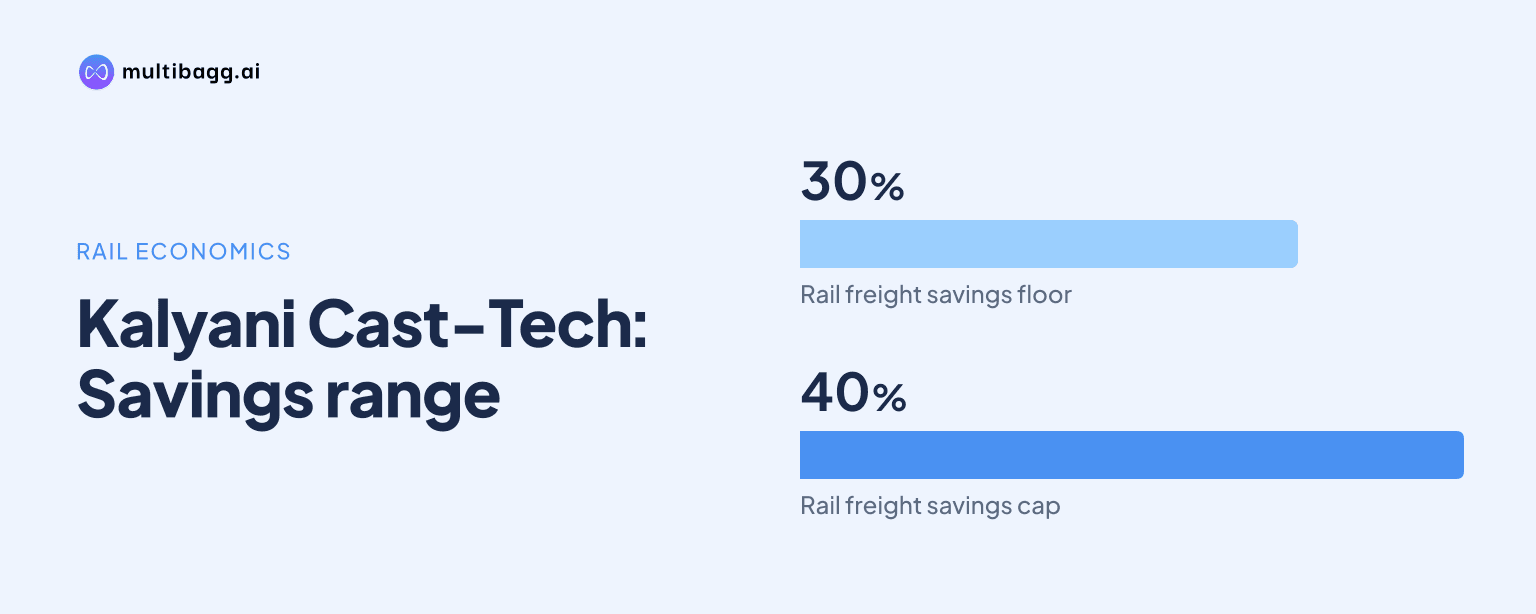
Kalyani Cast-Tech says its proposed container-wagon design could reduce rail freight unit costs by 30% to 40% by carrying 264 twenty-foot equivalent units, or TEUs, on a 49-wagon train versus 180 TEUs in its cited comparison. The estimate depends on final railway approvals, the stated charging structure and commercial adoption of the design.
Know Kalyani Cast-Tech inside out
Results, valuation, peers and who's buying, in one view.
How would Kalyani Cast-Tech’s wagon lower unit freight costs?
Kalyani Cast-Tech says the projected saving comes from loading more container volume while being charged for 3 TEUs per wagon. A TEU is a 20-foot equivalent unit. Management said a wagon carrying two double-stacked 42-foot containers would provide volume equivalent to 5.4 TEUs, leaving 2.4 TEUs of volume beyond its stated railway charging basis.
The proposed train would use 49 wagons instead of 45, which management said represents an 8% to 10% increase in wagon count. It calculates train capacity of 264 TEUs, compared with 180 TEUs for the cited existing configuration. The 30% to 40% unit-cost reduction is management’s projection from this loading and charging proposition, rather than a reported tariff change or operating result.
Kalyani Cast-Tech also said it reduced the wagon’s weight by 1.25 tonnes each and designed it around 42-foot rather than 40-foot containers. Management said the extra container length could accommodate cargo measuring 40 feet that may not fit practically into a standard 40-foot container. The design also provides for 10-foot containers, which management linked to potential parcel-cargo use.
What approvals does Kalyani Cast-Tech need before wagon production?
Kalyani Cast-Tech needs final approvals from the Research Designs and Standards Organisation, or RDSO, before it can manufacture the proposed wagon. The company said RDSO had granted stage-one clearance for its design, meaning management said the wagon parameters were within the railway system’s schedule of dimensions, but this is not final approval.
The company has also applied for an RDSO audit of its wagon factory and approval under the G-105 standard. Its first-phase facility has planned capacity of 2,400 wagons a year, but management said production can begin only after the required approval. Management said it hoped to receive final approval by March 31, 2027, while acknowledging that the inspection timetable is outside its control.
The proposal includes guard containers at both ends of a train in place of a conventional guard van. Management said this arrangement could avoid shunting a guard van when a train reverses direction at a terminal. This feature, the 49-wagon formation and the freight-cost estimate are all elements of a proposed design rather than disclosed in-service railway results.
Which specialised containers has Kalyani Cast-Tech developed?
Kalyani Cast-Tech has developed specialised containers for salt, wheat, cotton bales and two-wheelers, each intended to raise payload or expand rail cargo uses. Its stainless-steel salt container was tested for salt and other corrosive materials, including coal and soda ash, and management said it can hold up to 33.5 tonnes of salt. Indian Railways has given special rates for salt moved in these containers, according to management.
For wheat, Kalyani Cast-Tech said its wider 20-foot container with an openable roof carried up to 33 tonnes, compared with 26 to 27 tonnes in a normal container. Management described this as an increase of almost 27% while railway charges remain unchanged. It said it has supplied almost 400 of these containers for cargoes including silica sand, sponge iron, pig iron, cotton seed and rock phosphate.
A 40-foot super high-cube container developed for cotton bales can hold 200 bales, or around 34 tonnes, according to management. It said the configuration carries two standard lots of 100 bales. Kalyani Cast-Tech also said its triple-deck two-wheeler container can hold 72 or 90 motorbikes and 84 scooters, with a prototype tested through a major two-wheeler manufacturer.
Got a follow-up? Ask IRIS
How does the Shivlakha site support Kalyani Cast-Tech’s plans?
Kalyani Cast-Tech is developing an integrated manufacturing and logistics site at Shivlakha in Kutch on 144 acres, with potential expansion to 150 acres. The site combines container production, planned wagon production, a rail terminal, warehousing and an Inland Container Depot, or ICD, which can provide customs examination. Management received permission to construct and operate the ICD on September 10, 2026.
The Gati Shakti Cargo Terminal was inaugurated on September 15, 2026, after two full-length rail lines were commissioned. Management said the lines can handle two trains at a time and operate independently for cargo handling. It described the terminal as an enabler for its container and wagon operations and the ICD rather than a stand-alone business.
Warehouse construction began after a foundation ceremony on September 14, 2026. Management expects the ICD-related facility to be operational around the start of the next financial year. It also said the rail siding may require expansion within six to nine months, although it did not disclose terminal cargo volumes or contracted traffic.
What capacity, orders and funding has Kalyani Cast-Tech disclosed?
Kalyani Cast-Tech has stated container manufacturing capacity of about 7,000 TEUs at Rewari and 10,000 TEUs at Shivlakha, totalling around 17,000 TEUs. Rewari produced about 5,400 TEUs last year, which management said represented 75% to 80% utilisation. Shivlakha began production in June and had manufactured and delivered 500 containers at the time of the presentation.
Management cited an order book of around Rs 133 crore for the year and said it expected this could reach about Rs 170 crore as it negotiated additional container orders. About 50% of the order book comprised innovations developed in the preceding seven to nine months, management said, with normal containers making up the balance. It also said the first half had started below expectations amid geopolitical and supply-chain disruption, but it expected to catch up in the second half.
Kalyani Cast-Tech said it has funded expansion through internal generation, operating surplus and equity raised through warrants, without drawing debt so far. It has also received debt sanctions of about Rs 100 crore from HDFC Bank for use when required. On a reported Rs 10,000 crore container-manufacturing scheme, management said detailed government guidelines were awaited and it may need to raise capacity from 17,000 to 25,000 TEUs to qualify as a brownfield participant.
Conclusion
Kalyani Cast-Tech’s projected 30% to 40% rail-freight saving rests on a defined capacity comparison: 264 TEUs in its proposed 49-wagon train against 180 TEUs in the cited alternative. The concept combines a higher wagon count, 42-foot double-stacked containers and a stated charging basis of 3 TEUs per wagon despite volume equivalent to 5.4 TEUs.
The next disclosed milestones are the RDSO factory audit and final wagon approval, which management hoped to obtain by March 31, 2027, and the expected start of the ICD-related facility around the next financial year. Management’s order-book expectation of about Rs 170 crore, compared with Rs 133 crore currently cited, and any move toward 25,000 TEUs of container capacity are also developments to watch.