








Kaveri says fresh seed stock limits major write-off risk
MAX Plan at ₹4,999/yr

Find your next multibaggerBe a Pro Investor
Research stocks and track your picks on the go. Download the app.
Key highlights
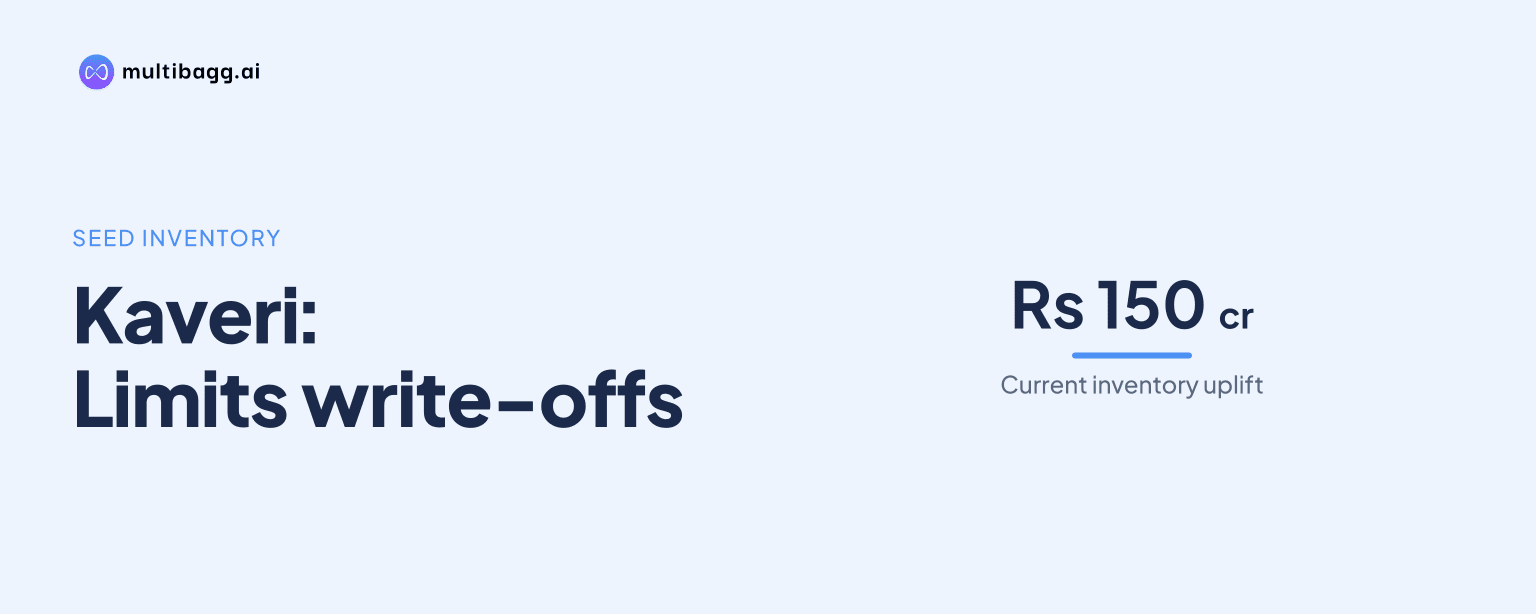
- Kaveri said inventory was roughly Rs 150 crore higher than the comparable prior-year level.
- Management said most current inventory was produced in the present financial year.
- Maize has a disclosed storage life of about 1.5 to 3 years, versus 3 to 5 years for cotton.
- Kaveri said it tests seed inventory every quarter and does not expect major write-offs.
powered by IRIS
Kaveri Seed Company Limited said on October 29, 2026 that it does not expect major inventory write-offs because most stock was produced in the current financial year, while maize, its principal inventory risk crop, has a storage life of about 1.5 to 3 years under its testing and storage process.
Know Kaveri Seed Company inside out
Results, valuation, peers and who's buying, in one view.
Why has Kaveri's seed inventory remained elevated?
Kaveri said inventory increased because production was higher than actual sales during a season that was weaker than management had anticipated. Management put the absolute inventory increase at roughly Rs 150 crore against the comparable prior-year level and said the cash-flow impact also reflected inventory of close to Rs 150 crore. It identified lower-than-expected sales, rather than ageing stock, as the immediate cause of the build-up.
Rice, cotton and maize make up the principal crop groups in the inventory discussion. Kaveri said it had stopped or curtailed production in some crops where supply was sufficient, but had not stopped maize production because it expects the available stock to be used in the next Kharif season. Kharif is India’s main monsoon crop season, while Rabi is the winter crop season.
Kaveri said most inventory across crops was newly produced in the current financial year. It added that maize inventory from the previous year was negligible because maize had been in short supply. This distinguishes the current working-capital build-up from a disclosed problem of seed becoming obsolete through age.
Is maize the main inventory risk for Kaveri?
Yes, Kaveri identified maize as the most delicate crop in its inventory, although management said it does not currently expect a major write-off. It said maize normally has a storage life of about 1.5 to 3 years, compared with 3 to 5 years for cotton. Rice can remain stored for more than 5 years, subject to the crop, seed variety and storage conditions.
Kaveri said its maize inventory was properly stored and had good germination and vigour at the October 29 call. Management said it tests inventory every quarter according to seed variety and inventory health. It also said seed quality had been maintained from post-harvest onward, supporting its view that substantial provisioning was not needed.
Maize is also central to management's demand assumptions for the next cycle. Kaveri said maize prices were already high and could indicate a supply shortage, though it did not provide a price figure or a formal demand forecast. Management said a positive next Kharif could support maize seed demand.
Weather remains relevant to that assumption. Kaveri said parts of combined Andhra Pradesh, Maharashtra and Karnataka had not received rain in the second half when the call took place, limiting expectations of a near-term positive response in maize sales. It nevertheless said the next Kharif looked favourable and did not expect current maize stock to become unusable before then.
Got a follow-up? Ask IRIS
How long can Kaveri store rice, cotton and maize seed?
Kaveri said rice can be stored for more than 5 years, cotton for 3 to 5 years and maize for about 1.5 to 3 years. Management described these as broad storage ranges, not unconditional guarantees, because inventory health depends on the specific seed variety, storage facilities and testing results.
The shorter maize storage range explains why management focused on that crop even while saying rice and cotton were not causes for concern. Kaveri said cotton and rice inventory could be used in future Kharif or Rabi demand, depending on the crop and seasonal requirements. Maize, by contrast, requires closer monitoring because it has the shortest disclosed storage period.
Kaveri said the inventory review is continuous, with testing carried out every quarter. It did not say every seed can be retained for the maximum stated duration. Instead, management said it assesses viability by variety and condition, with current germination and vigour results underpinning its expectation of no major write-offs.
Will Kaveri's inventory create a major write-off or margin hit?
Kaveri said it does not see any major inventory write-offs and expects any write-offs to remain in line with normal levels. Management based this expectation on the freshness of the inventory, storage infrastructure and current seed-quality results. The statement is management's assessment, rather than a quantified provisioning target.
Kaveri said the inventory should be used in the next Kharif season and, in some cases, during Rabi. For maize, management said it retained production because it expects next Kharif demand to absorb the stock. It added that a lack of maize sales in Rabi would not itself mean deterioration if the seed could be sold in the following cycle.
The company also linked first-half profitability to factors beyond inventory provisioning. On a standalone basis, Kaveri said earnings before interest, tax, depreciation and amortisation, or EBITDA, margin was 30.48%, compared with 30.32% on a half-on-half basis. Consolidated EBITDA margin was 29.85%, compared with 30.8%, with management citing subsidiary expenses and lower other income.
Management said it maintained EBITDA margin despite lower first-half revenue and expected margins to remain similar or improve if sales traction continued. It cited exports and the northern cotton market, which it said arrives in the fourth quarter, as potential supports. It did not provide a full-year margin target, leaving future Kharif demand and seed-quality testing central to the inventory outcome.
Conclusion
Kaveri's explanation is that elevated inventory is primarily fresh, saleable seed accumulated after production exceeded weaker-than-expected sales, rather than a large pool of ageing or impaired stock. The roughly Rs 150 crore increase therefore reflects working-capital timing, while maize requires the closest monitoring because its 1.5-to-3-year storage window is shorter than cotton's 3-to-5-year range and rice's more-than-five-year range.
The next issue to watch is demand in the coming Kharif season, particularly for maize, alongside rainfall and water availability in Karnataka, Andhra Pradesh, Telangana and Maharashtra. Management said it tests seed inventory quarterly, expects present stocks to serve the next Kharif and potentially Rabi, and sees no major write-offs at present; future test results and seasonal sales will determine whether that expectation holds.

