








NOCIL Targets Q3 TDQ Capitalisation, Rs 3 Crore Depreciation
Max Plan at ₹4,999/yr₹8,999

Find your next multibaggerBe a Pro Investor
Research stocks and track your picks on the go. Download the app.
Key highlights
- NOCIL hopes to capitalise Dahej TDQ in Q3 FY27 after pending customer approvals.
- Management estimates the Rs 220 crore TDQ asset could add about Rs 3 crore of quarterly depreciation.
- NOCIL reported Q2 FY27 revenue of Rs 427 crore and EBITDA of Rs 36 crore.
- NOCIL retained FY27 revenue guidance of Rs 1,400 crore to Rs 1,600 crore with EBITDA margins of around 10%.
powered by IRIS
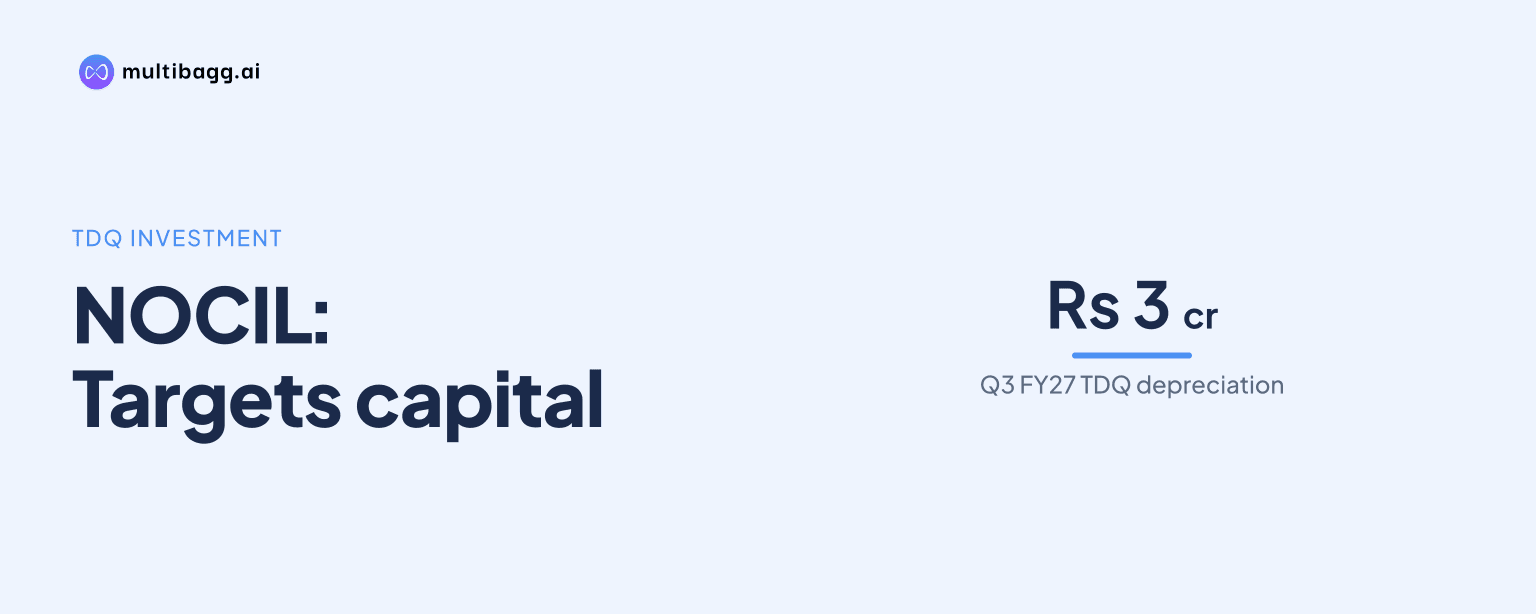
NOCIL Limited hopes to capitalise its Dahej TDQ expansion in Q3 FY27 once pending customer approvals arrive, which would introduce an estimated Rs 3 crore quarterly depreciation charge on a Rs 220 crore asset. Management said on October 30, 2026 that customer approvals were the condition for capitalisation.
Know NOCIL inside out
Results, valuation, peers and who's buying, in one view.
When will NOCIL capitalise the Dahej TDQ expansion?
NOCIL hopes to capitalise the Dahej TDQ expansion during Q3 FY27 after it receives pending customer approvals. Chief Financial Officer P. Srinivasan gave this timetable during the October 30, 2026 Q2 FY27 earnings call, after an analyst noted that the presentation had described the project as delivered ahead of schedule but not capitalised.
The timing is not a fixed Q3 FY27 commitment because management used the word “hopefully” and made approval receipt the prerequisite. Managing Director V. S. Anand had said earlier in the call that the brownfield TDQ expansion at Dahej was progressing towards customer approvals expected over the coming months. NOCIL did not disclose the number of customers involved, the outstanding approvals, or a specific date within Q3 FY27.
Customer acceptance therefore remains the disclosed near-term operational milestone for the Rs 220 crore investment. The call did not state the TDQ plant’s capacity, product mix, initial utilisation, customer volumes or sales contribution, so the financial effect that can be identified from the transcript is the expected depreciation following capitalisation.
How much depreciation would Dahej TDQ add?
NOCIL estimated that the Dahej TDQ asset could carry depreciation of about Rs 1 crore a month, or Rs 3 crore a quarter, after capitalisation. Mr. Srinivasan linked that estimate to the Rs 220 crore investment and did not present it as depreciation already booked in Q2 FY27.
The actual Q3 FY27 charge could depend on when capitalisation occurs within the quarter, because management did not give a date for approval completion. NOCIL also did not disclose the useful life, depreciation method, residual value or whether the full Rs 220 crore would be capitalised at one point. The Rs 3 crore quarterly figure is consequently management’s broad estimate rather than a reported accounting charge.
Depreciation is separate from earnings before interest, tax, depreciation and amortisation, or EBITDA. Accordingly, the estimated Rs 3 crore quarterly TDQ charge would not directly change EBITDA, but it could affect profit before tax and profit after tax after capitalisation. NOCIL reported Q2 FY27 profit before tax of Rs 28 crore and profit after tax of Rs 24 crore.
What was NOCIL’s earnings base before TDQ capitalisation?
NOCIL reported Q2 FY27 revenue from operations of Rs 427 crore, EBITDA of Rs 36 crore and an EBITDA margin of 8.4% before the expected TDQ depreciation began. Revenue increased 33% year on year and 6% sequentially, while EBITDA rose 61% year on year but declined 20% from Q1 FY27.
The sequential movement shows that higher revenue did not translate into higher quarterly EBITDA in Q2 FY27. Management said volumes fell 3% year on year and 7% sequentially because of temporary supply-side constraints and logistics challenges, while an increase in average selling prices supported the 33% revenue growth.
For H1 FY27, NOCIL reported revenue of Rs 830 crore, EBITDA of Rs 81 crore and an EBITDA margin of 9.8%. The chief financial officer said H1 revenue grew 36% year on year, EBITDA grew 54%, profit before tax rose 57% to Rs 65 crore and profit after tax increased 76% to Rs 52 crore.
The proposed TDQ depreciation would enter profit measures after a first half in which profit growth exceeded revenue growth. However, the call provides no basis to calculate the post-capitalisation impact on profit after tax because it does not disclose the applicable tax effect, TDQ revenue, incremental gross margin or other costs associated with the project.
Got a follow-up? Ask IRIS
What could offset the new TDQ depreciation in H2 FY27?
NOCIL said the supply-side constraints affecting Q2 FY27 had been addressed and that production volumes should start recovering in the second half. Management also said benefits from captive-power boilers should start contributing in H2 FY27, while fuller turbine utilisation is expected as volumes increase in the coming months.
Management retained its FY27 revenue range of Rs 1,400 crore to Rs 1,600 crore and said it expected to close towards the upper end, with EBITDA margins of around 10%. It also said it remained positive about achieving FY27 volume growth of 8% to 10%, supported by domestic and international markets. These are management expectations rather than reported results.
Management’s second-half volume indication was an index of 160 to 165, using Q1 FY20 volume as the base of 100, compared with a Q2 FY27 index of 135. The intended improvement is important because higher output could raise utilisation of existing assets and the captive-power equipment, but the call did not quantify how much of the volume recovery would come from Dahej TDQ.
Cost conditions remain another variable for H2 FY27. NOCIL said coal, gas and sea-freight expenses had increased during the first half and had raised conversion costs, while geopolitical conditions affected logistics. Management also said it saw a marginal pricing uptick in Q3 FY27, without providing a numerical forecast for raw-material costs, freight or TDQ pricing.
Did NOCIL disclose the Dahej TDQ return or duty protection?
NOCIL did not disclose a revenue target, margin target, payback period, utilisation plan or return estimate for Dahej TDQ. An analyst asked what return the plant could earn without antidumping-duty protection, but management answered the questions on capitalisation timing and depreciation rather than the project-return question.
The call did address antidumping-duty developments for other products, but did not connect them to a Dahej TDQ return case. Management said the antidumping-duty recommendation for PILFLEX-13 had not been notified or accepted by the Central government, while 4ADPA is an intermediate precursor to PILFLEX-13. It said a potential duty on 4ADPA could raise other domestic producers’ costs, although PILFLEX-13 imports would remain outside the antidumping zone.
Management also said antioxidants account for 60% of NOCIL’s business and that the antidumping duty on sulfonamides was not significant across the overall product basket. While it acknowledged some contribution from that duty in Q2 FY27, it could not quantify it. That leaves no disclosed assumption on TDQ pricing, protection or returns following Q3 FY27 capitalisation.
Conclusion
NOCIL’s Dahej TDQ expansion is an approval-dependent Q3 FY27 event rather than a completed accounting event. Customer approvals would allow capitalisation of the Rs 220 crore asset and introduce an estimated Rs 3 crore quarterly depreciation charge, while Q2 FY27 EBITDA was Rs 36 crore and profit before tax was Rs 28 crore.
The next item to watch is confirmation that approvals have been received and the amount of depreciation booked in Q3 FY27. Management’s wider plan depends on recovering volumes in H2 FY27, obtaining captive-power benefits as utilisation rises, and closing FY27 towards the upper end of its Rs 1,400 crore to Rs 1,600 crore revenue range with EBITDA margins of around 10%.

