








NOCIL targets 8-10% FY27 volume growth, backs FY28 at 10%
Max Plan at ₹4,999/yr₹8,999

Find your next multibaggerBe a Pro Investor
Research stocks and track your picks on the go. Download the app.
Key highlights
- NOCIL expects FY27 volume growth of 8% to 10% and indicated an H2FY27 volume index of 160 to 165.
- NOCIL reported a Q2FY27 volume index of 135, with volumes down 3% year on year and 7% sequentially.
- NOCIL management said roughly 10% FY28 volume growth is a fair assumption if the H2FY27 index objective is met.
- NOCIL retained FY27 revenue guidance of Rs 1,400 crore to Rs 1,600 crore and EBITDA-margin guidance of around 10%.
powered by IRIS
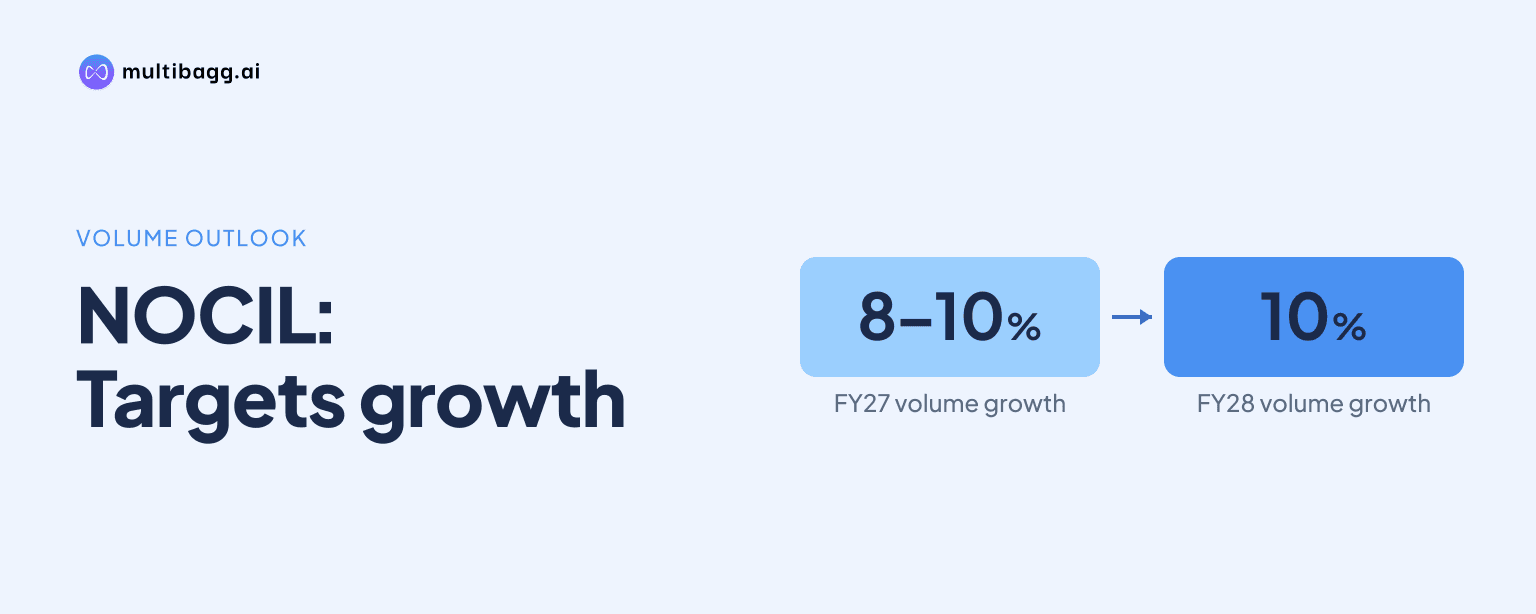
NOCIL Limited expects 8% to 10% volume growth in FY27 and indicated an H2FY27 volume index of 160 to 165, compared with 135 in Q2FY27. Management said on October 30, 2026 that roughly 10% FY28 volume growth was a fair assumption if the second-half index objective is achieved.
Know NOCIL inside out
Results, valuation, peers and who's buying, in one view.
Can NOCIL deliver 8-10% volume growth in FY27?
NOCIL said it remains positive about delivering 8% to 10% volume growth in FY27, despite reporting only 3% volume growth in H1FY27. Managing Director V. S. Anand said the H2FY27 volume index should be at least in the 160 range, specifying a range of 160 to 165, with Q1FY20 set as the base of 100.
The H2FY27 index indication is 25 to 30 points above the Q2FY27 index of 135. Q2FY27 volumes declined 3% year on year and 7% sequentially because of temporary supply-side constraints and logistical issues associated with the geopolitical situation, according to management.
NOCIL said the operational constraints affecting volumes had been addressed by the October 30 call, and production volumes should begin increasing in the coming months. The company had identified power issues in Q1FY27 and shipping, supply and logistics constraints in Q2FY27 as factors limiting normal operating leverage.
What will drive NOCIL's H2FY27 volume recovery?
NOCIL expects H2FY27 growth to come from both domestic and international markets. Domestic and export volumes each recorded single-digit growth in H1FY27, while management said overseas customer engagements were being converted into business opportunities.
Domestic tyre demand benefited from consumption tailwinds after GST 2.0, according to NOCIL. The company also cited replacement demand and original equipment manufacturer, or OEM, volumes as longer-term industry supports, although it said a weaker monsoon and inflationary pressure could weigh on near-term demand.
International opportunities are intended to mitigate softer tyre-market expectations rather than produce a sharp mix shift. An analyst said some credit-rating agencies had reduced projected tyre-volume growth to 4% to 5% from 8%; Anand responded that NOCIL had factored this moderation into its planning but still saw international opportunities progressing.
NOCIL said the proportion of specialised rubber chemicals within international volumes should remain in similar ratios, without a significant increase. That means the 160 to 165 H2FY27 index indication is based on broader domestic and export execution, rather than a disclosed assumption of a major product-mix change.
Does NOCIL expect 10% volume growth in FY28?
NOCIL management said about 10% FY28 volume growth is a fair assumption if the H2FY27 index objective is met. The comment responded to an analyst's calculation that an H2FY27 index of 160 to 165 would mathematically support 10% growth in FY28.
This was not a separately stated FY28 revenue or profitability forecast. NOCIL gave explicit FY27 financial guidance of Rs 1,400 crore to Rs 1,600 crore in revenue and EBITDA, or earnings before interest, tax, depreciation and amortisation, margin of around 10%, while its FY28 comment addressed volume growth only.
Management said it remained confident of finishing FY27 toward the upper end of the Rs 1,400 crore to Rs 1,600 crore revenue range. That confidence reflects H1FY27 revenue from operations of Rs 830 crore and the anticipated second-half recovery, but it remains subject to evolving market, cost and logistics conditions.
Got a follow-up? Ask IRIS
How did NOCIL perform in H1FY27 and Q2FY27?
NOCIL reported H1FY27 revenue from operations of Rs 830 crore, EBITDA of Rs 81 crore and profit after tax, or PAT, of Rs 52 crore. EBITDA rose 54% year on year and the EBITDA margin was 9.8%, compared with Rs 36 crore of EBITDA and an 8.4% margin in Q2FY27.
The transcript contains two year-on-year revenue growth figures for H1FY27: Anand cited 26% in his opening remarks, while Chief Financial Officer P. Srinivasan cited 36% in the financial review. NOCIL did not reconcile the difference during the October 30 call, although both speakers reported H1FY27 revenue of Rs 830 crore.
Q2FY27 revenue from operations increased 33% year on year and 6% sequentially to Rs 427 crore, primarily because of higher average selling prices. In contrast, Q2FY27 PAT of Rs 24 crore rose 98% year on year but fell 13% sequentially, while volume constraints reduced output during the quarter.
What costs and projects could affect NOCIL's outlook?
NOCIL said coal, gas, domestic freight and sea-freight costs increased during H1FY27, raising conversion costs. An analyst cited an increase of Rs 10 to Rs 20 per kilogram in conversion costs, while management did not provide a numerical cost forecast or a timetable for freight normalisation.
Management said the benefits of captive-power boilers should start contributing in H2FY27. It also said fuller turbine utilisation would occur as output rises in the coming months, linking the utility benefit to recovery in production volumes rather than setting a quantified savings target.
NOCIL's brownfield TDQ expansion at Dahej is awaiting customer approvals before capitalisation, which management hopes will occur in Q3FY27. The company said the project has an annual depreciation base of about Rs 220 crore, translating into depreciation of approximately Rs 1 crore a month or Rs 3 crore a quarter.
The integrated specialty rubber chemicals project is progressing as planned, but NOCIL disclosed no capacity addition or commissioning date on the call. On competition, management said antioxidants account for 60% of its business and that anti-dumping duty benefits on sulfonamides were not significant across the overall product basket.
Conclusion
NOCIL's FY27 outlook depends on restoring volumes after Q1FY27 power issues and Q2FY27 supply and logistics constraints, while converting opportunities in domestic and export markets. The 160 to 165 H2FY27 volume-index indication, against 135 in Q2FY27, underpins management's 8% to 10% FY27 growth expectation and its view that around 10% FY28 volume growth is a fair assumption.
The next disclosures to watch are progress toward the 160 to 165 H2FY27 index range, use of captive-power and turbine capacity as production rises, and customer approvals for TDQ capitalisation in Q3FY27. NOCIL also expects the outcome of the 4ADPA anti-dumping-duty matter to become clearer after about three months, while it aims to close FY27 toward the upper end of Rs 1,400 crore to Rs 1,600 crore revenue guidance with EBITDA margin around 10%.

