








Kaveri says new hybrids can double cotton sales to Rs 500 crore
MAX Plan at ₹4,999/yr

Find your next multibaggerBe a Pro Investor
Research stocks and track your picks on the go. Download the app.
Key highlights
- Kaveri management said cotton sales could rise from about Rs 250 crore to Rs 500 crore in 3-4 years.
- New hybrids account for more than 50% of Kaveri's current cotton sales, with management targeting an 80%-90% share.
- Kaveri reported new-product contribution to cotton sales of 37.7%, up from 21.4% in the comparable earlier period.
- First-half cotton revenue was Rs 222 crore versus Rs 224 crore a year earlier, while second-quarter new cotton-product revenue grew 41.7%.
powered by IRIS
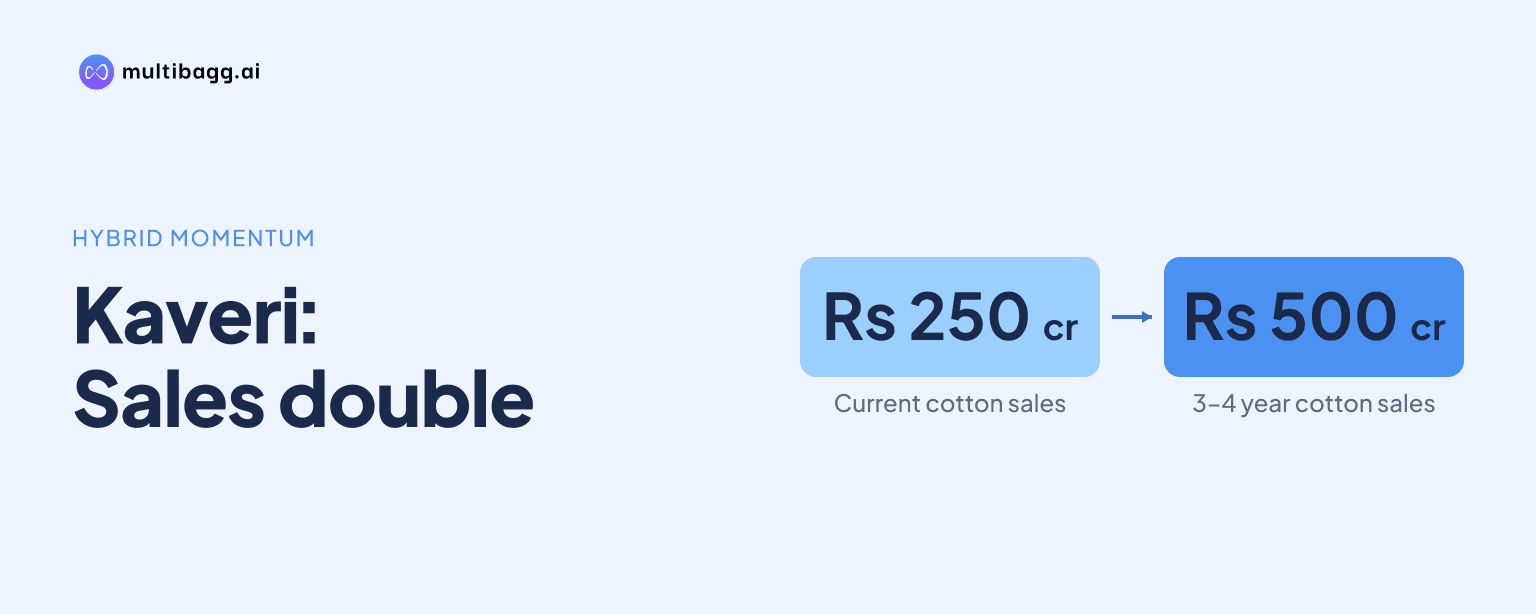
Kaveri Seed Company Limited said on October 29, 2026, that new cotton hybrids could raise cotton sales from about Rs 250 crore to Rs 500 crore in three to four years. Management said the plan relies on newer products replacing ageing hybrids, even as illegal cotton-seed sales pressure the market.
Know Kaveri Seed Company inside out
Results, valuation, peers and who's buying, in one view.
How does Kaveri plan to double cotton sales?
Kaveri plans to pursue Rs 500 crore of cotton sales through portfolio renewal rather than depending on a broad increase in cotton acreage. Management said the current cotton business was about Rs 250 crore and that the incremental sales over the next three to four years should come from new hybrids. It presented the Rs 500 crore figure as a management aspiration linked to product launches and replacement of older products.
Management said the current hybrid portfolio has been built over the previous two to four years, although weak monsoons delayed commercial progress by roughly one to one-and-a-half years. It said the hybrids launched during that period were now performing well in the market. Kaveri expects the newer products to sustain volumes and then expand sales as their acceptance increases.
The company said introducing a hybrid takes time because it must gain farmer acceptance before scaling commercially. Management described its portfolio work as an advance investment in products, arguing that its newer hybrids should perform better than the ageing portfolio over the next three to four years. That makes product adoption, rather than an assumed rise in acreage, the central mechanism behind the target.
What has changed in Kaveri's cotton portfolio?
Kaveri said more than 50% of its current cotton sales come from new hybrids, and management expects new hybrids to account for 80%-90% of sales in the next three to four years. The company said the change in mix is already under way, with newer products progressively taking the place of older hybrids as those products lose relevance in the market.
In its operational update, Kaveri said new products contributed 37.7% of cotton sales, compared with 21.4% in the comparable earlier period. The difference between that operating metric and management's statement that new hybrids comprise more than 50% of current cotton sales was not explained on the call. Both disclosures point to a rising contribution from recently launched products.
Management said older products fade as new technologies and hybrid offerings enter the market. It estimated that Rs 25 crore to Rs 50 crore of cotton portfolio sales had gone off the shelf as older products aged. Kaveri's strategy is therefore not simply to preserve that revenue, but to replace it with products designed for segments, geographies and applications where it had less presence previously.
Kaveri said the new portfolio can produce a positive sales trend even if total cotton acreage remains broadly flat. Management said cotton acreage was largely flat, but that certain segments receiving newer products were growing. Its argument is that market-share gains for newer hybrids can offset the loss of sales from ageing products without requiring a uniform expansion in planted area.
How is illegal cotton seed affecting Kaveri?
Kaveri said illegal cotton-seed sales were increasing year on year and were putting pressure on legal seed companies, particularly through market-share losses in older hybrids. Management said the issue had persisted for roughly 15 to 16 years since the relevant technology entered the market, but described the current increase in illegal product availability as a continuing challenge.
Management said Kaveri had not seen a major direct impact on its business so far, while acknowledging that illegal seed was gaining ground in a difficult market. It said the company's response was to maintain volumes through new hybrids, especially in northern markets, and seek growth in central and southern markets where it reported stronger product performance.
Kaveri also said the government was taking steps to control illegal cotton-seed sales, but management did not provide an enforcement target or timeline. It noted that smaller players continued to enter the market. The company therefore linked its ability to protect or increase market share primarily to hybrid performance and farmer acceptance, rather than to a forecast of regulatory action.
The pressure is most relevant to the older portfolio because management said new hybrids offer a way to retain market share when farmers compare products. Kaveri said the decline of older hybrids, together with illegal seed availability, was one reason for the portfolio reset. The Rs 500 crore aspiration consequently depends on new launches gaining sales faster than older products and illegal alternatives erode them.
Got a follow-up? Ask IRIS
What do the latest cotton figures show for Kaveri?
Kaveri reported first-half cotton revenue of Rs 222 crore, compared with Rs 224 crore a year earlier, a decline of 1.3%. Management attributed the broader first-half weakness to deficient rainfall and delayed monsoon conditions, with Karnataka identified as a significant source of pressure on crop sowing and sales conditions.
The company nevertheless said new cotton products supported a recovery in the second quarter. Kaveri reported that revenue from new cotton products grew 41.7% in that quarter, while the share of new products in cotton sales increased to 37.7% from 21.4%. The comparison shows that the newer portfolio grew even though reported first-half cotton revenue was slightly below the prior-year level.
Management said it had built a foundation in Haryana, Punjab and Rajasthan, while new products were contributing in central and southern markets. It said the northern segment was important for maintaining volumes, whereas central and southern areas offered a route to expand sales from the new portfolio. The call did not disclose cotton revenue separately for each region.
Weather remains an external variable in the strategy. Management said lower rainfall affected first-half sales and sowing, while the second-quarter recovery gave it confidence in the product portfolio. Kaveri did not set a cotton-acreage target for the next season, so future evidence will depend on the commercial performance of the hybrids under actual rainfall and planting conditions.
Can Kaveri reach Rs 500 crore without higher cotton acreage?
Management said it believes Kaveri can reach Rs 500 crore in cotton sales even if overall acreage does not materially increase, because the anticipated growth is product-led. It said 85%-90% of the portfolio in the next three to four years should consist of new products, compared with the greater role older hybrids played in the past.
The strategy relies on a transition in which older products are phased out and new hybrids gain the resulting market share. Management said the incremental growth should be from new hybrids only, not older products. It also said the newer portfolio had been developed to address areas where Kaveri previously did not have products, creating a potential source of sales beyond replacement demand.
The target still has execution risks disclosed on the call. Management said farmers must accept a hybrid for it to scale, competition includes both domestic and multinational companies, and illegal seed remains a market-share issue. It also said weather delayed launches by one to one-and-a-half years, showing that the timing of portfolio conversion can be affected by seasonal conditions.
Conclusion
Kaveri's stated route to Rs 500 crore of cotton sales is a portfolio-led expansion from about Rs 250 crore, with new hybrids expected to rise from more than 50% of current sales to 80%-90% over three to four years. The first-half comparison, however, showed cotton revenue of Rs 222 crore versus Rs 224 crore a year earlier, making execution in the new portfolio more important than acreage recovery alone.
The next indicators are whether the 37.7% contribution from new cotton products continues to rise, whether second-quarter new-product revenue growth of 41.7% is sustained, and how quickly ageing products are replaced. Management also identified illegal cotton-seed activity, rainfall conditions and farmer adoption in northern, central and southern markets as factors that could affect the planned three-to-four-year transition.

