








Keva targets markets representing over 75% of global F&F demand
MAX Plan at ₹4,999/yr

Find your next multibaggerBe a Pro Investor
Research stocks and track your picks on the go. Download the app.
Key highlights
- Keva is targeting markets representing more than 75% of global F&F demand across Asia, the Middle East, Europe and North America.
- Keva operates 11 Creation and Development Centres supported by 29 scientists, 35 perfumers and four flavourists.
- FY26 total income rose 11.5% to Rs 2,378 crore, with Rest of World growth of 32% and Europe growth of 15%.
- Keva sources 46% of raw materials internationally and 54% domestically, with about 15% to 20% sourced from in-house facilities.
powered by IRIS
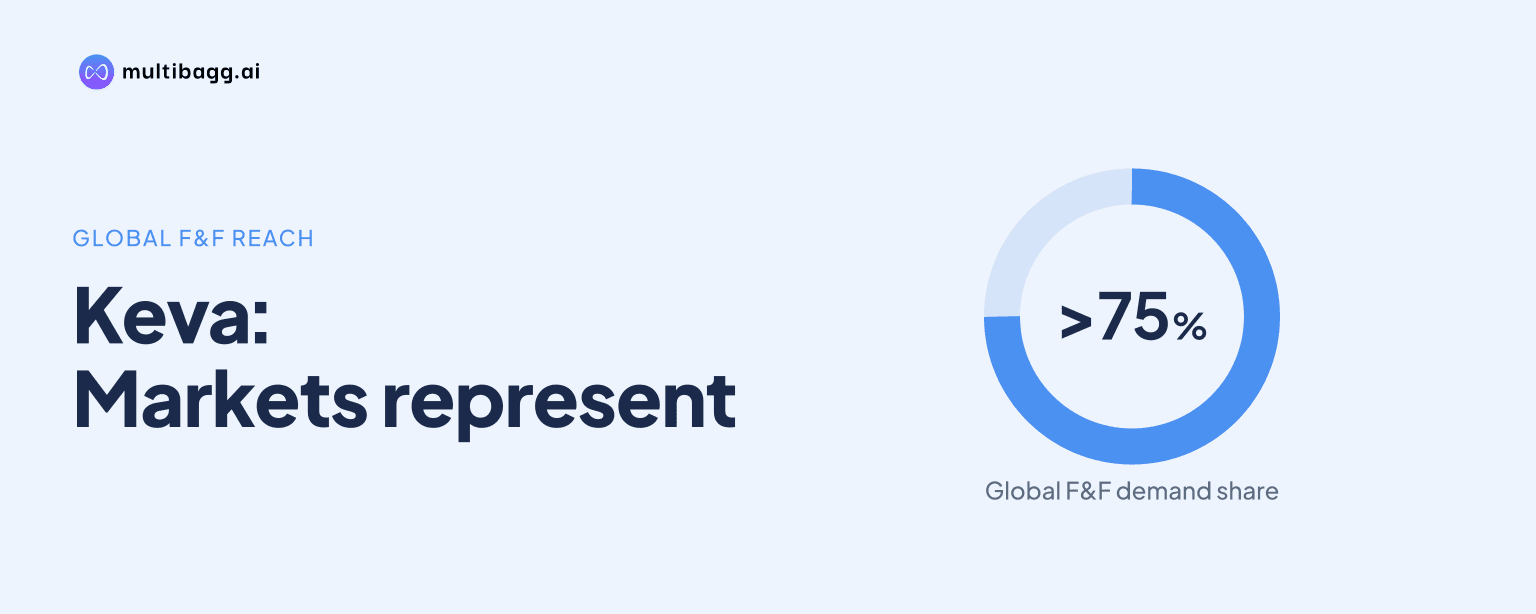
Keva is pursuing markets representing over 75% of global fragrances and flavours, or F&F, demand through 11 Creation and Development Centres, customer-near innovation, regional supply capability and North American manufacturing presence. The strategy spans Asia, the Middle East, Europe and North America, while 46% of raw materials are sourced internationally and 54% domestically.
Know S H Kelkar & Company inside out
Results, valuation, peers and who's buying, in one view.
How is Keva targeting over 75% of global F&F demand?
Keva is concentrating its global growth strategy on Asia, the Middle East, Europe and North America, which management identifies as markets representing more than 75% of worldwide F&F demand. The plan combines India-led relationships in fragrances and flavours with expansion in three international regions rather than relying on a single export market.
In Asia, Keva says its leadership position in India is anchored in customer relationships across both F&F segments. The company plans to scale domestic options to unlock operating leverage and margin expansion, although the presentation provides no financial target or timetable. Keva has more than 3,600 fragrance customers and more than 500 flavour customers.
The disclosed operating update shows growth in international markets during financial year 2026, or FY26. Total income rose 11.5% year on year to Rs 2,378 crore from Rs 2,147 crore in FY25, while Rest of World growth was 32% and Europe growth was 15%. Keva also reported its first commercial order from the United States in FY26.
What role do Keva's 11 creation centres play?
Keva's 11 Creation and Development Centres, or CDCs, are located in key markets close to customers and collaborate as extensions of customers' research and development, or R&D, capabilities. The centres are supported by 29 scientists, 35 perfumers, four flavourists, evaluators and application specialists developing customised, market-ready solutions.
Keva recently established a Fine Fragrance Development Center in Hamburg, Germany, for regional markets with global talent. It also established a Creative Development Center in Manchester, United Kingdom, which it describes as an innovation hub intended to support long-term success in Europe and strengthen its talent base.
In North America, Keva has established a Creative Development Centre in New Jersey, United States, with design capabilities and access to proprietary patented molecules for tailored solutions. Management describes the site as a strategic US foothold, while its wider North American plan includes CDC and manufacturing presence for local execution in what it calls the world's largest fragrance markets.
Customer proximity is intended to support a faster response to product briefs. Keva says multinational fast-moving consumer goods, or FMCG, customers are decentralising decision-making and product life cycles are shortening, producing new briefs every three to four years. Its product library of more than 50,000 formulations supports rapid turnaround alongside localised product development.
Got a follow-up? Ask IRIS
How is Keva building regional execution beyond exports?
Keva's stated regional-execution model combines local innovation, application capabilities, supply presence and manufacturing rather than treating international growth solely as exports. In Europe, the strategy uses acquisitions and CDCs in fragrance hubs to reach premium and multinational customers and provide faster turnaround on customised solutions.
Keva acquired CFF in 2018 and Holland Aromatics in 2022, according to its historical-growth discussion. The company says the transactions strengthened its European platform and broadened access to international customers and markets, while the Hamburg and Manchester facilities add fine-fragrance and creative-development capacity in the region.
In the Middle East, Keva says its presence enhances regional supply capability and that it is expanding its footprint to build a diversified, scalable regional revenue base. The presentation does not disclose the number of Middle East sites, regional revenue or a timetable, so the stated plan is an expansion of supply and revenue diversification rather than a quantified target.
North America combines a New Jersey CDC, manufacturing presence and Keva's first commercial US order in FY26. Management says this is a scalable platform for developed-market growth over the medium term, using local design and manufacturing capability. It does not disclose a North American revenue goal or the value of the first US order.
How does Keva's raw-material sourcing support global expansion?
Keva sources 46% of its raw materials internationally and 54% domestically, according to the presentation. Its named international sourcing nations include India, Germany, Brazil, China and the United States, while its domestic supplier base includes 262 Indian suppliers and 250 ingredients sourced from owned facilities.
The company groups its key raw materials into four broad categories: crude oil-based materials, turpentine-based materials, citrus oil and naturals. Each category contributes 25% to 30% of the raw-material volume mix. Keva says the F&F industry uses more than 2,000 raw materials and that it uses more than 1,500.
About 35% of Keva's raw-material requirement comes from its top 10 suppliers, while about 15% to 20% of total requirements are sourced from in-house facilities. Some supplier relationships have continued for more than 20 years, and Keva says it makes strategic inventory investments to hedge significant supply and price volatility.
The sourcing structure sits alongside a customer base of more than 4,100 customers, including FMCG leaders, domestic companies, trade customers and global corporates. Keva says several customer relationships span more than 15 years. Its Cobra branded small packs are sold through hundreds of traders and resellers across India.
Conclusion
Keva's strategy joins four disclosed elements: markets representing more than 75% of worldwide F&F demand, 11 customer-near CDCs, region-specific supply or manufacturing capability, and domestic and international raw-material sourcing. FY26 showed 32% Rest of World growth, 15% Europe growth and a first US commercial order, alongside total income of Rs 2,378 crore.
The next disclosed execution points are Keva's medium-term developed-market growth plan in North America, its Middle East footprint expansion and Europe-focused localised innovation. Management has not disclosed regional revenue targets, a timetable for these initiatives or the value of the first US order, leaving those matters unresolved.

