








S H Kelkar & Company Limited Q2 Revenue Rises 15% to ₹636 Crore
MAX Plan at ₹4,999/yr

Find your next multibaggerBe a Pro Investor
Research stocks and track your picks on the go. Download the app.
Key highlights
- S H Kelkar & Company Limited reported Q2 FY27 revenue of ₹636.2 crore, up 14.9% year on year.
- Q2 FY27 EBITDA rose 49.9% to ₹78.9 crore and EBITDA margin improved to 12.5% from 9.5%.
- H1 FY27 flavours revenue grew 47% year on year to ₹184 crore, although management called the pace anomalous.
- Net debt was ₹911 crore on September 30, 2026, with a reduction targeted by March 2027.
powered by IRIS
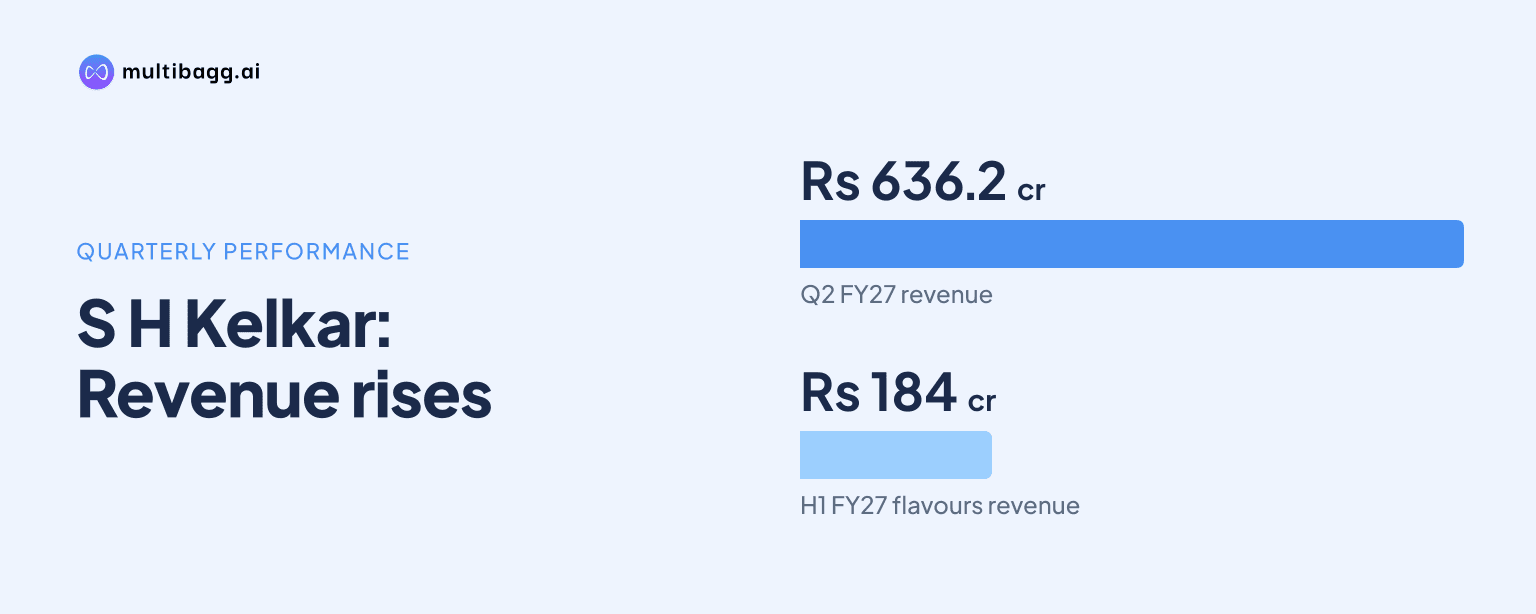
S H Kelkar & Company Limited reported Q2 FY27 consolidated revenue of ₹636.2 crore, up 14.9% year on year. EBITDA increased 49.9% to ₹78.9 crore, lifting the operating margin to 12.5% from 9.5% a year earlier and supporting management's stated aim of reaching a 15% margin over the next 12 to 24 months.
Know S H Kelkar & Company inside out
Results, valuation, peers and who's buying, in one view.
How did SHK perform in Q2 FY27?
SHK delivered higher revenue, EBITDA and profit in the September quarter, with consolidated revenue reaching ₹636.2 crore against ₹553.7 crore in Q2 FY26. The company reported EBITDA of ₹78.9 crore, compared with ₹52.6 crore a year earlier. Net profit rose 58.1% year on year to ₹14.5 crore, while earnings per share stood at ₹1.05.
For the first half of FY27, revenue from operations rose 14.5% to ₹1,298.6 crore. H1 EBITDA increased 33% to ₹168 crore and the EBITDA margin improved to about 13%. H1 net profit grew 72.4% to ₹59.9 crore. The Q2 result did not include an exceptional item, whereas the preceding Q1 had a ₹30 crore exceptional gain.
What drove SHK's revenue growth during the first half?
SHK's flavours business was the strongest growth contributor, recording 47% year-on-year growth in H1 FY27 to ₹184 crore. Management said this pace included one-off export sales linked to inventory building by customers and should not be treated as the normal run rate. It identified growth of more than 20% a year as a sustainable level for the flavours segment.
The fragrance business grew 11.9% in H1 FY27. Management said underlying growth was about 14% after excluding the low-margin business that SHK exited in Q4 FY26. Domestic fragrance growth of about 9% comprised a 5% increase from price or mix and a 4% increase in volume. On a like-for-like basis after the business exit, domestic fragrance growth was said to be closer to 12%.
What is SHK's EBITDA margin outlook?
SHK expects operating leverage from recent investments to support EBITDA margin expansion, subject to raw material costs. Group CEO Kedar Hujay said the company could reach a 15% EBITDA margin in about 12 months if raw material inflation stabilises. If inflation continues, the timeline could extend to up to two years.
Management expects continuing revenue growth of 12% to 13% over the next two to three years, with EBITDA growth of around 13% to 14%. The stated margin outlook reflects the contribution expected from new capacity and customer development centres, rather than a change in the reported Q2 financial performance alone.
Got a follow-up? Ask IRIS
What is the status of SHK's expansion projects?
SHK said its Europe capital expenditure programme is complete, and the related factory has been operational since May. In India, the first new fragrance factory is expected to be ready by the fourth quarter of FY27, while a second facility is planned for FY28. Management described these projects as the completion of its major capital expenditure expansion programme for the coming decades.
The company has also established customer development centre investments in the US, Germany and the UK, which have begun making first sales. Its Jakarta factory is fully operational. These facilities are intended to support product development and market access, although the company did not provide separate revenue contributions from each location.
How are debt, inventory and capital expenditure positioned?
SHK reported net debt of ₹911 crore as of September 30, 2026. Group CFO Jagdish Shagarwal said inventories were elevated to maintain supply continuity, increasing working-capital requirements. He said the September debt balance was expected to be the peak for the year, with a reduction targeted by March 2027 as inventory is optimised.
Remaining capital expenditure for FY27 is expected to be ₹30 crore to ₹35 crore. For FY28, total capital expenditure, including operational and maintenance spending, is projected at ₹75 crore to ₹80 crore. Interest costs are expected to remain at ₹16 crore to ₹17 crore per quarter in the second half of FY27, while annualised depreciation and amortisation is expected to reach ₹145 crore to ₹150 crore after the new facility is capitalised.
Why do SHK's standalone and consolidated numbers differ?
SHK said standalone numbers do not represent the complete operating performance because operations were moved to subsidiaries, KFG and KFL, after a fire incident. Management expects the reported standalone position to normalise next year when operations move back under direct control.
For investors, the consolidated result therefore remains the relevant measure for assessing the current scale of revenue, profitability and debt. The difference also explains why comparing standalone figures with the group's consolidated revenue and EBITDA can give an incomplete view of business performance.
Conclusion
SHK's Q2 FY27 result showed 14.9% revenue growth and a sharper 49.9% rise in EBITDA, with the operating margin improving to 12.5%. Flavours delivered unusually strong H1 growth, while the fragrance business continued to expand after the exit from low-margin categories. Higher inventory and net debt remain relevant balance-sheet considerations alongside the earnings improvement.
The next areas to watch are progress at the first Indian fragrance factory expected in Q4 FY27, the planned debt reduction by March 2027, and the pace at which new overseas customer development centres convert first sales into broader revenue. Management's ability to reach its 15% EBITDA margin objective will also depend on the course of raw material inflation.

