








S H Kelkar says overseas returns may take up to eight years
MAX Plan at ₹4,999/yr

Find your next multibaggerBe a Pro Investor
Research stocks and track your picks on the go. Download the app.
Key highlights
- S H Kelkar expects overseas markets to break even in three to four years and generate good returns after seven to eight years.
- Management said roughly Rs 80 crore has been invested in CDCs that are not yet producing meaningful revenue.
- S H Kelkar reported budgeted first-half US sales and first sales in Germany and the United Kingdom.
- Management expects overseas revenue to become meaningful to group revenue in another 12 to 18 months.
powered by IRIS
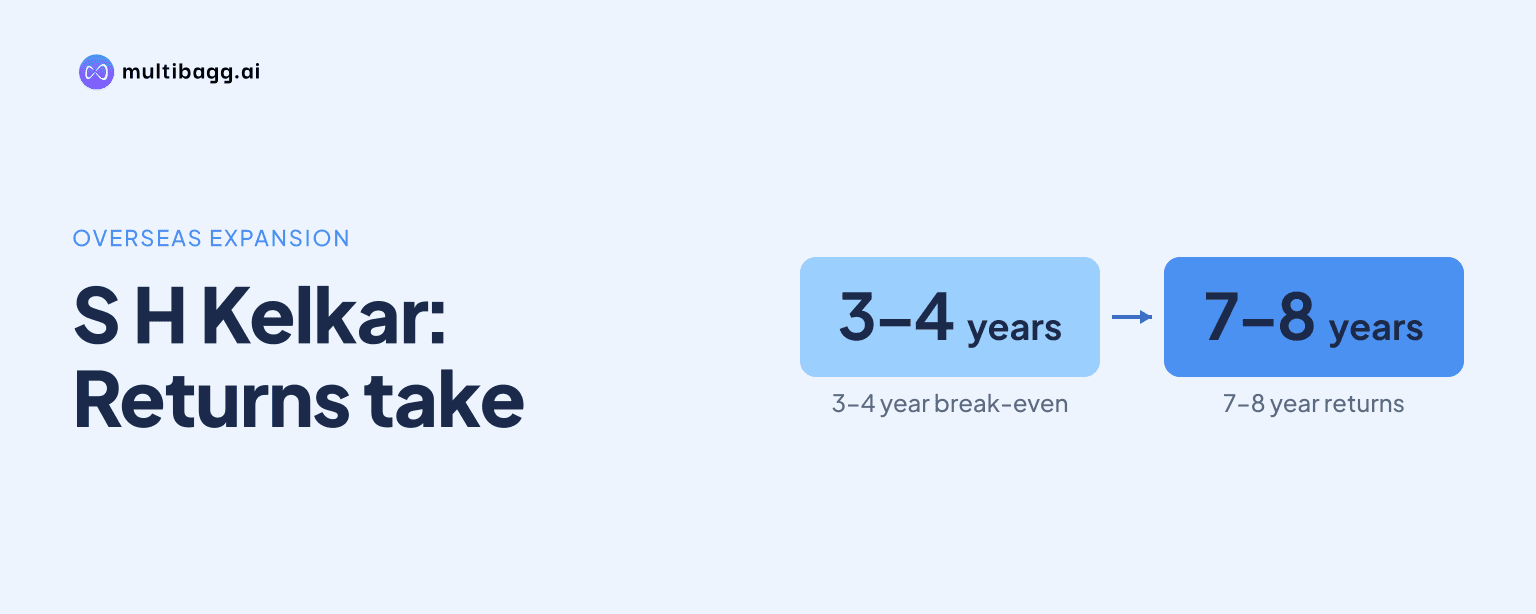
S H Kelkar and Company Limited said its newer overseas markets may take seven to eight years to generate a good return on investment, with break-even expected in three to four years and roughly Rs 80 crore already spent on development centres that are not producing meaningful revenue.
Know S H Kelkar & Company inside out
Results, valuation, peers and who's buying, in one view.
Why will S H Kelkar's overseas returns take up to eight years?
S H Kelkar expects its newer overseas markets to take a good three to four years to break even and a further three to four years to generate meaningful returns. Management said the international build-out is a long-term investment programme rather than a near-term profit driver, describing the expected seven-to-eight-year path as a long haul.
The company is expanding beyond India, which management described as 5% or less of the global Fragrance and Flavour market. Management said the markets being added are 20 to 30 times larger than India, requiring proportionately, and sometimes disproportionately, more investment before sales reach sufficient scale.
Management said it made a large investment step in 2024 after mergers among larger competitors created openings for midsized companies. S H Kelkar increased its investment portfolio in the United States and Europe, while also funding domestic recovery after a fire incident two years earlier that required what management called double capital expenditure.
What is holding down S H Kelkar's return on capital employed?
S H Kelkar said its consolidated return on capital employed, or ROCE, reflects spending on new markets and domestic recovery, unlike its mature India business. Management said India, where the company has operated for more than two to three decades, produces ROCE in the 20% range.
Management identified roughly Rs 80 crore of spending on customer development centres, or CDCs, that are not yet generating meaningful revenue. It said it was investing profits from the existing business into future markets rather than reporting losses from those markets, although the investment currently affects consolidated capital employed.
The domestic capital base has also been affected by the fire-related recovery programme, according to management. It expects the domestic business, capital employed and a new factory to begin pushing ROCE back towards normal levels by next year, but it did not provide a consolidated ROCE target.
How much progress has S H Kelkar made in the US and Europe?
S H Kelkar has started recording revenue in all three newer markets, but management said the amounts remain small. The United States delivered budgeted sales in the first half, while Germany and the United Kingdom recorded their first sales as the company began to monetise investments made over the past two years.
Germany and the United Kingdom are being built with new Fragrance products and new clients, because S H Kelkar had no existing Fragrance customers in those markets. Management clarified that it had not said Germany would break even in the current year; the operation is instead in the early revenue-scaling phase.
Management said the prior 12 to 18 months were used to establish teams, systems, products and initial client activity in these markets. It expects another 12 to 18 months before revenue from the United States, Germany and the United Kingdom becomes meaningful in the context of total company revenue, although percentage growth may be rapid from a small base.
Got a follow-up? Ask IRIS
What growth and margin outlook has S H Kelkar provided?
S H Kelkar expects revenue growth of 12% to 13% a year and earnings before interest, tax, depreciation and amortisation, or EBITDA, growth of 13% to 14% over the next two to three years. Management said the forecast depends on inflation and volume conditions, and it described the revenue view as a continuing rather than one-year expectation.
The company said mature products that have been in the market for multiple decades are growing at 5% to 6%, while new products and categories are growing at 25%. The resulting mix produces the 12% to 13% company-wide growth expectation, rather than a growth rate matching the newer business lines alone.
Management said the roughly 13% EBITDA margin reported in recent quarters was at the lower end of its sustainable range. It expects a steady inflation environment could allow EBITDA margin to reach 15% in 12 months; further inflation could extend that timing to two years, with management targeting 15% EBITDA or more within 12 to 18 months.
Which operations are growing faster than S H Kelkar's overall forecast?
S H Kelkar said its Flavour business has an underlying growth rate of more than 20%, above the 12% to 13% group revenue outlook. Management reported Flavour revenue of Rs 72 crore in Q2 and Rs 180 crore in H1, and assessed a normal quarterly run rate at roughly Rs 90 crore.
The difference between Q1 and Q2 partly reflected an exceptional inventory order rather than end-consumption growth. Management said about Rs 20 crore of Q1 Flavour business resulted from customer stock-building amid freight disruption, longer lead times and logistics uncertainty, and it therefore treated 20%-plus growth as the sustainable basis rather than growth above 40%.
Management linked its Flavour outlook to the growing share of processed and packaged food, alongside 7% to 8% volume consumption growth as population rises. It also said it had nearly doubled Flavour development strength compared with two years earlier, providing added product-development capacity for the segment.
Conclusion
S H Kelkar's lower consolidated returns reflect the different stages of its operations: mature India activities generate ROCE in the 20% range, while overseas CDCs carrying roughly Rs 80 crore of investment are only beginning to produce sales. Management's timeline indicates that initial revenue scaling, market break-even and good investment returns will occur over distinct periods rather than at once.
The next measures to watch are management's stated 12-to-18-month timeframe for overseas revenue to become meaningful, its three-to-four-year overseas break-even expectation, and its target of 15% EBITDA or more within 12 to 18 months if inflation conditions permit. Management also plans to reduce inventory intensity over the next six months while growing sales, and expects the pending insurance claim to close by March 2027.

