








SH Kelkar and Company Ltd. Flavours outpaced Fragrance in H1
MAX Plan at ₹4,999/yr

Find your next multibaggerBe a Pro Investor
Research stocks and track your picks on the go. Download the app.
Key highlights
- Keva’s Flavours revenue rose 47.4% year on year to Rs 184 crore in H1 FY27.
- Keva’s Flavours EBITDA increased 92.0% to Rs 52 crore in H1 FY27.
- Keva’s Fragrance revenue rose 11.9% to Rs 1,088 crore, while EBITDA increased 24.1% to Rs 121 crore.
- Keva’s consolidated EBITDA rose 33.3% to Rs 167.5 crore and EBITDA margin reached 13.0% in H1 FY27.
powered by IRIS
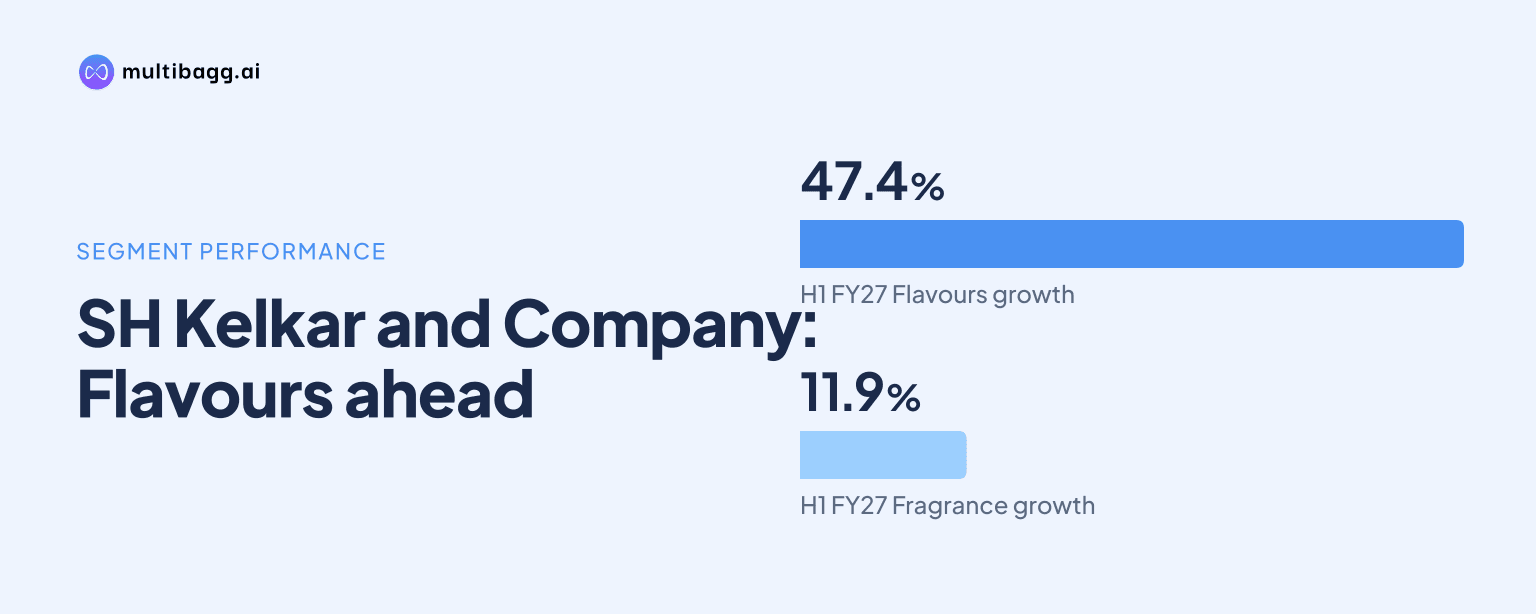
In H1 FY27, SH Kelkar and Company Ltd.’s Flavours revenue rose 47.4% to Rs 184 crore and earnings before interest, tax, depreciation and amortisation (EBITDA) rose 92.0% to Rs 52 crore, outpacing Keva’s Fragrance revenue growth of 11.9% and EBITDA growth of 24.1%. Fragrance nevertheless remained larger, with Rs 1,088 crore of revenue.
Know S H Kelkar & Company inside out
Results, valuation, peers and who's buying, in one view.
How did Keva’s Flavours business outperform Fragrance in H1 FY27?
Keva’s Flavours business outperformed Fragrance on year-on-year growth rates and incremental EBITDA in H1 FY27. Flavours revenue increased by Rs 59 crore, to Rs 184 crore from Rs 125 crore in H1 FY26, while Fragrance revenue increased by Rs 115 crore, to Rs 1,088 crore from Rs 973 crore. The smaller Flavours base produced growth of 47.4%, compared with 11.9% for Fragrance.
Flavours EBITDA rose by Rs 25 crore to Rs 52 crore from Rs 27 crore, marginally exceeding Fragrance’s Rs 24 crore increase to Rs 121 crore from Rs 97 crore. Keva attributed Flavours’ performance to healthy demand and continued traction across key markets. For Fragrance, it cited continued customer engagement and demand across key end-use segments, as well as operational efficiencies, cost optimisation and margin protection.
The segment figures exclude Global Ingredients, as stated in Keva’s presentation. Flavours added Rs 25 crore of EBITDA during H1 FY27, against Rs 24 crore added by Fragrance, despite generating Rs 904 crore less revenue than Fragrance in the period. The figures show faster percentage growth and a slightly larger EBITDA increase from Flavours, while Fragrance continued to supply most segment revenue and EBITDA.
What happened to Keva’s Flavours growth in Q2 FY27?
Keva’s Flavours revenue still grew faster than Fragrance in Q2 FY27, but its growth rate was below the H1 FY27 rate. Flavours revenue rose 28.1% to Rs 72 crore from Rs 56 crore in Q2 FY26, while Fragrance revenue increased 14.8% to Rs 549 crore from Rs 478 crore. Total segment revenue excluding Global Ingredients rose 16.2% to Rs 621 crore from Rs 534 crore.
The Q2 FY27 result means the 47.4% H1 FY27 Flavours expansion was not evenly spread across both quarters, since Q2 growth was 28.1%. Conversely, Fragrance’s Q2 growth rate of 14.8% was above its 11.9% H1 FY27 increase. Keva did not disclose quarterly segment EBITDA, so the presentation does not establish whether Flavours’ 92.0% H1 EBITDA growth continued in Q2.
India was the fastest-growing reported geography in Q2 FY27, with revenue up 24.5% to Rs 365 crore from Rs 293 crore. Europe revenue rose 13.8% to Rs 132 crore from Rs 115 crore, while Rest of World, or RoW, declined 1.0% to Rs 124 crore from Rs 126 crore. This differed from H1 FY27, when India, Europe and RoW each recorded revenue growth.
Got a follow-up? Ask IRIS
Which markets supported Keva’s H1 FY27 segment growth?
Keva reported growth in both India and international markets for Flavours in H1 FY27. India accounted for 56% of Flavours revenue and grew 49.7% year on year, while RoW accounted for the remaining 44% international share. Keva identified healthy demand and continued traction across key markets as the support for total Flavours revenue growth of 47.4%.
Fragrance had a different geographic mix, with India accounting for 57% of H1 FY27 revenue, Europe for 25% and RoW for 18%. International revenue, comprising Europe and RoW, therefore represented 43% of Fragrance revenue, versus 44% for Flavours. Fragrance revenue grew 9.6% in India and 16.4% in Europe, against total segment growth of 11.9%.
At the broader business level excluding Global Ingredients, Emerging Markets revenue rose 16.5% to Rs 1,021 crore in H1 FY27 from Rs 876 crore, ahead of Europe’s 13.5% increase to Rs 252 crore from Rs 222 crore. In the separate geography-based disclosure, Europe rose 18.8% to Rs 280 crore, RoW rose 18.4% to Rs 265 crore and India rose 13.9% to Rs 727 crore. Keva’s market-segment and geography disclosures use different classifications and should not be read as identical measures.
How did Keva’s segment growth relate to consolidated H1 FY27 results?
Keva reported consolidated revenue from operations of Rs 1,299.6 crore in H1 FY27, up 14.5% from Rs 1,134 crore in H1 FY26. Gross profit increased 15.1% to Rs 551 crore from Rs 478 crore, while gross margin increased by 25 basis points to 42.6% from 42.3%. A basis point equals one-hundredth of a percentage point.
Consolidated EBITDA increased 33.3% to Rs 167.5 crore from Rs 126 crore, and the EBITDA margin rose to 13.0% from 11.1%. Profit after tax increased 72.4% to Rs 60 crore from Rs 35 crore, lifting the profit-after-tax margin to 4.6% from 3.1%. Management attributed profitability protection to proactive raw-material planning, pricing actions, operational efficiencies and cost optimisation.
Global Ingredients moved in the opposite direction from Flavours and Fragrance. Revenue declined to Rs 20 crore in H1 FY27 from Rs 32 crore in H1 FY26, while EBITDA moved to a Rs 5 crore loss from a Rs 1 crore profit. Keva said the business was navigating volatility in global supply chains and commodity markets while managing procurement, inventory and customer supply requirements.
Conclusion
Keva’s H1 FY27 segment performance showed Flavours as the faster-growing business, with 47.4% revenue growth and 92.0% EBITDA growth, while Fragrance remained the primary contributor by scale at Rs 1,088 crore of revenue and Rs 121 crore of EBITDA. Flavours also contributed Rs 25 crore of incremental EBITDA, slightly more than Fragrance’s Rs 24 crore increase, even though its revenue base was much smaller.
The next disclosed focus is inventory and debt management. Management said higher inventory was deliberately held to maintain supply continuity amid global sourcing volatility, increasing working capital, and it plans to optimise inventory to normal levels during the rest of FY27. Management also said debt peaked at September 30, 2026, when net debt was Rs 911 crore and net debt-to-equity was 0.64 times, and expects debt to moderate by March 2027, subject to market conditions.

