










Kissht raises FY27 AUM target above 60% as credit costs fall
Key highlights
- Kissht raised FY27 AUM growth guidance to more than 60% from more than 40%.
- Q2 FY27 AUM was Rs 9,317 crore, up 68.4% year on year.
- Credit costs fell to 6.2% of average AUM from 9.3% a year earlier.
- Q2 FY27 profit after tax was Rs 125 crore, double the year-earlier amount.
powered by IRIS
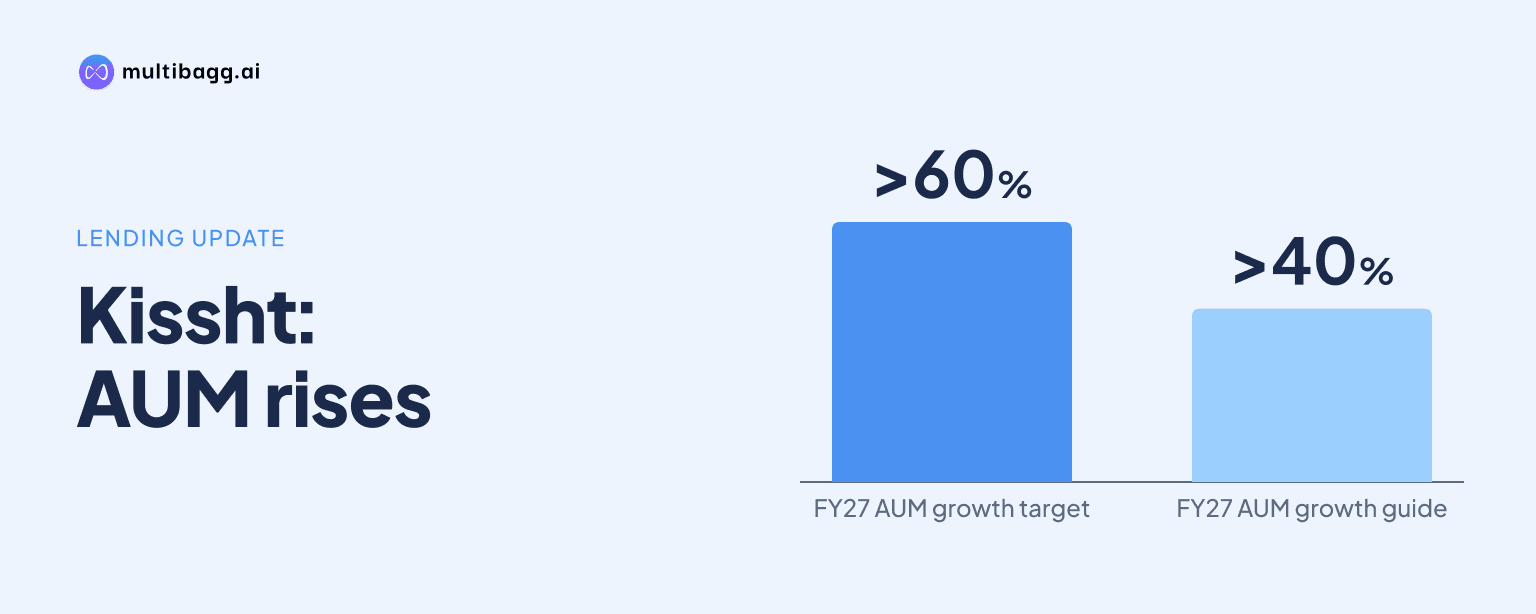
OnEMI Technology Solutions Limited, known as Kissht, raised FY27 assets under management, or AUM, growth guidance to more than 60% from more than 40% after Q2 FY27 AUM reached Rs 9,317 crore, up 68.4% year on year, while credit costs fell to 6.2% of average AUM from 9.3% a year earlier.
Know Onemi Technology Solutions inside out
Results, valuation, peers and who's buying, in one view.
Why did Kissht raise its FY27 AUM growth target?
Kissht raised its FY27 AUM growth target because management said first-half momentum supported a higher outlook. The company increased guidance to more than 60% from more than 40% after AUM rose 16.4% quarter on quarter and 68.4% year on year in Q2 FY27. Management retained its other targets of return on average equity above 20% and gross non-performing assets, or GNPA, below 2.25%.
The September-quarter expansion was supported by disbursements of Rs 4,612 crore, up 56% year on year, although AUM grew faster than disbursements. Management attributed the difference to longer-tenure loans for better-quality borrowers, with average tenure reaching 17.8 months and average ticket size reaching Rs 43,380. Longer tenure leaves disbursed loans outstanding for more time and adds to the AUM balance.
Growth also came from deeper engagement with existing customers, according to management. Active customers rose 58% year on year to 3.61 million, compared with a 22.5% increase in total customers served to 12.8 million. Management said repeat borrowing, higher ticket sizes among better-quality customers and a measured increase in tenure were the three principal contributors to AUM growth.
How did Kissht's credit costs and asset quality change?
Kissht reported lower credit costs and improved delinquency measures in Q2 FY27, and management raised its target for annual impairment-cost reduction to more than 15%. Credit costs were 6.2% of average AUM, down from 6.8% in Q1 FY27 and 9.3% in Q2 FY26. The earlier target had been a 10% to 15% year-on-year reduction.
Stage-2 loans declined to 2.37% from 3.15% in June and 4.11% a year earlier, reversing the seasonal increase management had identified in the preceding quarter. GNPA fell 7 basis points quarter on quarter and 75 basis points year on year to 2.18%, while net NPA was 0.34%, down 2 basis points sequentially. Management expects Stage-2 loans to remain stable through FY27.
Early repayment indicators also improved during the quarter. First equated monthly instalment, or EMI, 90-plus delinquency fell to 0.69% from 0.73% in Q1 FY27 and 1.16% a year earlier, while collection efficiency rose 30 basis points sequentially to 97.12%. Kissht reported Stage-3 coverage of 84.6% and Stage-2 coverage of 77.6%.
Got a follow-up? Ask IRIS
What changes is Kissht making to borrower selection?
Kissht said it is reducing exposure to more leveraged customers while increasing lending to higher-scoring borrowers. New loans to customers with three or more live loans declined by more than 35% over 12 months and by more than 7% quarter on quarter. Loans to borrowers with bureau scores above 760 rose to 24.8% from 20.8%, while about 4% of loans were made to customers scoring below 700.
Management contrasted its approach with industry data it cited showing retail credit balances growing 19% while borrower numbers grew by less than 9%. Kissht said it began restricting lending to consumers carrying gold loans 13 months earlier, and their exposure had declined to below 8% of the total book. The company said the restrictions were tighter in northern India than southern India.
Kissht also cited technology-led monitoring as a mechanism for controlling risk. Its underwriting models were in their 42nd iteration, with an area under the curve, or AUC, of 75%, compared with 66% in 2023. Management said transformer-based sequence models added 2.5 points to AUC, and its monitoring systems led to seven risk-policy or model actions during the latest quarter.
Can funding and profit trends support Kissht's FY27 targets?
Kissht said lower borrowing costs, operating leverage and lower risk costs support management's plan to keep return on average equity above 20% in FY27. Average borrowing cost fell to 13.76% in Q2 FY27 from 14.45% in the previous quarter, while finance cost declined 12% quarter on quarter despite higher borrowings. Management said it passes part of its funding-cost benefit to customers through pricing.
The chief financial officer said incremental borrowing in Q2 FY27 was raised at 12.1%, below the 13.76% average cost of outstanding borrowings. Management expects older, higher-cost debt to roll off over the next three to four quarters, which it said would result in at least a 150-basis-point reduction in overall borrowing cost if incremental funding costs do not decline further. Potential ratings changes were identified as a possible additional benefit, not a reported outcome.
Total income increased 43% year on year to Rs 740 crore, while pre-provisioning operating profit rose 40% to Rs 287 crore and profit after tax doubled to Rs 125 crore. Return on average AUM increased 73 basis points to 5.78%, and return on average equity was 21.65%. Total income as a share of average AUM fell quarter on quarter to 34.2% from 35.9%.
Loan against property, or LAP, AUM reached Rs 737 crore, or 7.9% of total AUM, compared with 4.1% a year earlier. Management said LAP turned profitable in Q2 FY27, one quarter before its previously indicated Q3 breakeven. Kissht had Rs 4,199 crore of on-book AUM and Rs 5,118 crore of off-book AUM, a 45:55 split supported by more than 45 lending partners.
Conclusion
Kissht's upgraded FY27 outlook combines faster AUM growth with lower reported credit costs in Q2 FY27. The September-quarter data showed AUM growth of 68.4%, credit cost declining to 6.2% of average AUM and GNPA at 2.18%, while management linked these movements to borrower selection, longer-tenure loans, collections and risk monitoring.
The next reported quarters will show whether impairment cost falls by more than 15% year on year, whether GNPA stays below the guided 2.25%, and whether the 13.76% average borrowing cost declines as legacy debt rolls off over the next three to four quarters. Management also said the net-worth benefit of its Rs 832 crore preferential allotment would be visible from the following quarter onward.