










Kissht LAP turns profitable early, targets 2.5x growth
Key highlights
- Kissht said its LAP business became profitable in Q2, one quarter before its earlier Q3 estimate.
- Kissht management targets LAP growth of about 15% to 20% quarter on quarter and roughly 2.5-times scale over two years.
- LAP accounted for 7.9% of Kissht’s total AUM, compared with 7.8% previously.
- Kissht reported overall credit cost of 6.2% of average AUM, down from 9.3% a year earlier.
powered by IRIS
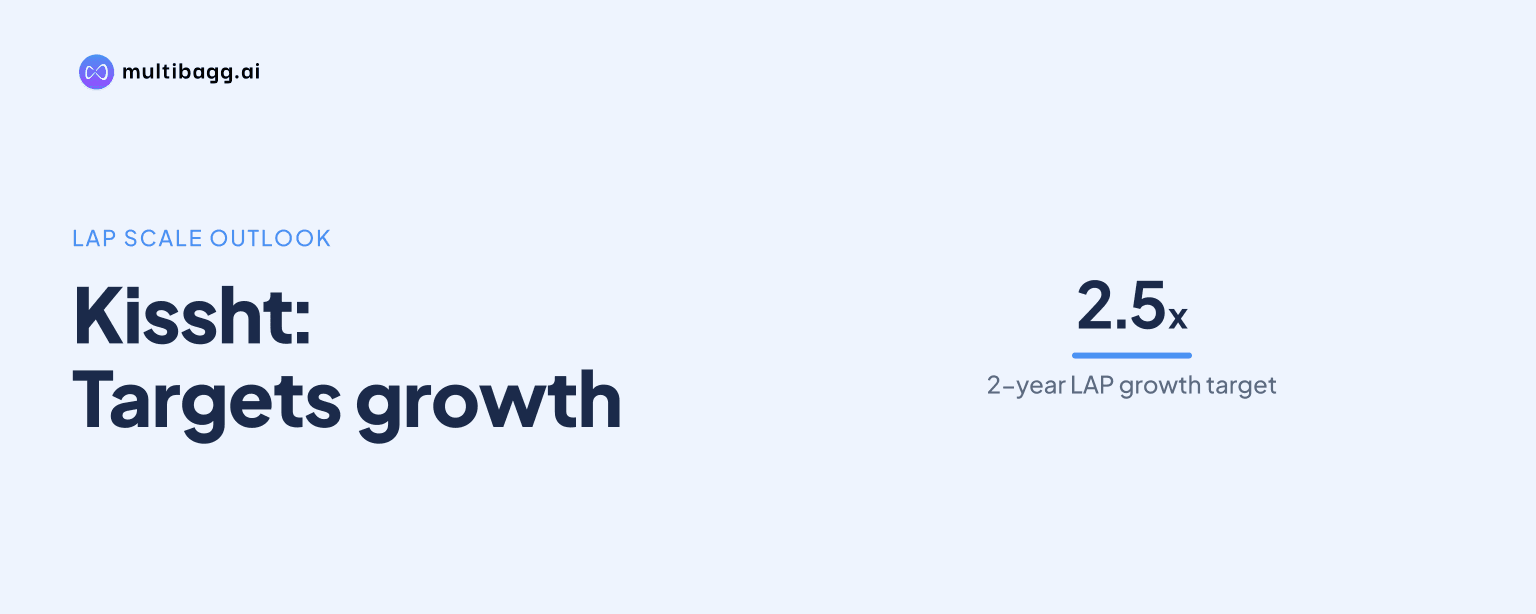
OnEMI Technology Solutions Limited said its Kissht loan-against-property, or LAP, business became profitable in Q2, one quarter before management’s earlier Q3 estimate, because risk performance was better than expected. Management now expects LAP to expand by about 15% to 20% quarter on quarter and reach roughly 2.5 times its current scale over the next two years.
Know Onemi Technology Solutions inside out
Results, valuation, peers and who's buying, in one view.
Why did Kissht’s LAP business become profitable in Q2?
Kissht said LAP became profitable in Q2 because risk outcomes were better than management had expected when it projected a Q3 break-even. Management did not disclose a standalone LAP profit amount, margin or return measure, but identified lower-than-expected risk as the principal reason the secured-lending business reached profitability one quarter early.
LAP remained a small component of Kissht’s assets under management, or AUM, at 7.9%, up from 7.8%. Management said the modest change in LAP’s portfolio share should not be read as its full growth rate because the personal-loan, or PL, business was expanding faster. It said LAP’s underlying growth had been almost at the same level as PL growth.
How fast does Kissht expect its LAP business to grow?
Kissht expects LAP to grow by about 15% to 20% quarter on quarter and said the business could become about 2.5 times its current size over the next two years. This is management’s stated expansion plan rather than reported future financial performance, and management noted that LAP starts from a smaller base than PL.
Kissht said branch profitability had improved significantly, although it did not provide a branch-level profit figure or branch count. LAP is being sourced from existing Kissht customers, open-market channels and distributor partnerships. Management also expects a modest increase in LAP ticket size, which it said could widen access to higher-quality customers and support its confidence in group return on equity, or ROE, of more than 20%.
How is Kissht managing costs and risk in LAP?
Kissht is shifting some LAP personnel from direct payroll to a third-party structure, while retaining a limited number of employees in branches. Management said the transition was incomplete in Q2 and could continue in Q3. It expects the model to provide more flexible fixed and variable compensation, but cautioned that a lower employee-cost line would not automatically reduce total operating costs.
Kissht also said it made LAP provision-coverage changes for delinquent accounts, including changes related to the 1-to-30-day bucket and Stage 2 classification, to take a more prudent approach. It said there was no change to the standard LAP portfolio and did not foresee another policy change. At the overall company level, credit cost fell to 6.2% of average AUM from 6.8% and from 9.3% a year earlier, while gross non-performing assets, or GNPA, declined to 2.18%, down 75 basis points.
Got a follow-up? Ask IRIS
What supports Kissht’s wider risk-management approach?
Kissht said its company-wide credit-cost improvement reflects a greater focus on higher-quality customers, deeper engagement with repeat borrowers and frequent underwriting adjustments. Management guided for credit cost to decline by more than 15% from Q4FY26 to Q4FY27. That target covers the wider portfolio rather than LAP alone, but it underpins management’s view that secured-product expansion can proceed with controlled risk.
Kissht reported overlap with microfinance institution, or MFI, borrowing of less than 3.4%, Kisan Credit Card, or KCC, exposure of less than 2.6%, overlapping gold loans below 8%, and drought-affected areas below 6%. Management said it monitors these exposures regularly and adjusts underwriting by location and customer segment. It identified certain self-employed geographies as an area under monitoring, without quantifying the related portfolio exposure in the call.
How does LAP fit into Kissht’s product strategy?
Kissht said its longer-term strategy cannot rely solely on unsecured PLs, making LAP its disclosed product expansion with a defined growth target. Management said it was also studying gold loans and auto loans, but did not announce a launch date, portfolio target or expected financial contribution for either product. LAP is therefore the non-PL business currently linked to a specific two-year scale objective.
Kissht’s PL strategy shows why management is seeking a broader mix. It said the PL average ticket size was Rs 43,000 and that fewer than 5% of loans were between Rs 2 lakh and Rs 3 lakh, its maximum ticket ceiling. Higher-income customers had blended customer-acquisition cost, or CAC, of about Rs 1,200 versus about Rs 850 overall, but management said their larger tickets and longer tenures offset the additional acquisition spending. Organic sourcing was between 30% and 30.5% in Q2, broadly unchanged from about 30% in the prior quarter.
Conclusion
Kissht’s Q2 LAP profitability arrived one quarter before management’s earlier Q3 expectation, with better-than-expected risk performance cited as the driver. Although LAP represented 7.9% of AUM, management is positioning it as a growing secured-lending component alongside the larger PL business, supported by branch economics, distributor channels and a targeted increase in ticket sizes.
The next disclosures to watch are whether LAP sustains the stated 15% to 20% quarterly growth rate, whether the Q3 payroll-to-third-party transition changes the cost mix as management expects, and whether provision coverage remains stable after the Q2 adjustment. Management’s stated goal of roughly 2.5-times LAP scale over two years will also depend on risk outcomes as the business expands.