










Knowledge Realty Trust sees Bengaluru occupancy closer to 90%
Key highlights
- KRT reported Bengaluru occupancy of 86% and said it can move closer to 90% by FY27-end.
- KRT identified 1.6 million square feet of Bengaluru vacancies, split between technology parks and Global City.
- Bengaluru added about 1.1 million square feet of new leasing over the past year, but similar-sized exits kept occupancy flat.
- KRT’s economic occupancy rose from 87% in the prior quarter to 89% as of October 31.
powered by IRIS
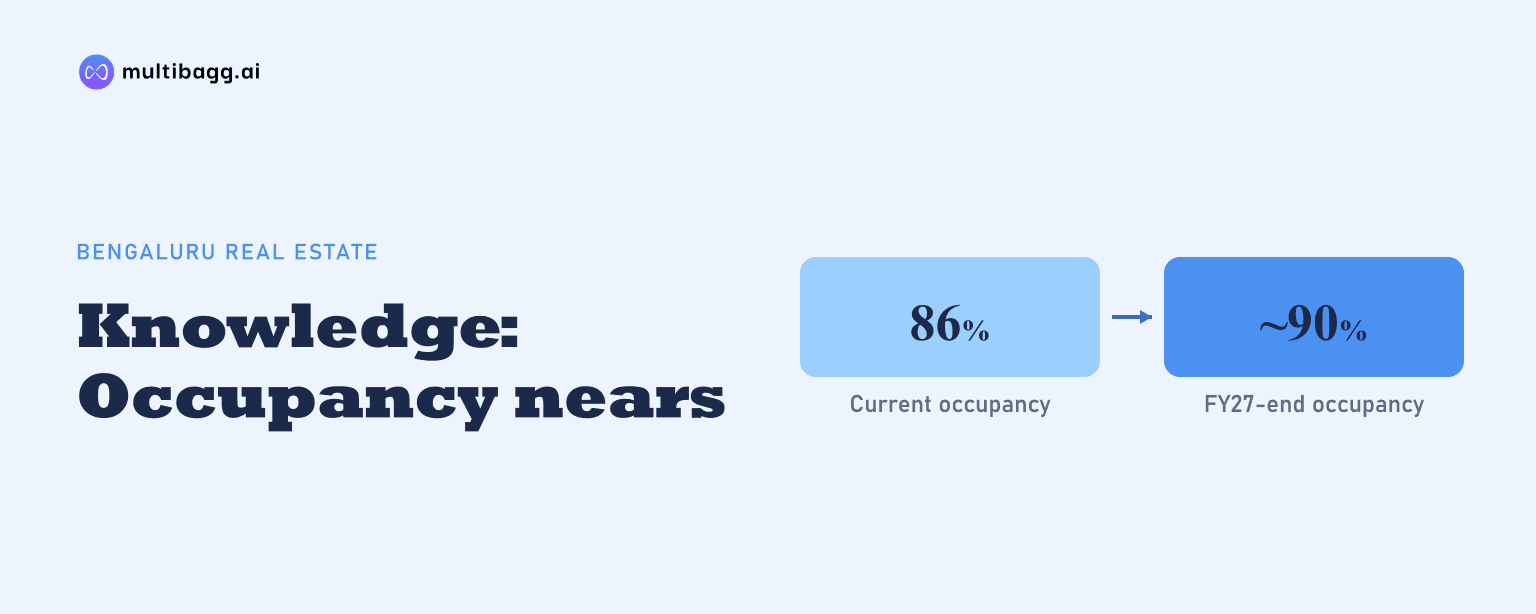
Knowledge Realty Trust said Bengaluru occupancy, reported at 86%, can move closer to 90% by FY27-end as it pursues leasing for 1.6 million square feet of vacancies, including 0.8 million square feet in three large technology parks and a similar area at Global City. Management said legacy tenant exits and special economic zone constraints have held back the city’s progress.
Know Knowledge Realty Trust inside out
Results, valuation, peers and who's buying, in one view.
Why is KRT Bengaluru occupancy below the portfolio level?
KRT’s Bengaluru occupancy is below the trust’s 93% occupancy by square footage because new leasing has been broadly offset by tenant departures. Management said it completed about 1.1 million square feet of new leasing in Bengaluru over the past year, but exits were of a similar size, leaving occupancy flat despite leasing activity.
The departures were mainly legacy occupiers, including Juniper at Exora and some special economic zone, or SEZ, tenants at Cessna. Management said these exits can create efficiency gains and mark-to-market opportunities, meaning rent can potentially be reset closer to current market levels when the premises are re-let. Since listing in August 2025, KRT said efficiency changes have added almost 100,000 square feet of area in Bengaluru.
The comparison shows why Bengaluru is the principal lease-up focus while Mumbai and Hyderabad have different priorities. Mumbai rose 300 basis points, or 3 percentage points, during Q2 FY27 to 95%, while Hyderabad was 99% occupied and management focused there on rent repricing rather than filling vacant space.
Where are KRT’s Bengaluru vacancies located?
KRT’s principal Bengaluru vacancies are split evenly between large outer-ring-road technology parks and Global City. Exora, Cessna and Softzone together account for about 0.8 million square feet of vacant area, while Global City has a further 0.8 million square feet, taking the identified vacancy pool to roughly 1.6 million square feet.
Management said it was in advanced discussions for large take-ups at Exora, Cessna and Softzone, and expressed confidence about the outer-ring-road, or ORR, assets. Those parks are large technology-focused campuses, whereas Global City is expected to recover more gradually. Management described Global City’s progress as slow and steady, rather than setting a lease-up timetable for the entire 0.8 million square feet.
Global City’s lower occupancy has a more limited effect on portfolio value than its area suggests, according to management, because it is a below Rs 60-per-square-foot rental market. By comparison, management described Mumbai as a Rs 250 to Rs 300 market, where 95% occupancy produces a larger contribution to portfolio value. This distinction explains why occupancy by value reached 94% in Q2 FY27, above the 93% figure by area.
How will KRT address SEZ constraints in Bengaluru?
KRT is addressing Bengaluru’s SEZ-related leasing constraint by demarcating about 0.5 million square feet at Global City and Cessna. Management said the demarcations were either under way or completed, which should broaden the pool of potential occupiers for that space, although it did not give individual asset-level completion dates or committed leases tied to the process.
SEZ exposure is concentrated in Bengaluru within KRT’s portfolio, management said. That concentration, together with tenant exits, was cited as a reason certain Bengaluru properties remained at 80%, 82% or 86% occupancy. Management contrasted this with Mumbai, which it said was at 86% occupancy when KRT filed for its initial public offering and reached 95% after roughly one to one-and-a-half years of leasing work.
The SEZ changes are intended to support leasing rather than merely replace lost tenants. KRT said older leases can be less efficient in their use of space, and fresh occupiers may expand after installing new fit-outs. The company did not quantify future rent or area gains from the 0.5 million square feet being demarcated, so the eventual impact on Bengaluru occupancy remains dependent on lease execution.
Got a follow-up? Ask IRIS
Can KRT reach 90% Bengaluru occupancy by FY27-end?
KRT said it can get Bengaluru occupancy closer to 90% by the end of FY27, but management did not provide a precise target. The statement followed an analyst’s reference to 86% current occupancy and management’s disclosure of advanced discussions for large take-ups at the 0.8 million square feet of vacancies in Exora, Cessna and Softzone.
At the wider portfolio level, management said it expected occupancy by square footage to rise from 93% toward a 94% to 95% range by March FY27 on a same-store basis. It cautioned that adding a couple of Bengaluru assets could reduce reported overall occupancy by about 1 percentage point. That means portfolio growth and Bengaluru’s path toward 90% may not move in a straight line if new assets are included.
KRT also reported improvement in economic occupancy, which measures space that has begun contributing economically rather than only being contractually committed. Economic occupancy rose from 87% at the end of the preceding quarter to 88% at Q2 FY27-end and 89% as of October 31. Management said the gap to committed occupancy had narrowed from 6 percentage points to 4 percentage points.
What leasing evidence supports KRT’s Bengaluru plan?
KRT’s evidence is the volume of current leasing activity and a broader portfolio leasing record, rather than announced Bengaluru deals. In Q2 FY27, the trust signed 0.8 million square feet of gross leasing, of which 0.5 million square feet achieved an average leasing spread of 24%. Gross leasing for the first half of FY27 reached 2.2 million square feet.
Management also said it had achieved annual escalations on 100% of leasing completed in the quarter. Across the portfolio, 66% of 1.1 million square feet expiring in the second half of FY27 was already tied up or under closure at a 23% spread. These measures show leasing and renewal activity, but management did not identify how much of the tied-up space was in Bengaluru.
Development will add another moving part in the city. Sattva Endeavour was expected to become operational in Q3 FY27 and was 25% pre-leased, while Sattva Spectrum was scheduled for Q4 FY27 and was in discussions with multiple clients. A 1.4 million-square-foot Global City block had just started construction and was described as about three years from completion, so it is not an immediate answer to current vacancies.
Conclusion
Bengaluru’s lease-up case combines space released by legacy exits, large-campus leasing discussions and SEZ demarcation work. This differs from Mumbai, where occupancy reached 95% in Q2 FY27, and Hyderabad, where 99% occupancy has shifted management’s attention to repricing; Bengaluru also gained almost 100,000 square feet through efficiency changes since August 2025.
The next points to watch are lease signings at Exora, Cessna, Softzone and Global City, and progress on roughly 0.5 million square feet of SEZ demarcation. Management expects Sattva Endeavour to open in Q3 FY27 and said it hoped to report further leasing traction in its next update; Sattva Spectrum is scheduled to become operational in Q4 FY27.