










Knowledge Realty Trust Sees 25% Rental Upside Through FY30
Key highlights
- KRT reported 25% weighted average rental mark-to-market potential through FY30.
- Mumbai has 34% of rentals expiring over two and a half years, with 31% mark-to-market potential.
- KRT repriced about 0.6 million square feet in Hyderabad at a 41% average spread since listing.
- Of 1.1 million square feet expiring in H2 FY27, 66% was tied up or under closure at a 23% spread.
powered by IRIS
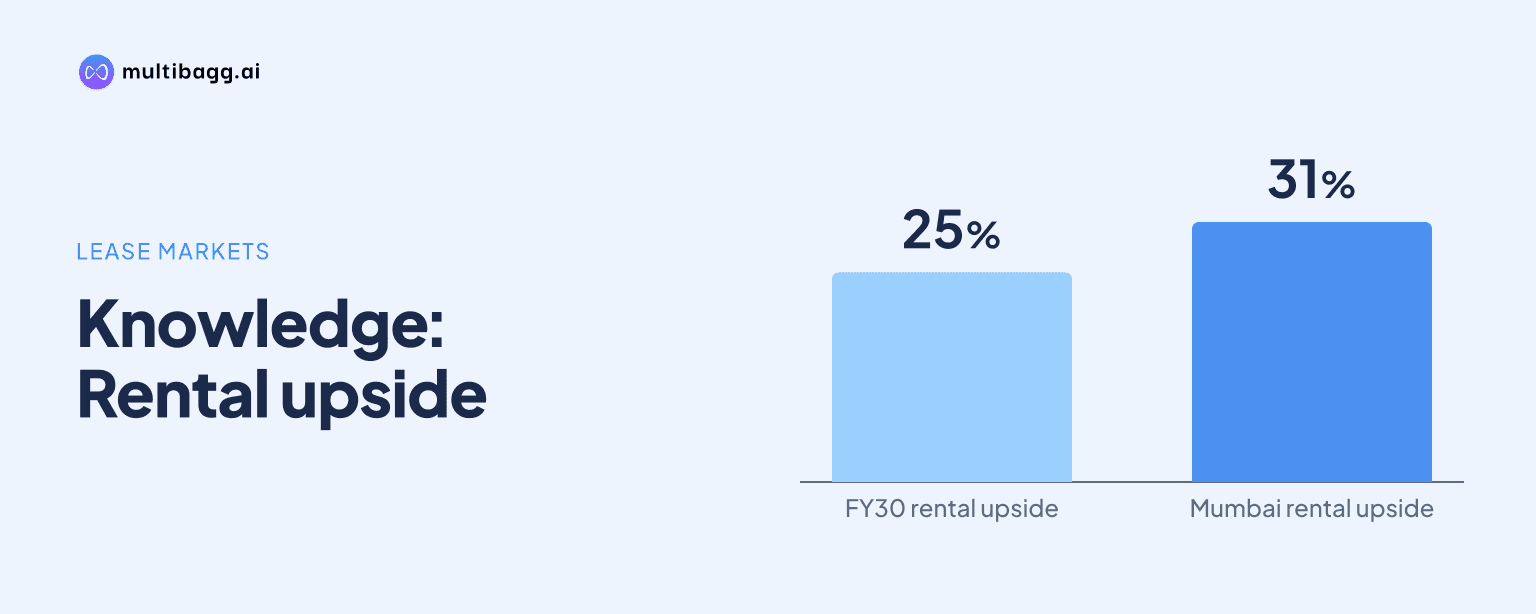
Knowledge Realty Trust said on November 3, 2026, that it has 25% weighted average rental mark-to-market potential through FY30, supported by 31% potential on Mumbai rentals expiring over the next two and a half years and a 41% average spread on Hyderabad repricing since listing. The outlook depends on lease expiries, vacancy leasing and selective tenant churn.
Know Knowledge Realty Trust inside out
Results, valuation, peers and who's buying, in one view.
How does KRT plan to capture 25% rental upside through FY30?
KRT plans to capture the 25% weighted average mark-to-market potential through FY30 through expiring-lease repricing, vacancy lease-up, annual escalations and conversion of committed leases into economic occupancy. Management also identified an active development pipeline and possible inorganic growth, with loan-to-value, or LTV, at 18%.
The operating base has improved since KRT listed in August 2025. Portfolio occupancy increased from 91% at listing to 93%, while in-place rent rose 7% year-on-year from Rs 94 to Rs 101 per square foot. In Q2 FY27, value-based occupancy reached 94%, rising 100 basis points from the previous quarter.
KRT achieved annual escalations on 100% of leasing completed in Q2 FY27. It also reported a 24% average leasing spread on 0.5 million square feet of the quarter's 0.8 million square feet of gross leasing. Gross leasing totalled 2.2 million square feet in the first half of FY27, providing the near-term pool for rental resets and occupancy gains.
Where are KRT's biggest rental repricing opportunities?
KRT identified Mumbai and Hyderabad as the principal current repricing markets, using different approaches. Mumbai is gaining occupancy while leases are renewed at higher rents, whereas Hyderabad was 99% occupied and relies on proactive tenant churn to reset rents when opportunities arise.
Mumbai occupancy reached 95% in Q2 FY27, up 300 basis points from the preceding quarter and 600 basis points in two quarters. Prima Bay became 100% leased from 88% in March after a leading engineering company took 66,000 square feet. One BKC rose from 87% to 96%, and the Central Mumbai portfolio increased from 89% to 95%.
KRT re-leased 0.6 million square feet in Mumbai during the preceding six months at a 28% spread. Management said 34% of Mumbai rentals will expire over the next two and a half years, carrying 31% mark-to-market potential. That potential is higher than the 25% weighted average for the whole portfolio through FY30.
In Hyderabad, KRT has repriced about 0.6 million square feet since listing at a 41% average spread across seven or eight leases, according to management. At Sattva Knowledge City, a global investment banking firm took 44,000 square feet at a gross rent of Rs 159 per square foot, against the prior Rs 83, while a global technology company took 23,000 square feet at Rs 163, against Rs 103.
Management said those Hyderabad rents were above market rents because they included value from fit-outs left by departing tenants. It said proactive churn should continue to create opportunities, but cautioned that the amount of such activity may vary year to year because the space is already leased before a tenant exit is arranged.
Got a follow-up? Ask IRIS
How much of KRT's near-term lease expiry is already addressed?
KRT said 66% of the 1.1 million square feet expiring in the second half of FY27 was tied up or under closure at a 23% spread. The disclosure gives a near-term indicator for the FY30 potential, although management did not provide a final outcome for the remaining 34% of that expiry area.
The 23% spread on the partly addressed H2 FY27 expiry pool is below the 31% potential on Mumbai rentals expiring over two and a half years. It is also close to the portfolio-wide 25% weighted average potential, indicating that the FY30 estimate incorporates lease maturities across several markets rather than only the current half-year expiry cycle.
Economic occupancy is another conversion lever. It rose from 87% at the end of the previous quarter to 88% at September 30, 2026, and reached 89% as of October 31, 2026. The gap with committed occupancy narrowed from 6 percentage points at the end of the prior quarter to 4 percentage points, with management expecting further compression during FY27.
What could Bengaluru vacancies and new assets contribute?
KRT said Bengaluru occupancy could move closer to 90% by the end of FY27 from 86% at the time of an analyst question, but management presented this as an expectation rather than formal guidance. KRT completed about 1.1 million square feet of new leasing in Bengaluru in the prior year, offset by exits of a similar amount, leaving occupancy broadly flat.
Exora, Cessna and Softzone account for about 0.8 million square feet of vacancy in Bengaluru's outer-ring-road market, and KRT said it was in advanced discussions for large take-ups there. Global City has a separate 0.8 million square feet vacancy, where management described leasing progress as slow and steady in a sub-Rs 60 per square foot rental market.
KRT said it had completed or was completing special economic zone demarcation for about 0.5 million square feet at Global City and Cessna. Bengaluru also gained about 100,000 square feet through efficiency gains since listing as legacy tenants exited and new occupiers configured their premises differently.
Sattva Endeavour is scheduled to become operational in Q3 FY27 and was 25% pre-leased, while Sattva Spectrum is expected to become operational in Q4 FY27. KRT said it was in advanced leasing discussions at both properties. Separately, Q2 FY27 revenue rose 13% year-on-year to Rs 1,273 crore and net operating income rose 15% to Rs 1,140 crore, with a 90% margin.
Conclusion
KRT's 25% weighted average mark-to-market potential through FY30 is based on identified lease expiries and observed re-leasing spreads, not solely on raising occupancy. Mumbai offers 31% potential on 34% of rentals expiring over two and a half years, while Hyderabad has produced a 41% average spread on 0.6 million square feet since listing despite 99% occupancy.
The next disclosed milestones are the remaining 34% of H2 FY27 expiry area, Bengaluru's progress from 86% occupancy toward management's expectation of close to 90% by FY27-end, and the Q3 FY27 and Q4 FY27 operational starts for Sattva Endeavour and Sattva Spectrum. Management also said it is evaluating sponsor and third-party acquisitions, without disclosing transaction terms or timing.