










Knowledge Realty Trust says GCC mix limits disruption risk
Key highlights
- GCCs accounted for 46% of KRT revenue in Q2 FY27, and front-office occupiers accounted for another 30%.
- KRT said traditional IT-services exposure was in low-single-digit occupancy.
- Portfolio occupancy reached 94% by value at September 30, 2026, up 100 basis points during Q2 FY27.
- KRT reported Q2 FY27 revenue of Rs 1,273 crore, up 13% year-on-year.
powered by IRIS
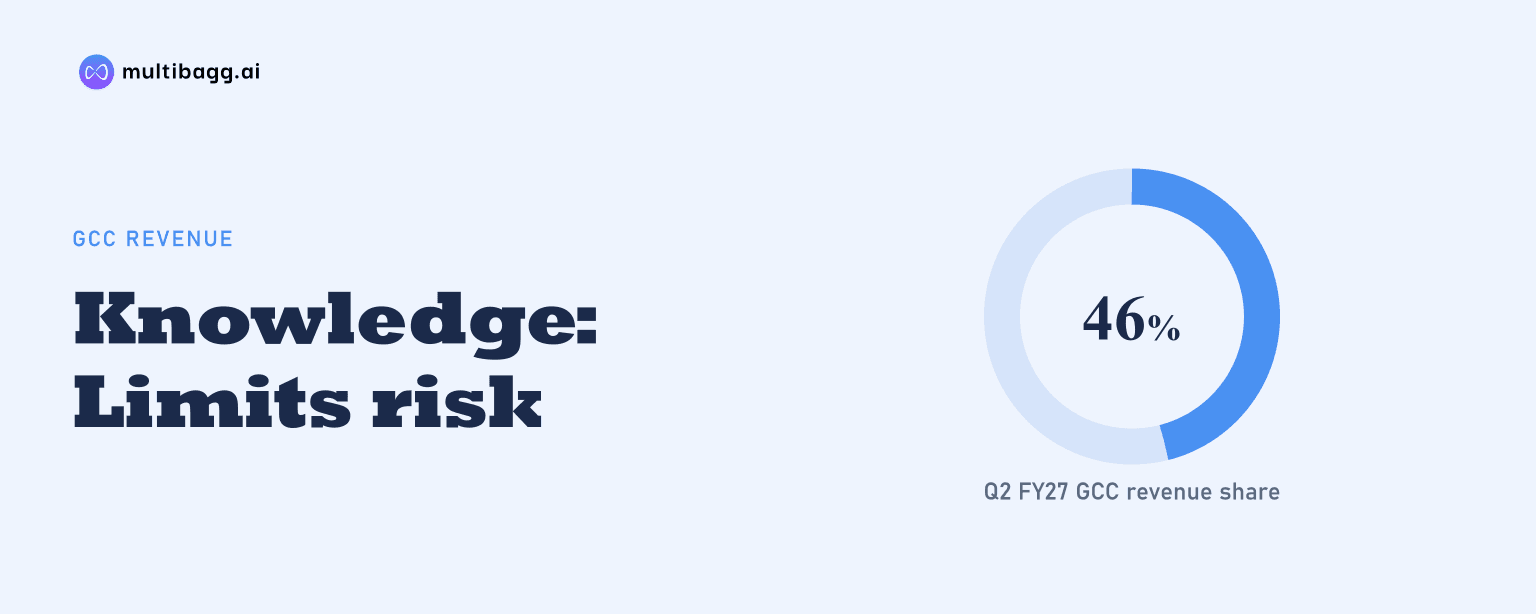
Knowledge Realty Trust said global capability centres, or GCCs, generated 46% of Q2 FY27 revenue, while front-office occupiers supplied another 30%, a mix management said limits direct exposure to disruption in traditional IT services. KRT reported 94% portfolio occupancy by value at September 30, 2026, up 100 basis points during the quarter.
Know Knowledge Realty Trust inside out
Results, valuation, peers and who's buying, in one view.
How concentrated is KRT's revenue in GCCs?
KRT said GCCs account for 46% of overall revenue, rather than 46% of leased area. Management used revenue as the relevant measure when responding to an investor question on potential artificial-intelligence-led disruption among technology occupiers during the November 3, 2026 earnings call.
Front-office occupiers, described by management as India-facing clients, contribute a further 30% of KRT revenue. Together, GCCs and front-office tenants represented 76% of revenue in Q2 FY27, leaving 24% across other tenant categories. The call did not provide a detailed revenue split for the remaining categories.
The GCC mix also reflects a wider leasing-market shift cited by management. GCCs accounted for 43% of office absorption in the first nine months of calendar year 2026, compared with 30% four years earlier. Hyderabad and Bengaluru represented about two-thirds of GCC leasing in the September quarter, and those two cities also make up nearly two-thirds of KRT's portfolio.
Why does KRT think its tenant mix limits technology disruption risk?
KRT said its traditional IT-services exposure is in the low single digits of occupancy, which management identified as the technology tenant segment more likely to pivot or face disruption. Management contrasted that limited exposure with GCCs' 46% revenue share and the 30% contribution from front-office occupiers.
Chief Executive Officer Shirish Godbole said management remained optimistic about office demand over the next six and 12 months, while acknowledging that it could not forecast longer-term outcomes. He said India had become more integrated into front-office operations and that technology was tied closely to business strategy and execution, supporting continued office demand in the foreseeable future.
This outlook is management's assessment rather than a leasing forecast. In Q2 FY27, KRT reported portfolio occupancy of 93% by area and 94% by value, with the value-based figure up 100 basis points during the quarter. A basis point is one-hundredth of a percentage point.
What does KRT's leasing performance show about office demand?
KRT reported 0.8 million square feet of gross leasing in Q2 FY27 and 2.2 million square feet in the first half of FY27. Of the quarterly total, 0.5 million square feet achieved an average leasing spread of 24%, meaning rents on those transactions exceeded preceding contractual levels by that percentage.
Mumbai delivered the largest recent occupancy improvement. The city reached 95% occupancy, up 300 basis points from the preceding quarter and 600 basis points over two quarters. KRT said it re-leased 0.6 million square feet in Mumbai over the prior six months at a 28% spread, while Prima Bay became fully leased from 88% in March and One BKC rose from 87% to 96%.
Hyderabad, where occupancy was 99%, offered a different route to rental growth. Since listing, KRT said it had repriced about 0.6 million square feet at an average spread of 41% through proactive churn. At Sattva Knowledge City, a global investment-banking firm leased 44,000 square feet at Rs 159 per square foot, compared with a previous rent of Rs 83, while a global technology company took 23,000 square feet at Rs 163, against Rs 103 previously.
Bengaluru remained the less occupied market, at 86%, despite 1.1 million square feet of new leasing over the preceding year because exits were of a similar size. Management said Exora, Cessna and Softzone accounted for about 0.8 million square feet of vacancy, while Global City had another 0.8 million square feet. It cited advanced discussions for larger take-ups in the first three assets and said Bengaluru could move closer to 90% by the end of FY27.
Got a follow-up? Ask IRIS
What occupancy and rental growth does KRT expect next?
KRT management said it was looking for same-store occupancy of 94% to 95% by March 2027, compared with 93% by area at the end of Q2 FY27. The overall portfolio figure could be about 1 percentage point lower after the addition of assets in Bengaluru, so the range is not a formal forecast for the expanded portfolio.
Economic occupancy rose from 87% at the end of the preceding quarter to 88% at September 30, 2026, and to 89% as of October 31. Management said the gap to committed occupancy narrowed from 6 percentage points at the previous quarter-end to 4 percentage points, and expected it to compress further during FY27 as contracted leases start contributing rent.
Rental reversion remains a disclosed growth mechanism. KRT said 34% of Mumbai rentals will expire over the next two and a half years, carrying 31% mark-to-market potential, while the portfolio's weighted average mark-to-market potential is 25% through FY30. Of the 1.1 million square feet due to expire in the second half of FY27, 66% was already tied up or under closure at a 23% spread.
Development is another part of management's plan. Sattva Endeavour was scheduled to become operational in Q3 FY27 and was 25% pre-leased, while Sattva Spectrum was scheduled for Q4 FY27. KRT said the 1.4 million-square-foot Global City block was about three years from completion, and Image Tower was expected to be considered for acquisition in the second half of calendar year 2027.
Conclusion
KRT's stated tenant mix places GCCs and front-office occupiers at 76% of revenue, while traditional IT services are only a low-single-digit share of occupancy. That composition underpins management's view that the portfolio has less direct exposure to the tenant segment it regards as most susceptible to technology-sector disruption. The operating evidence in Q2 FY27 included 94% value-based occupancy, 0.8 million square feet of gross leasing and revenue growth of 13% year-on-year to Rs 1,273 crore.
The next test is whether leasing converts in Bengaluru, where occupancy was 86%, and in the assets scheduled to open in Q3 and Q4 FY27. Investors can watch progress toward management's 94% to 95% same-store occupancy range by March 2027, lease-up at the 25%-pre-leased Sattva Endeavour, and any update on Image Tower or other acquisition discussions in calendar year 2027.