










KPR Mill Q1 FY27: Sugar Growth Lifts Margin Outlook
Key highlights
- K.P.R. Mill reported Q1 FY27 revenue of Rs 19,355 million, up 9.6% year on year and 4.4% above the Motilal Oswal estimate.
- Sugar represented 22% of the portfolio and grew 21% in Q1 FY27, while textiles represented 77% and grew 1%.
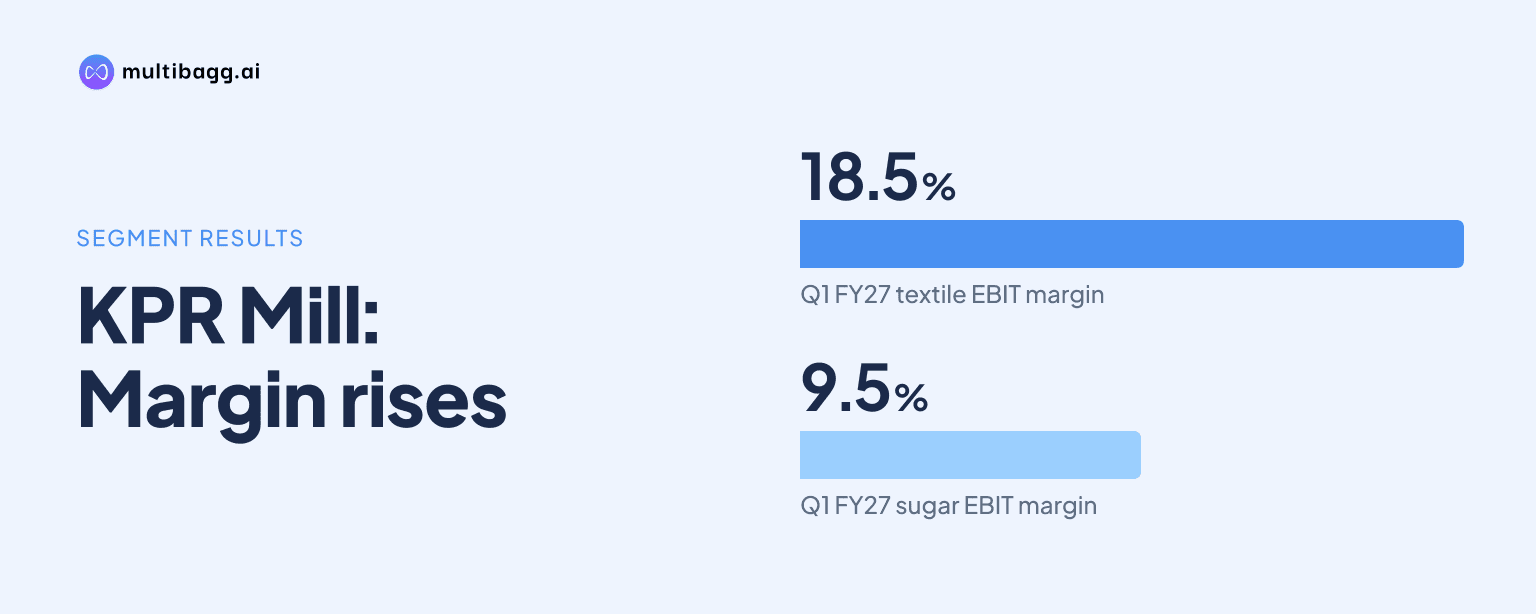
- Textile EBIT margin increased 130 basis points year on year to 18.5% in Q1 FY27.
- Sugar EBIT margin rose 920 basis points year on year to 9.5%, while gross margin expanded 480 basis points to 40.7%.
powered by IRIS
Q1 performance sets the context
K.P.R. Mill reported revenue of Rs 19,355 million in the first quarter of FY27, up 9.6% year on year. Revenue was also 4.4% above Motilal Oswal’s estimate of Rs 18,546 million. The result showed a mixed segment trend, with sugar delivering the larger growth contribution while textiles remained broadly stable. Sugar accounted for 22% of the portfolio and grew 21% during the quarter. Textiles contributed 77% of sales but recorded growth of 1%. The improvement in profitability was more pronounced than the change in textile sales. This makes margin performance a central factor in assessing the quarter.
Know K P R Mill inside out
Results, valuation, peers and who's buying, in one view.
Sugar business drives revenue growth
The sugar business was the strongest reported source of growth in Q1 FY27. Its 21% growth contrasted with the 1% increase in the textile portfolio. As sugar represented 22% of the portfolio, its expansion helped lift consolidated revenue despite muted textile growth. The available data does not provide standalone sugar revenue or volume figures. It also does not provide a quantified breakup for garments within the textile portfolio. Still, the reported segment mix indicates that sugar made a meaningful contribution to the quarter’s overall growth. Investors will therefore be watching whether the segment can maintain this earnings support in subsequent periods.
Textile margins improve despite muted sales
Textile EBIT margin improved by 130 basis points year on year to 18.5% in Q1 FY27. This occurred even as textile revenue growth was limited to 1%. The margin movement suggests that profitability in the company’s largest business improved despite the modest top-line trend. Since textiles represented 77% of sales, changes in this segment have a substantial effect on overall operating performance. The company’s reported figures do not specify the underlying reasons for the margin expansion. Accordingly, the improvement should be viewed as a reported quarterly outcome rather than attributed to any particular cost or pricing factor. Further disclosures with later results may offer a clearer view of the sustainability of the margin trend.
Sugar profitability expands sharply
Sugar EBIT margin rose by 920 basis points year on year to 9.5%. This was the largest segment-level margin improvement reported for the quarter. Combined with 21% revenue growth, the change reinforced sugar’s contribution to consolidated profitability. The difference between sugar and textile margins remains significant, with textiles reporting an 18.5% EBIT margin. However, the pace of sugar margin improvement was far higher in percentage-point terms. The quarterly gross margin expanded by 480 basis points year on year to 40.7%, providing another indication of improved profitability across the business mix. The data supplied does not disclose segment-wise gross margins.
Key Q1 FY27 figures
Got a follow-up? Ask IRIS
Comparison with recent quarterly data
The reported Q1 FY27 revenue of Rs 19,355 million was also stated as an 8.45% quarter-on-quarter increase from Rs 17,846.5 million. Another supplied quarterly data set lists Q1 FY26 net sales at Rs 17,663 million, while the Q1 FY27 result was Rs 19,355 million. The company’s Q1 FY27 operating profit was stated at Rs 3,750 million, with an operating margin of 19.37%, and net profit was Rs 2,590 million. For comparison, Q2 FY26 revenue was Rs 16,320.3 million, operating profit was Rs 3,381.6 million, and PAT was Rs 2,180.3 million. These are quarterly figures from different periods and should not be treated as direct like-for-like comparisons without the company’s complete financial statements. They nevertheless show the scale of the latest reported quarter relative to recent disclosed results.
FY27 and FY28 earnings estimates
Motilal Oswal’s estimates in the supplied material place FY27 revenue at Rs 75,203 million and FY28 revenue at Rs 84,626 million. The estimates imply revenue growth between the two forecast years. EBITDA margin is estimated at 20.8% for FY27 and 21.5% for FY28. Adjusted PAT is estimated at Rs 10,664 million for FY27 and Rs 12,519 million for FY28. These are estimates, not company guidance or reported results. The Q1 margin gains in textiles and sugar are relevant because the forecasts assume higher margins in FY28. Actual performance will depend on subsequent quarterly results and business conditions not detailed in the supplied information.
Forecast snapshot
Market relevance of the result
The first-quarter result matters because KPR Mill’s revenue beat the cited analyst estimate and margins strengthened in both reported segments. The company’s portfolio remains primarily textile-led, so the 1% textile revenue growth remains an important constraint within an otherwise higher-revenue quarter. At the same time, the 130-basis-point increase in textile EBIT margin indicates improved profitability in the dominant business. Sugar’s 21% growth and 920-basis-point margin increase provided additional support. The 480-basis-point expansion in gross margin to 40.7% was a key consolidated indicator. Investors assessing the company’s outlook will likely focus on whether these segment margins are retained as revenue progresses through the year.
Next scheduled result
K.P.R. Mill’s board approved unaudited standalone and consolidated results for the quarter ended June 30, 2026, at its meeting on August 10, 2026. The supplied corporate calendar lists an earnings release for Q2 FY27 on October 28, 2026. That release will provide the next reported update on revenue, segment growth and margins. It will also show whether sugar continues to offset slower growth in textiles. The Q1 FY27 result established a higher margin base, but no conclusion on future performance can be drawn until the next reported numbers are available. For now, the available figures show that sugar growth and improved segment profitability supported KPR Mill’s margin outlook in the opening quarter of FY27.