










Kranti Industries H1 operating cash flow rises to Rs 4.33 crore
Key highlights
- Kranti Industries generated Rs 4.33 crore of operating cash flow in H1 2026, up from Rs 3.01 crore in H1 2025.
- Trade receivables released Rs 6.90 crore of cash in H1 2026, versus a Rs 2.71 crore cash outflow a year earlier.
- Inventories used Rs 9.04 crore of cash in H1 2026, compared with Rs 8.46 crore in H1 2025.
- Operating profit before working-capital changes was Rs 6.76 crore, down from Rs 7.29 crore.
powered by IRIS
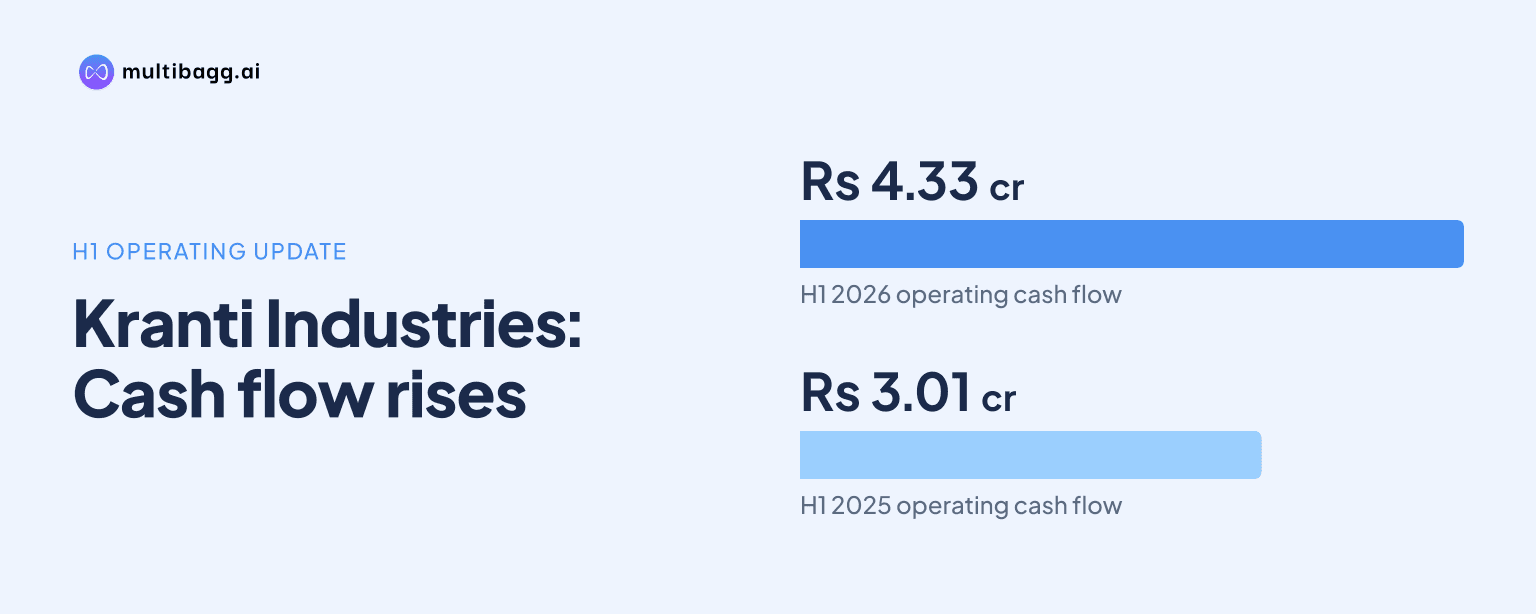
Kranti Industries Limited generated Rs 4.33 crore of net operating cash flow in the half year ended 30 September 2026, up 44% from Rs 3.01 crore a year earlier, as a Rs 6.90 crore release from trade receivables partly offset a Rs 9.04 crore inventory-related cash outflow. The company’s pre-working-capital operating profit declined to Rs 6.76 crore.
Know Kranti Industries inside out
Results, valuation, peers and who's buying, in one view.
How much operating cash did Kranti Industries generate in H1?
Kranti Industries generated Rs 4.33 crore in net cash flow from operating activities in the half year ended 30 September 2026, compared with Rs 3.01 crore in the half year ended 30 September 2025. The Rs 1.32 crore increase followed income-tax payments of Rs 14.10 lakh in H1 2026, compared with Rs 11.76 lakh in the prior-year half.
Cash generated from operations before income-tax payments rose to Rs 4.47 crore in H1 2026 from Rs 3.12 crore in H1 2025. The cash-flow statement is standalone and uses the indirect method under Indian Accounting Standard, or Ind AS, 7, which starts with profit and adjusts for non-cash charges and changes in working-capital balances.
What drove Kranti Industries’ operating cash-flow increase?
Kranti Industries’ largest disclosed working-capital change was a Rs 6.90 crore cash inflow from trade receivables in H1 2026, compared with a Rs 2.71 crore cash outflow in H1 2025. This Rs 9.61 crore year-on-year swing in the receivables line helped offset the higher inventory cash requirement during the 2026 half year.
The standalone balance sheet shows trade receivables at Rs 11.19 crore on 30 September 2026, down from Rs 18.09 crore on 31 March 2026. Inventories moved in the opposite direction, rising to Rs 38.92 crore from Rs 29.88 crore over the same six-month period. The cash-flow statement records those movements as a Rs 6.90 crore inflow from receivables and a Rs 9.04 crore outflow for inventories.
How did inventory affect Kranti Industries’ operating cash flow?
Kranti Industries used Rs 9.04 crore of cash through inventory growth in H1 2026, compared with Rs 8.46 crore in H1 2025. The inventory-related outflow was Rs 57.80 lakh higher than a year earlier and exceeded the company’s Rs 4.33 crore net operating cash inflow, making collections from receivables significant to the positive operating cash result.
Trade payables contributed Rs 3.43 lakh of cash in H1 2026, far below the Rs 8.21 crore contribution reported in H1 2025. Other current financial liabilities added Rs 22.24 lakh, while other current assets used Rs 17.67 lakh. Current provisions used Rs 2.29 crore of cash in H1 2026, compared with Rs 4.17 crore in the prior-year half.
Got a follow-up? Ask IRIS
Did Kranti Industries’ pre-working-capital profit increase?
No. Kranti Industries reported operating profit before working-capital changes of Rs 6.76 crore in H1 2026, down from Rs 7.29 crore in H1 2025. The Rs 52.81 lakh decline indicates that the improvement in net operating cash flow came from reported working-capital movements rather than a higher pre-working-capital operating cash measure.
Standalone revenue from operations rose to Rs 50.62 crore for the six months ended 30 September 2026 from Rs 41.70 crore a year earlier, while profit before tax declined to Rs 69.08 lakh from Rs 2.76 crore. In the operating cash-flow reconciliation, depreciation and amortisation was Rs 4.06 crore, up from Rs 3.29 crore, and interest paid was Rs 2.46 crore, compared with Rs 1.74 crore in H1 2025.
What happened to Kranti Industries’ investing and financing cash flows?
Kranti Industries ended H1 2026 with Rs 10.73 lakh of cash and cash equivalents, compared with Rs 13.18 lakh at the beginning of the half year. The Rs 2.45 lakh net decrease came after the Rs 4.33 crore operating cash inflow was offset by Rs 3.21 crore used in investing activities and Rs 1.14 crore used in financing activities. The H1 2025 ending cash balance was Rs 2.22 lakh.
Investing activities included Rs 3.71 crore spent on property, plant and equipment, intangible assets and capital work-in-progress in H1 2026, compared with Rs 3.11 crore in H1 2025. Financing cash flows included Rs 46.20 lakh from long-term borrowings, Rs 1.67 crore from net short-term borrowings, Rs 2.19 crore of interest paid and Rs 81.36 lakh of lease-principal payments.
How did Kranti Industries’ balance-sheet funding change?
Kranti Industries’ standalone current borrowings were Rs 24.68 crore at 30 September 2026, up from Rs 23.01 crore at 31 March 2026. Non-current borrowings increased to Rs 19.28 crore from Rs 18.82 crore, while total equity increased to Rs 46.45 crore from Rs 45.91 crore over the same period.
Current liabilities were Rs 54.72 crore at 30 September 2026, compared with Rs 51.77 crore six months earlier. Within that total, dues to creditors other than micro and small enterprises were Rs 18.71 crore, down from Rs 19.31 crore, while dues to micro and small enterprises increased to Rs 4.72 crore from Rs 4.08 crore.
Conclusion
Kranti Industries’ H1 2026 operating cash flow increased to Rs 4.33 crore despite a Rs 9.04 crore inventory outflow and lower operating profit before working-capital changes. The central change was the Rs 6.90 crore cash release from trade receivables, compared with a Rs 2.71 crore use of cash from the same line in H1 2025, while trade payables provided materially less cash than a year earlier.
The next reporting period will show whether inventory, which stood at Rs 38.92 crore on 30 September 2026, is converted into sales and cash, and whether receivables remain near Rs 11.19 crore. It will also show the cash effect of the Rs 3.71 crore H1 spending on property, plant and equipment, intangible assets and capital work-in-progress, alongside the Rs 1.67 crore net increase in short-term borrowings.