








Krishca projects Rs 98.22 crore in four-year PLI incentives
MAX Plan at ₹4,999/yr

Find your next multibaggerBe a Pro Investor
Research stocks and track your picks on the go. Download the app.
Key highlights
- Krishca projects Rs 98.22 crore of potential PLI incentives across two speciality-steel projects.
- The cold-rolling project accounts for Rs 72.93 crore of the projected PLI total from FY27 to FY30.
- Vajra is projected to add Rs 25.28 crore of PLI incentives from FY28 through FY30.
- The Chennai cold rolling mill has Rs 130 crore of listed capex and commercial production targeted around December 2026.
powered by IRIS
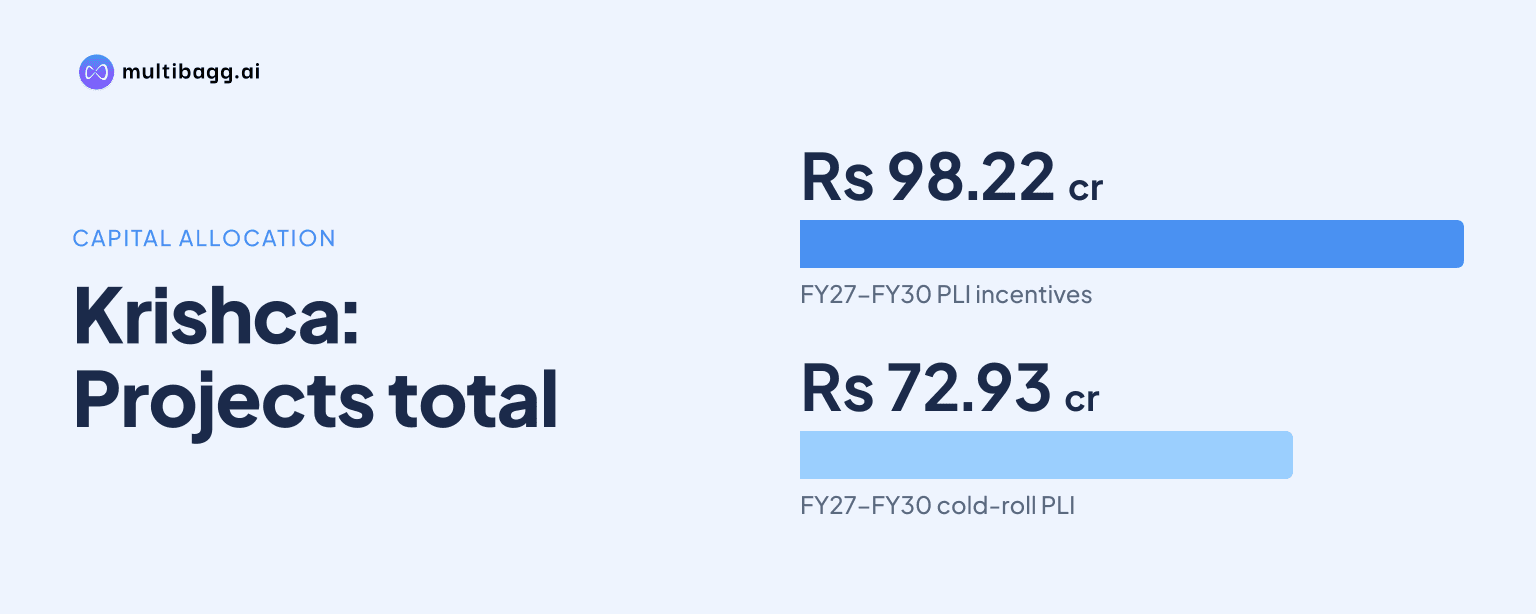
Krishca Strapping Solutions Limited projects Rs 98.22 crore of potential Production Linked Incentive (PLI) receipts over four years, based on disclosed cold-rolling and superalloy production ramps, with Rs 72.93 crore assigned to the cold-rolling project from FY27 to FY30.
Know Krishca Strapping Solutions inside out
Results, valuation, peers and who's buying, in one view.
What PLI incentive total does Krishca project?
Krishca projects Rs 98.22 crore of PLI incentives from two speciality-steel projects, comprising Rs 72.93 crore from its cold-rolling mill project and Rs 25.28 crore from Vajra Alloys. The cold-rolling schedule covers FY27 through FY30, while the Vajra schedule begins in FY28 and ends in FY30, despite the presentation describing the combined opportunity as four years.
The presentation says both new projects have qualified for the government PLI scheme and describes the amount as potential incentives over the next four years. It also says Krishca was the only South India company to have a Ministry of Steel PLI memorandum of understanding among 88 memorandums signed in February 2026. The disclosed calculations, however, are linked to incremental production rather than a fixed payment.
How does the cold-rolling project produce Rs 72.93 crore of PLI?
Krishca projects Rs 72.93 crore of PLI incentives from the cold-rolling project as annual production rises from 12,000 tonnes in FY27 to 70,000 tonnes in FY30. The project’s largest annual incentive is Rs 22.14 crore in FY29, when the table assumes 45,000 tonnes of production and a 9% incentive rate.
The production plan increases by 58,000 tonnes between FY27 and FY30, while the incentive rate declines from a high of 10% in FY28 to 7% in FY30. As a result, the incentive value rises to Rs 22.14 crore in FY29 before reducing to Rs 21.52 crore in FY30, even though the incremental-production value increases by Rs 61.50 crore in the final year.
The presentation describes the Chennai cold rolling mill as a 60,000-tonnes-per-annum facility requiring Rs 130 crore of capital expenditure, with commercial production targeted around December 2026. That stated capacity is 10,000 tonnes below the FY30 production assumption of 70,000 tonnes in the PLI table, and the presentation does not explain the difference. It also lists FY27 monthly production of 1,333 tonnes alongside annual production of 12,000 tonnes.
What does Vajra Alloys add to Krishca’s PLI projection?
Vajra Alloys contributes a projected Rs 25.28 crore to Krishca’s total PLI estimate, based on production increasing from 150 tonnes in FY28 to 700 tonnes in FY30. The annual incentive values shown are Rs 6.46 crore in FY28, Rs 9.33 crore in FY29 and Rs 9.48 crore in FY30.
Vajra’s incentive rate declines from 15% in FY28 to 13% in FY29 and 11% in FY30, while the incremental-production value considered for PLI rises from Rs 43.09 crore to Rs 86.19 crore. The table separately shows total values under the PLI 1.2 guidelines of Rs 43.09 crore, Rs 114.92 crore and Rs 201.11 crore across the three years. The incentive calculation uses the lower incremental-production values, not the full annual values.
The Vajra facility has phase-one capacity of 800 tonnes per annum, compared with the modelled FY30 output of 700 tonnes. The presentation identifies aerospace, defence, industrial engineering, oil and gas and power plants as target industries. It says industrial and precision components are the near-term focus, while defence and aerospace approvals are expected to take about 12 months.
Got a follow-up? Ask IRIS
How are the incentive amounts calculated under Krishca’s plan?
Krishca calculates the projected incentives by applying stated percentage rates to incremental production values rather than to total annual output values. For the cold-rolling project in FY28, the presentation shows total value of Rs 307.50 crore but incremental production considered for PLI of Rs 159.90 crore; at a 10% rate, this results in the listed Rs 15.99 crore incentive.
The same mechanism is shown for Vajra in FY30, where the project’s total value under PLI 1.2 guidelines is Rs 201.11 crore and the incremental value is Rs 86.19 crore. Applying the disclosed 11% rate gives the listed Rs 9.48 crore incentive after rounding. The annual Vajra incentive figures add to Rs 25.27 crore after rounding, whereas the presentation reports a Rs 25.28 crore project total.
The cold-rolling annual incentive figures add to the reported Rs 72.93 crore total, and the two stated project totals produce the reported Rs 98.22 crore combined amount. The Rs 0.01 crore difference between Vajra’s displayed annual values and its stated total indicates a rounding effect, although Krishca does not disclose the underlying unrounded figures.
What will determine whether Krishca receives the projected incentives?
Krishca’s projected Rs 98.22 crore depends on achieving the disclosed production ramp, the associated incremental-production values and the incentive rates in the PLI schedule. Cold-rolling output is assumed to rise from 12,000 tonnes in FY27 to 70,000 tonnes in FY30, while Vajra output is assumed to increase from 150 tonnes in FY28 to 700 tonnes in FY30.
The project schedules also show declining rates as output expands. Cold rolling moves from 9% in FY27 to 10% in FY28 before declining to 7% in FY30, while Vajra declines from 15% in FY28 to 11% in FY30. Therefore, higher output does not automatically result in a proportionately higher incentive because the calculations use incremental value and changing rates.
For the Chennai project, the December 2026 commercial-production target precedes the FY27 incentive schedule. For Vajra, the presentation’s stated approximately 12-month approval timeline for defence and aerospace applications remains relevant to its target markets, although its PLI table is based on production volumes rather than customer approvals.
Conclusion
Krishca’s PLI projection is concentrated in the cold-rolling project, which accounts for Rs 72.93 crore of the Rs 98.22 crore combined estimate. Vajra adds Rs 25.28 crore from FY28 to FY30, with both calculations relying on incremental production values instead of the projects’ full annual values under the PLI guidelines.
The next disclosed milestones are commercial production around December 2026 for the Rs 130 crore Chennai cold rolling mill and Vajra’s approximately 12-month defence and aerospace approval process. Readers can also watch whether Krishca reconciles the Chennai facility’s stated 60,000-tonnes-per-annum capacity with the 70,000-tonne FY30 production assumption in the PLI schedule.

