










Krishna GVK Q2 profit rises 64% on Rs 22.95 crore dividend
Key highlights
- Krishna GVK's Q2 financial year 2026-27 standalone profit after tax rose 64% to Rs 38.53 crore.
- Krishna GVK received a Rs 22.95 crore dividend from Green Woods Palaces and Resorts Private Limited in Q2.
- Standalone revenue from operations increased 5.3% year on year to Rs 112.90 crore.
- Capital work in progress increased to Rs 365.86 crore at September 30, 2026 from Rs 298.42 crore at March 31, 2026.
powered by IRIS
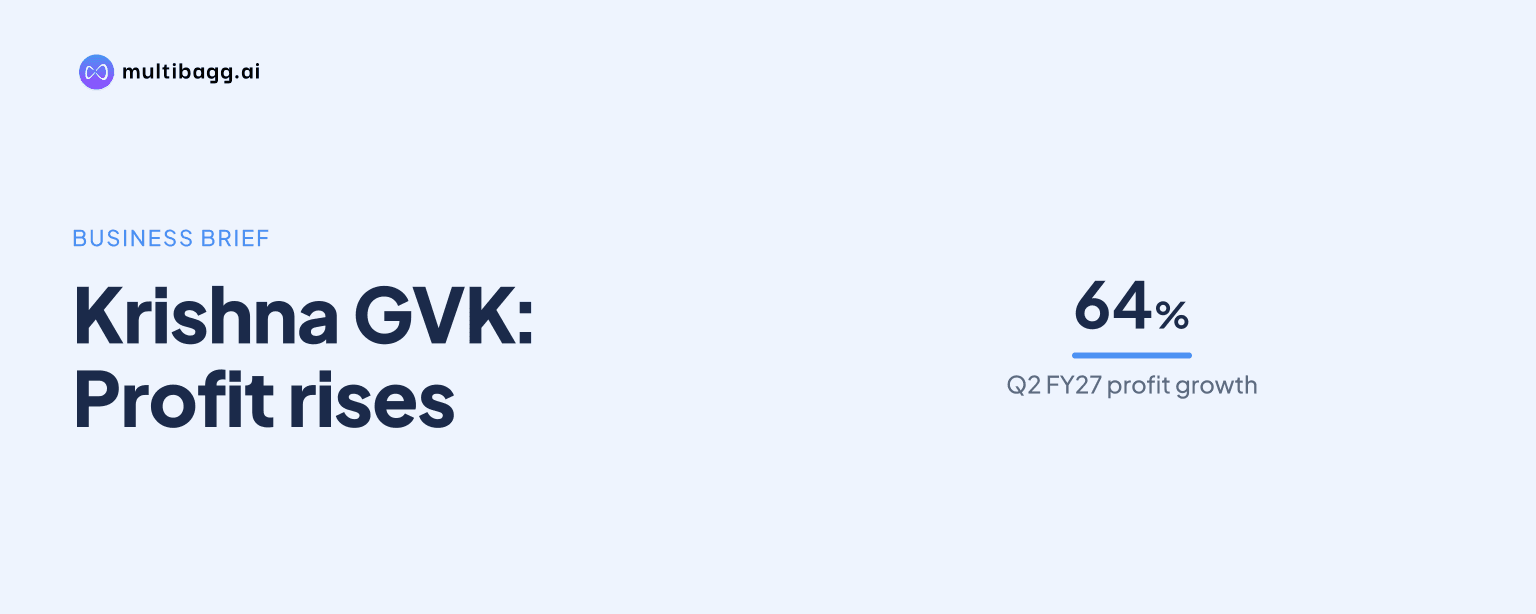
KRISHNA GVK Luxury Hotels Limited reported standalone profit after tax of Rs 38.53 crore for the second quarter (Q2) ended September 30, 2026, up 64% from Rs 23.51 crore a year earlier, after other income included a Rs 22.95 crore dividend from subsidiary Green Woods Palaces and Resorts Private Limited.
Know TajGVK Hotels & Resorts inside out
Results, valuation, peers and who's buying, in one view.
Why did Krishna GVK's Q2 standalone profit rise 64%?
The increase reflected other income of Rs 24.41 crore in the September 2026 quarter, compared with Rs 2.15 crore a year earlier. Krishna GVK said it received dividend income of Rs 22.95 crore from Green Woods Palaces and Resorts Private Limited during Q2 of financial year 2026-27, and included that dividend in other income.
Standalone profit before tax increased by Rs 20 crore year on year to Rs 51.50 crore, while tax expense rose by Rs 4.98 crore to Rs 12.97 crore. Profit after tax was Rs 38.53 crore, or earnings per share of Rs 6.14, compared with Rs 23.51 crore and Rs 3.75 per share in the quarter ended September 30, 2025.
How did Krishna GVK's hotel operations perform in Q2?
Krishna GVK's revenue from operations rose 5.3% year on year to Rs 112.90 crore in the quarter ended September 30, 2026, from Rs 107.18 crore. The company said it operates only in hoteliering, so separate operating-segment disclosure under Indian Accounting Standard (Ind AS) 108 was not applicable.
Operating revenue was also Rs 3.66 crore higher than the Rs 109.24 crore reported in the June 2026 quarter. Total expenses rose to Rs 85.81 crore from Rs 83.37 crore sequentially, while profit before tax rose to Rs 51.50 crore from Rs 26.05 crore as other income increased to Rs 24.41 crore from Rs 0.18 crore.
Year on year, employee benefits expense increased by Rs 1.29 crore to Rs 23.86 crore, fuel, power and light costs rose by Rs 1.08 crore to Rs 8.36 crore, and other expenses increased by Rs 5.14 crore to Rs 39.17 crore. Food and beverages consumed rose by Rs 0.45 crore to Rs 10.11 crore, while finance costs were Rs 1.16 crore against Rs 1.15 crore a year earlier.
What do Krishna GVK's half-year results show?
Krishna GVK reported standalone profit after tax of Rs 57.20 crore for the half year ended September 30, 2026, down from Rs 59.73 crore in the corresponding half of 2025. Revenue from operations nevertheless increased by Rs 8.57 crore to Rs 222.14 crore, while total income rose by Rs 9.11 crore to Rs 246.73 crore.
The half-year comparison shows total expenses increasing by more than operating revenue. Expenses rose by Rs 12.41 crore to Rs 169.18 crore, and profit before tax declined by Rs 3.30 crore to Rs 77.55 crore from Rs 80.85 crore, despite other income of Rs 24.59 crore against Rs 24.05 crore in the earlier period.
Tax expense for the six months decreased by Rs 0.77 crore to Rs 20.35 crore, including current tax of Rs 19.53 crore and deferred tax of Rs 0.82 crore. Basic and diluted earnings per share for the half year were Rs 9.12, compared with Rs 9.53 for the half year ended September 30, 2025.
Got a follow-up? Ask IRIS
How is Krishna GVK funding capital work in progress?
Krishna GVK's capital work in progress stood at Rs 365.86 crore at September 30, 2026, up from Rs 298.42 crore at March 31, 2026 and Rs 182.70 crore a year earlier. Property, plant and equipment was Rs 399.33 crore, compared with Rs 397.19 crore at March 31, 2026, while total assets reached Rs 1,122.27 crore.
During the half year ended September 30, 2026, Krishna GVK spent Rs 75.44 crore on property, plant and equipment including capital work in progress, compared with Rs 67.01 crore in the prior-year half. It received Rs 22.95 crore of dividends and Rs 3.13 crore of interest in investing cash flows, resulting in net cash used in investing activities of Rs 42.69 crore.
Operating activities generated net cash of Rs 9.96 crore in the six months, down from Rs 46.85 crore a year earlier. Financing cash flows contributed Rs 33.86 crore, including Rs 48.51 crore of proceeds from bank borrowings and Rs 12.54 crore of dividend paid; cash and cash equivalents ended the period at Rs 22.31 crore, compared with Rs 21.18 crore at March 31, 2026.
What changed in Krishna GVK's balance sheet and review status?
Krishna GVK's total borrowings were Rs 117.46 crore at September 30, 2026, comprising Rs 94.96 crore of non-current borrowings and Rs 22.50 crore of current borrowings. This was higher than Rs 68.78 crore at March 31, 2026, while the standalone debt-equity ratio was 0.15 for the half year, compared with 0.09 at March 31, 2026.
Total equity was Rs 775.45 crore at September 30, 2026, compared with Rs 730.79 crore at March 31, 2026. Statutory auditor M. Bhaskara Rao & Co. issued a limited review report dated November 12, 2026, stating that nothing had come to its attention suggesting the standalone results failed to disclose required information or contained a material misstatement.
Conclusion
Krishna GVK's Q2 standalone profit increase to Rs 38.53 crore combined a 5.3% rise in hoteliering revenue with a much larger increase in other income. The Rs 22.95 crore subsidiary dividend accounted for most of the Rs 24.41 crore other-income total, while total expenses increased by Rs 7.98 crore from a year earlier.
The unresolved point for subsequent disclosures is how the Rs 365.86 crore capital work-in-progress balance develops, as the filing does not identify the underlying projects. Changes in operating cash generation, which was Rs 9.96 crore in the first half, and borrowings, which rose to Rs 117.46 crore, will also show how the balance-sheet position changes alongside capital expenditure.