










KSH says copper pass-through moves margin percentages, not EBITDA
Key highlights
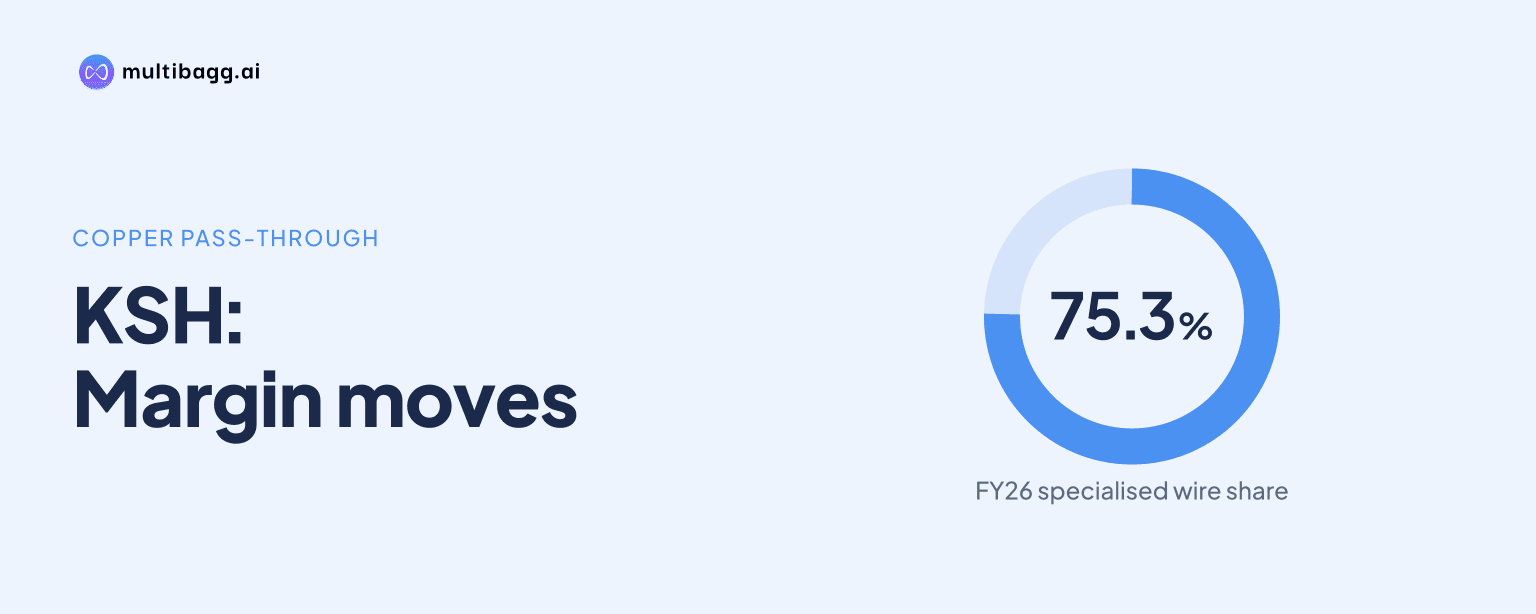
- Specialised magnet winding wires contributed 75.3% of KSH’s FY26 revenue, or Rs 2,187.1 crore.
- KSH says copper is fully passed through, while value addition is fixed per tonne in its pricing illustration.
- H1-FY27 EBITDA per tonne was Rs 97,600, up 48.58% from Rs 65,687 in H1 FY26.
- KSH plans to increase capacity from 57,845 metric tonnes to 72,200 metric tonnes by the end of Q1 FY29.
powered by IRIS
KSH International Limited says copper is fully passed through to customers, so a rise in copper prices can reduce its EBITDA margin percentage without reducing absolute EBITDA per tonne; specialised magnet winding wires accounted for 75.3% of FY26 revenue. The company’s illustration keeps EBITDA at Rs 60,000 per tonne as copper-linked revenue changes.
Know KSH International inside out
Results, valuation, peers and who's buying, in one view.
What share of KSH revenue comes from specialised winding wires?
Specialised magnet winding wires represented 75.3% of KSH’s FY26 revenue, while standard magnet winding wires represented 24.7%. Specialised-wire revenue was Rs 2,187.1 crore in FY26, compared with Rs 716.8 crore for standard magnet winding wires, making the specialised segment KSH’s larger reported product category.
KSH describes specialised wires as high-specification conductors for transformer and high-voltage uses, including high-voltage direct current, or HVDC, transformers, 765 kilovolt transformers and reactors. Its listed products include continuously transposed conductors, rectangular enamelled copper and aluminium magnet wires, and paper-insulated rectangular copper and aluminium wires. The company cites technical complexity, quality standards and long original equipment manufacturer approval cycles for this range.
Both segments grew from FY23 to FY26, but specialised-wire revenue increased by Rs 1,421.9 crore, compared with an increase of Rs 514.4 crore for standard wires. In H1-FY27, specialised wires generated Rs 1,760.3 crore and standard wires generated Rs 612.1 crore. KSH links specialised products to transformers, traction motors, wind generators and hydro generators, while it lists home appliances, motors, alternators and switchgear for standard round enamelled wires.
How does KSH pass through copper costs?
KSH says its pricing structure is copper price, passed through, plus value addition fixed per tonne. The copper component is linked to market prices, while the value-add component is fixed per tonne in the company’s stated mechanism. KSH therefore presents changes in copper prices as changes in the revenue component billed to customers.
KSH’s illustrative example assumes value addition of Rs 1 lakh per tonne and operating cost of Rs 40,000 per tonne. In each illustrated case, earnings before interest, tax, depreciation and amortisation, or EBITDA, are Rs 60,000 per tonne. These are assumed values rather than reported operating results, and are intended to explain the company’s margin mechanics.
When copper prices increase, KSH says revenue per tonne rises because the copper component is passed through. With value addition at Rs 1 lakh per tonne and operating cost at Rs 40,000 per tonne in the illustration, EBITDA remains Rs 60,000 per tonne despite the higher revenue base. KSH says the resulting decline in EBITDA margin percentage does not, in that example, represent a decline in absolute EBITDA per tonne.
Got a follow-up? Ask IRIS
Why can KSH’s EBITDA margin percentage change without lower EBITDA per tonne?
KSH says EBITDA margin percentage can change because copper prices alter the revenue denominator while absolute EBITDA per tonne stays stable in its illustration. At an assumed copper price of Rs 8 lakh per tonne, the illustration shows EBITDA margin of 7.5%; at Rs 9 lakh per tonne, it shows 6.7%; and at Rs 11 lakh per tonne, it shows 5.5%.
Across those three cases, the assumed value addition remains Rs 1 lakh per tonne, operating cost remains Rs 40,000 per tonne, and EBITDA remains Rs 60,000 per tonne. The percentage declines as the revenue base rises from Rs 8 lakh to Rs 11 lakh per tonne. KSH distinguishes this arithmetic effect from a change in the illustrated absolute EBITDA amount.
KSH also states that lower copper prices can decrease revenue per tonne and improve the EBITDA margin percentage because the denominator declines. Its presentation says this occurs while absolute EBITDA per tonne remains stable under the illustrated assumptions. Period comparisons of reported margin percentages therefore need to be read with KSH’s copper-linked pricing mechanism and EBITDA-per-tonne disclosure.
What do KSH’s recent volume and EBITDA-per-tonne figures show?
KSH reported H1-FY27 sales volume of 16,812 metric tonnes, up 27.83% from 13,152 metric tonnes in H1 FY26, while EBITDA per tonne rose 48.58% to Rs 97,600 from Rs 65,687. Revenue from operations increased 95.45% to Rs 2,483.9 crore, and EBITDA increased 89.93% to Rs 164.1 crore in H1-FY27.
In Q2 FY27, KSH reported sales volume of 8,842 metric tonnes, compared with 7,037 metric tonnes in Q2 FY26. Revenue from operations was Rs 1,319.7 crore, compared with Rs 712.1 crore a year earlier, while EBITDA was Rs 89.7 crore versus Rs 46.1 crore. EBITDA per tonne reached Rs 1,01,454, compared with Rs 65,515 in Q2 FY26.
Installed capacity rose from 29,045 metric tonnes on March 31, 2025, to 57,845 metric tonnes on September 30, 2026. FY26 sales volume was 28,168 metric tonnes, with capacity utilisation of 64.8%, while H1-FY27 utilisation was 76.0% on 16,812 metric tonnes. KSH’s board has approved further specialised-wire expansion to take total capacity to 72,200 metric tonnes by the end of Q1 FY29.
Conclusion
KSH’s disclosed product mix means specialised magnet winding wires accounted for more than three quarters of FY26 revenue, while its pricing model separates copper-linked billing from fixed value addition per tonne. The reported H1-FY27 figures showed revenue growth of 95.45%, sales-volume growth of 27.83% and EBITDA per tonne of Rs 97,600, alongside the company’s explanation that margin percentages can move with copper prices.
The next disclosed operational milestone is KSH’s plan to expand installed capacity from 57,845 metric tonnes as of September 30, 2026, to 72,200 metric tonnes by the end of Q1 FY29. The presentation leaves future copper-price movements and their effect on reported revenue denominators unresolved, while identifying volume, utilisation and EBITDA per tonne as relevant operating measures.