










KSH plans Rs 185 crore Supa expansion to 72,200 MT by Q1 FY29
Key highlights
- KSH plans capital investment of up to Rs 185 crore for a Supa specialised-wire expansion and land acquisition.
- KSH targets capacity of 72,200 MT by Q1 FY29, versus a planned post-Phase II base of 59,045 MT.
- KSH reported 57,845 MT of available capacity and 76% utilisation in Q2 FY27.
- KSH's H1 FY27 sales volume increased 27.83% year on year to 16,812 MT.
powered by IRIS
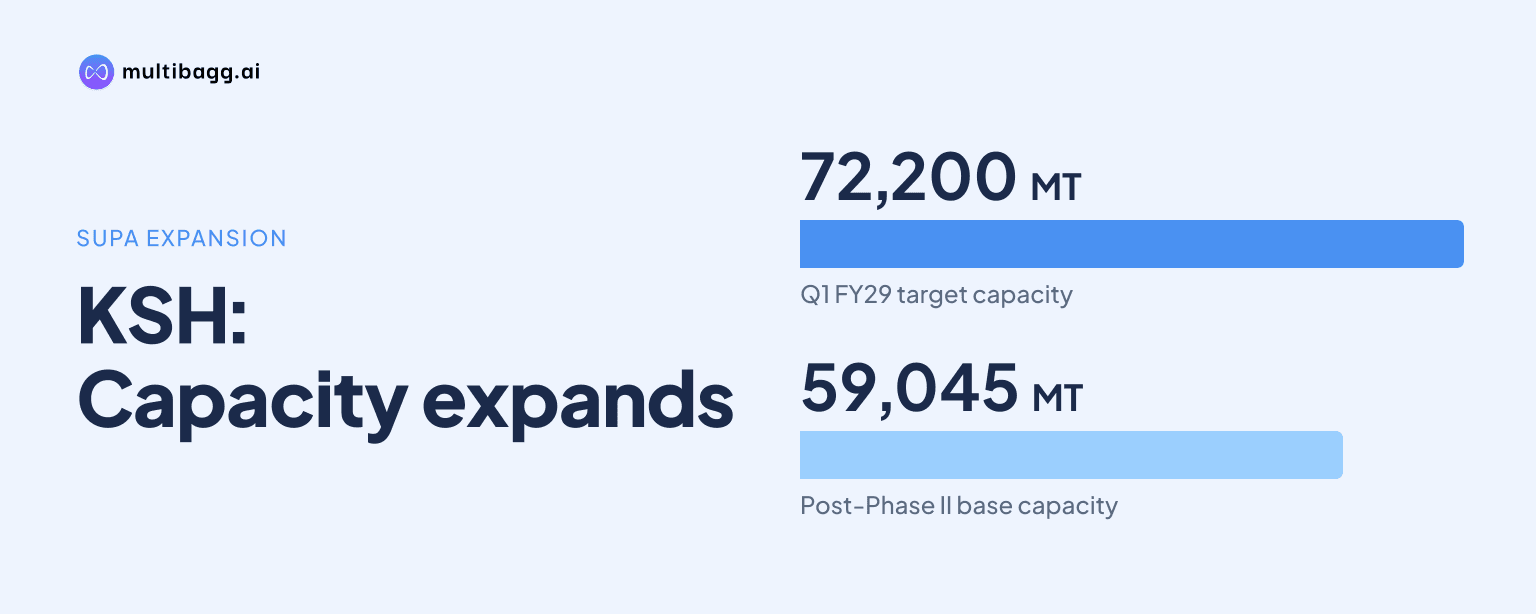
KSH International Limited plans to invest up to Rs 185 crore in a brownfield specialised-wire expansion and land acquisition at Supa, Ahilyanagar, targeting total capacity of 72,200 metric tonnes (MT) by Q1 FY29. The plan follows reported available capacity of 57,845 MT and 76% utilisation in Q2 FY27.
Know KSH International inside out
Results, valuation, peers and who's buying, in one view.
What is KSH's Supa specialised-wire expansion plan?
KSH has approved a Phase 3 project at Supa comprising a brownfield expansion and land acquisition, with capital investment of up to Rs 185 crore. The company presents the project as an expansion of specialised-wire capacity from 59,045 MT after Phase II to 72,200 MT after the project, a stated increase of 22%, with completion expected in Q1 FY29.
The Phase 3 investment is directed at specialised magnet winding wires rather than the whole product portfolio. Specialised magnet winding wires contributed 75.3% of KSH's FY26 revenue, compared with 24.7% from standard magnet winding wires. The specialised range includes continuously transposed conductors for high-voltage direct-current, or HVDC, transformers and 765 kilovolt transformers, along with rectangular enamelled copper and aluminium wires for traction motors and electric vehicles.
KSH's presentation uses two capacity measures before the Phase 3 addition. The expansion page identifies 59,045 MT as post-Phase II capacity, while the operating update states that 57,845 MT was available in Q2 FY27 and that 96% of the planned 59,045 MT had been installed six months ahead of schedule. This means the 59,045 MT figure is the planned Phase II base, whereas 57,845 MT was the capacity available at the reported date.
How has KSH's capacity utilisation changed?
KSH's installed capacity increased from 29,045 MT on March 31, 2025 to 57,845 MT as of September 30, 2026. The footprint update links the higher capacity to Phase I, part of Phase II and further capacity additions at the fourth unit in Supa, Maharashtra, which is positioned closer to customers pursuing expansion.
Sales volume rose from 23,324 metric tonnes per annum in FY25 to 28,168 MT in FY26, but capacity utilisation declined from 80.3% to 64.8% as the capacity base expanded. In H1 FY27, KSH reported sales volume of 16,812 MT and utilisation of 76.0%, indicating a higher utilisation rate than FY26 but below the FY25 level.
The Q2 FY27 operating update also reported 76% utilisation of available capacity, with quarterly sales volume of 8,842 MT. That volume was 25.65% above 7,037 MT in Q2 FY26, while H1 FY27 volume was 27.83% above 13,152 MT in H1 FY26. KSH has scheduled the Phase 3 project for Q1 FY29 despite reported utilisation remaining below the FY25 rate of 80.3%.
Got a follow-up? Ask IRIS
Which markets does KSH intend the new capacity to serve?
KSH says the Supa project is intended to serve transformers, railways, renewable energy and electric vehicles. Its stated rationale includes maintaining supply continuity for large original equipment manufacturers, or OEMs, with multi-year backlogs, improving the long-term mix towards specialised wires, supporting exports and increasing readiness for larger orders and new customer opportunities.
The company's cited end-use markets include power, renewables, industrials, railways, data centres, electric vehicles, internal-combustion-engine applications, home appliances, refrigeration and air conditioning. Its specialised-wire products are used in power and distribution transformers, wind-generator rotors and stators, hydro generators, locomotive traction transformers and electric-vehicle traction motors.
Management said domestic and international OEM demand supported utilisation of expanded specialised-wire capacity during Q2 FY27. It reported 87% year-on-year specialised revenue growth and 108% export revenue growth in the quarter, and said KSH had received trial HVDC export orders. The presentation does not disclose the value, delivery schedule or conversion outcome for those trial orders.
What financial and operating results provide context for KSH's plan?
KSH reported revenue from operations of Rs 2,483.9 crore in H1 FY27, up 95.45% from Rs 1,270.9 crore in H1 FY26. Earnings before interest, tax, depreciation and amortisation, or EBITDA, increased 89.93% to Rs 164.1 crore, while profit after tax increased 72.51% to Rs 90.2 crore. These increases were faster than the 27.83% rise in H1 sales volume to 16,812 MT.
EBITDA per tonne increased 48.58% to Rs 97,600 in H1 FY27 from Rs 65,687 in H1 FY26. In Q2 FY27, EBITDA per tonne was Rs 1,01,454, compared with Rs 65,515 a year earlier, as volume increased 25.65% to 8,842 MT. The specialised-wire mix was 74% in Q2 FY27, down from 77% in Q2 FY26.
KSH describes its pricing structure as the copper price passed through to customers plus fixed value addition per tonne. In its illustrative example, copper priced at Rs 8 lakh, Rs 9 lakh and Rs 11 lakh per tonne produces assumed EBITDA per tonne of Rs 60,000 in each case, although EBITDA margin changes from 7.5% to 6.7% and 5.5%. The example is an illustration rather than a forecast of actual copper prices or profitability.
KSH also reported total debt of Rs 341.3 crore in Q2 FY27, compared with Rs 484.3 crore in Q2 FY26, while debt-to-equity declined to 0.38 from 1.38. Management said debt consisted mostly of growth-driven working-capital loans and reported positive operating cash flow in H1 FY27, but the presentation does not specify the funding mix for the up to Rs 185 crore Phase 3 investment.
Conclusion
KSH's Phase 3 plan would add capacity after the company increased its available base to 57,845 MT in Q2 FY27 and reported 76% utilisation. The proposed Rs 185 crore project focuses on specialised wires, which accounted for 75.3% of FY26 revenue, and seeks to raise the post-Phase II capacity reference point of 59,045 MT to 72,200 MT.
The next disclosed milestone is completion by Q1 FY29. Before then, the measures to watch are progress from the reported 96% installation of the planned 59,045 MT, utilisation of available capacity, the specialised-wire revenue mix and export development, including whether trial HVDC orders develop into commercial business.