










Kusumgar Ltd. says approvals and integration support defence lock-in
Key highlights
- Kusumgar says more than 50 years of accumulated know-how supports its approval-led aerospace and defence business.
- Kusumgar lists five manufacturing locations: Kosamba, Kothwa, Karanj, Valsad and Vapi.
- Q2 FY27 revenue rose 81% year on year to Rs 250.9 crore.
- Kusumgar’s capability list expanded from weaving and coating in 2018 to integration and signature management by 2026.
powered by IRIS
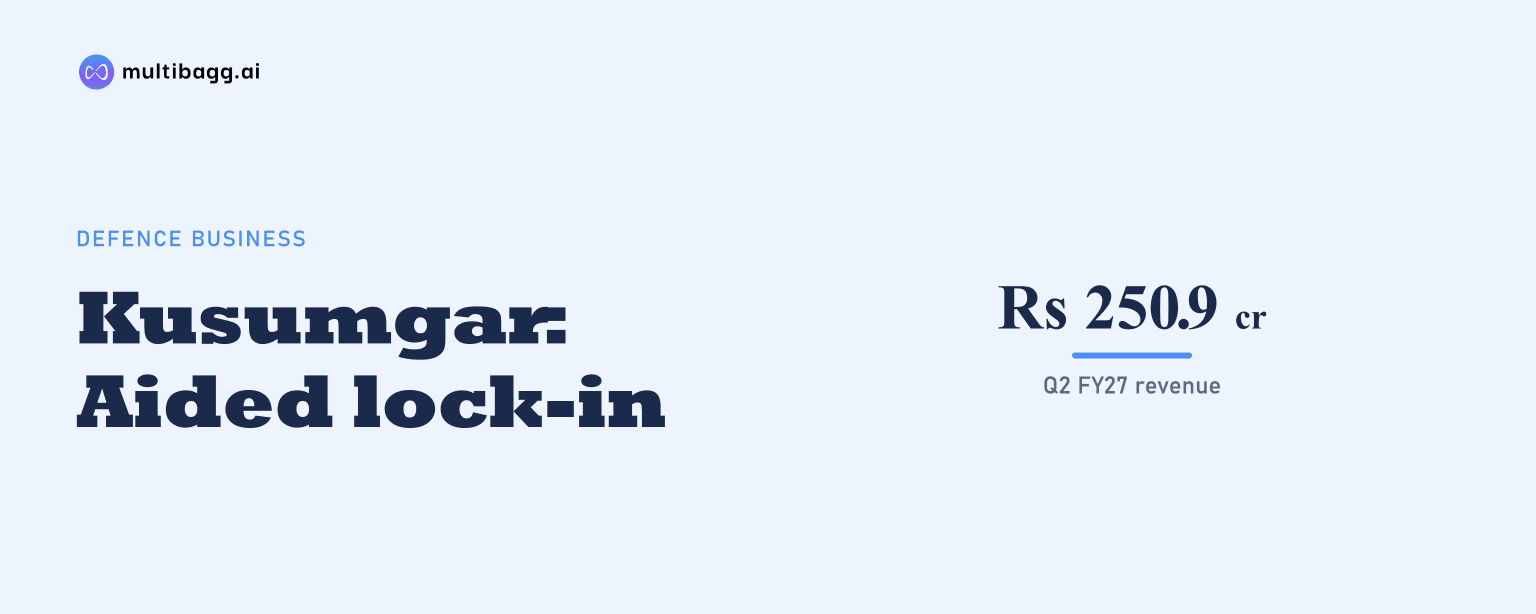
In Q2 FY27, Kusumgar Ltd. said multi-year qualification cycles, five-site vertically integrated manufacturing and exclusive technology partnerships support defence customer lock-in, while revenue rose 81% year on year to Rs 250.9 crore. The company also cites more than 50 years of accumulated material and process expertise.
Know Kusumgar inside out
Results, valuation, peers and who's buying, in one view.
Why does Kusumgar say approval cycles create customer lock-in?
Kusumgar says qualification can create customer lock-in because its products face multi-year testing and approval cycles before they are embedded with customers. The company states that, once qualified, customer switching costs are high, particularly where it supplies custom solutions through approval-heavy processes. This is a management characterisation rather than a disclosed measure of contract duration, retention or switching cost.
Kusumgar identifies more than 50 years of accumulated material and process expertise as another part of this mechanism. It says know-how compounds with every programme delivered, while some products can take a decade to mature before becoming long-term, recurring business. The presentation does not identify the number of such programmes or revenue generated by products that took a decade to develop.
The qualification argument is tied to aerospace and defence applications. Kusumgar lists aerial delivery and recovery systems, camouflage solutions, custom solutions and lifecycle support within its Aerospace & Defence Solutions business. Its Aerospace & Defence Fabrics range includes parachute and Lighter-Than-Air fabrics, ballistic and protective applications, camouflage fabrics, and military gear and wear.
How does Kusumgar’s in-house integration support its offer?
Kusumgar says its vertically integrated model gives it control from materials through systems and testing across five manufacturing locations: Kosamba, Kothwa, Karanj, Valsad and Vapi. The stated sequence starts with yarn preparation and weaving, moves through chemistry and finishes, and ends with design, cutting, assembly, integration, testing and lifecycle support. This places the production stages cited by the company inside one operating footprint.
At the materials stage, Kusumgar lists fine-denier polyamide, polyester and aramid capabilities, including fabric capability from 25 gm onwards. At the chemistry stage, it names processing, dyeing, coating and lamination, including multispectral camouflage and infrared-signature finishes. The company presents materials, surface treatment and finished-system performance as connected parts of its aerospace and defence offer.
Kusumgar also cites mechanical and physical testing, plus functional, thermal and chemical testing, within its manufacturing footprint. It says it has an internal laboratory accredited by the National Accreditation Board for Testing and Calibration Laboratories (NABL), alongside one quality system running from yarn to field. Its listed certifications include ISO 9001:2015, IATF 16949:2016, ISO 14001:2015, OEKO-TEX Standard 100 and AS9100D, although the presentation does not specify which facility or product line each certification covers.
Got a follow-up? Ask IRIS
Which partnerships and capabilities has Kusumgar added?
Kusumgar says exclusive arrangements with global technology leaders provide access to design, intellectual property, know-how and licences for unique customer solutions. It also says it co-develops products with users, combining user involvement with in-house materials, chemistry and process know-how. The presentation does not name the partners, state the duration of exclusivity or quantify sales linked to these arrangements.
Its capability timeline shows an expansion from weaving, nylon dyeing, printing and polyurethane coating in 2018 to polyester dyeing, large-roll manufacturing, thermoplastic polyurethane lamination and specialised finishes by 2022. By 2026, the list had expanded to specialty knits, polytetrafluoroethylene lamination, signature management, design, fabrication and integration. The 2026 list adds system-level activities alongside fabric-processing capabilities.
The product and market range widened alongside those capabilities. Kusumgar’s 2018 products included military materials, parachute materials and custom materials; the 2022 additions listed tape backings and activewear; and 2026 included parachute systems and camouflage systems. Its stated markets moved from domestic defence and domestic industry in 2018 to export industry and global brands in 2022, with defence exports added by 2026 as part of ongoing efforts to enter new high-technology areas.
What financial evidence accompanies Kusumgar’s positioning?
Kusumgar reported Q2 FY27 revenue of Rs 250.9 crore, compared with Rs 138.8 crore in Q2 FY26, an increase of 81%. Earnings before interest, tax, depreciation and amortisation (EBITDA) rose 132% to Rs 71.3 crore from Rs 30.8 crore, while profit after tax (PAT) increased 272% to Rs 40.6 crore from Rs 10.9 crore. The figures do not isolate the contribution from approval-led defence products.
Kusumgar describes aerospace and defence as the majority of its business while also identifying industrial, automotive, outdoor and lifestyle fabrics as other areas. Total income was Rs 711.8 crore in FY26, down from Rs 790.2 crore in FY25, before H1 FY27 total income reached Rs 503.7 crore. The presentation provides no segment revenue, order-book or customer-concentration data, so it does not permit a numerical assessment of how much Q2 FY27 growth came from defence qualification cycles or technology partnerships.
Conclusion
Kusumgar’s stated defence advantage combines long approval cycles, custom products, accumulated know-how, exclusive technology access and control across materials, chemistry, systems and testing. Its 2018-to-2026 capability progression shows a move from weaving and coating into signature management, fabrication and integration, while Q2 FY27 revenue of Rs 250.9 crore was 81% above the prior-year quarter.
What to watch next is whether Kusumgar’s ongoing effort to enter new high-technology areas produces disclosed product, export or segment outcomes. The company identifies defence exports by 2026 and says some products can take a decade to mature, but it has not provided targets for exports, qualification wins, partnership sales or aerospace and defence revenue share.