










Kusumgar Limited flags 100–120-day cycle, Rs 6.7 crore provision
Key highlights
- Kusumgar says its normal full-year working-capital cycle is around 100–120 days.
- Kusumgar booked a Rs 6.7 crore ECL provision on government receivables in H1 FY27.
- H1 FY27 revenue was Rs 498.2 crore, compared with Rs 261.2 crore in H1 FY26.
- H1 FY27 capital expenditure was Rs 44.1 crore, mainly for maintenance and debottlenecking.
powered by IRIS
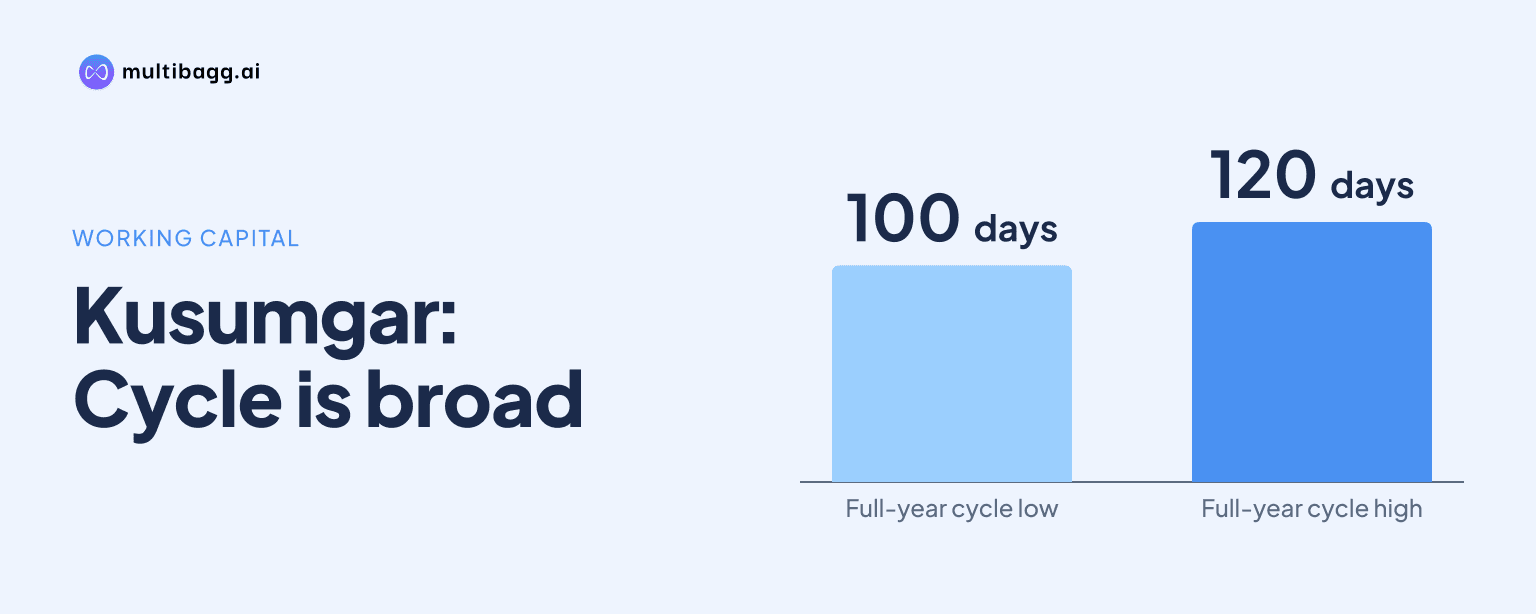
Kusumgar Limited said its normal full-year working-capital cycle is about 100–120 days because defence and government payments follow inspection and acceptance, and it recorded a Rs 6.7 crore expected credit loss provision on government receivables in H1 FY27. The company said the provision will reverse when the amount is collected.
Know Kusumgar inside out
Results, valuation, peers and who's buying, in one view.
Why does Kusumgar have a 100–120-day working-capital cycle?
Kusumgar says its working-capital cycle is typically around 100–120 days over a full year because a large part of its business is with defence and government customers. Payment from these customers follows their inspection and acceptance process, making administrative acceptance a determinant of when completed deliveries are collected.
The 100–120-day range is a full-year indication rather than a fixed quarter-end measurement. Kusumgar said the cycle can move from quarter to quarter because the timing of large deliveries affects period-end balances. A delivery made near a reporting date may remain in receivables until the customer's inspection and acceptance process is completed.
Kusumgar did not disclose a quarterly receivables balance, debtor-days measure or ageing analysis in its Q2 FY27 investor Q&A for the quarter and half year ended 30 September 2026. It also does not disclose an order book, tender pipeline or win rates, saying orders can range from purchase orders to letters of intent and customer projections. The 100–120-day range is therefore its stated measure of normal working-capital timing.
What does Kusumgar's Rs 6.7 crore ECL provision mean?
Kusumgar recorded a Rs 6.7 crore expected credit loss, or ECL, provision in H1 FY27 under its ECL policy, relating to government receivables. The company said the provision shall be reversed when the amount is collected. It did not name a customer or disclose the gross receivable amount covered by the provision.
The disclosure was made for the half year ended 30 September 2026, alongside Kusumgar's explanation that government payments depend on customer inspection and acceptance. The company did not describe the Rs 6.7 crore charge as a write-off, nor did it say that its collection process had changed. Its stated condition for reversal is collection of the receivable.
The source treats the ECL provision and the normal 100–120-day cycle as related but separate disclosures. It does not establish whether the provision resulted from a delay beyond the usual cycle, a particular stage of inspection or a broader change in government payment behaviour. Kusumgar provided no receivable ageing or collection-date estimate in the Q2 FY27 document.
Got a follow-up? Ask IRIS
How did the provision coincide with Kusumgar's H1 FY27 results?
Kusumgar reported higher H1 FY27 revenue and profit while disclosing the Rs 6.7 crore ECL provision. Revenue from operations rose to Rs 498.2 crore from Rs 261.2 crore in H1 FY26, while profit after tax, or PAT, increased to Rs 83.2 crore from Rs 17.6 crore. Management attributed growth mainly to continued execution of aerospace and defence solutions contracts.
In Q2 FY27, revenue was Rs 250.9 crore, up 81% from Rs 138.8 crore in Q2 FY26 and broadly level with Rs 247.2 crore in Q1 FY27. Earnings before interest, tax, depreciation and amortisation, or EBITDA, were Rs 71.3 crore at a 28.4% margin, while PAT was Rs 40.6 crore compared with Rs 10.9 crore a year earlier. Kusumgar said the Q2 revenue pattern reflected a more even pace of execution than in the previous year.
The comparison shows that the H1 FY27 provision was disclosed during a period of substantially higher revenue and PAT than a year earlier. Kusumgar reports financially as a single segment and does not publish quarterly product-line or geographic revenue splits. It said product mix, operating leverage and raw-material prices influence margins, with a richer product mix contributing to the recent improvement.
What could change Kusumgar's working-capital requirements?
Kusumgar says the timing of large deliveries, customer inspections and customer acceptance can change quarter-end balances. For H2 FY27, management identified timely execution, customer product qualifications in India and overseas, and working-capital control as priorities. It also identified the timing of product approvals and military tenders as risks that can affect quarterly business activity.
Input procurement is another operating consideration because Kusumgar plans critical materials against confirmed orders and uses qualified suppliers in more than one geography. Imported materials represented 38.91% of materials consumed in FY26, up from 27.92% in FY25. The company said it is developing domestic sources for critical inputs, while continuing to use qualified overseas suppliers where domestic supply does not meet customer specifications.
Capital expenditure also uses cash, although Kusumgar said current capacity supports its existing business. H1 FY27 capital expenditure was Rs 44.1 crore, mainly for maintenance and debottlenecking. Management said it continues to evaluate investments in new technologies and capabilities, but gave no quantified future capital-expenditure target and said significant projects would be disclosed when relevant.
Conclusion
Kusumgar's disclosures show that receivable timing is tied to the inspection and acceptance procedures used by its defence and government customers. The Rs 6.7 crore H1 FY27 ECL provision adds an accounting charge linked to government receivables, while the company has stated that it expects reversal upon collection. Revenue and PAT nevertheless rose sharply year on year during the same half-year period.
The next disclosure to watch is progress on management's H2 FY27 plan for timely execution, product qualifications and working-capital control. Investors will also be looking for any update on collection of the government receivables and reversal of the Rs 6.7 crore provision, as well as any significant capital-expenditure decision beyond the Rs 44.1 crore spent in H1 FY27.