










Kusumgar H1 EBITDA margin reaches 29.7% with richer mix
Key highlights
- Kusumgar's H1 FY27 EBITDA margin excluding other income was 29.7%, versus 25.6% in FY25.
- Q2 FY27 EBITDA margin including other income was 28.4%, down from 31.1% in Q1 FY27 but above 22.2% in Q2 FY26.
- H1 FY27 revenue was Rs 498.2 crore, compared with Rs 261.2 crore in H1 FY26.
- Imported materials accounted for 38.91% of FY26 materials consumed, versus 27.92% in FY25.
powered by IRIS
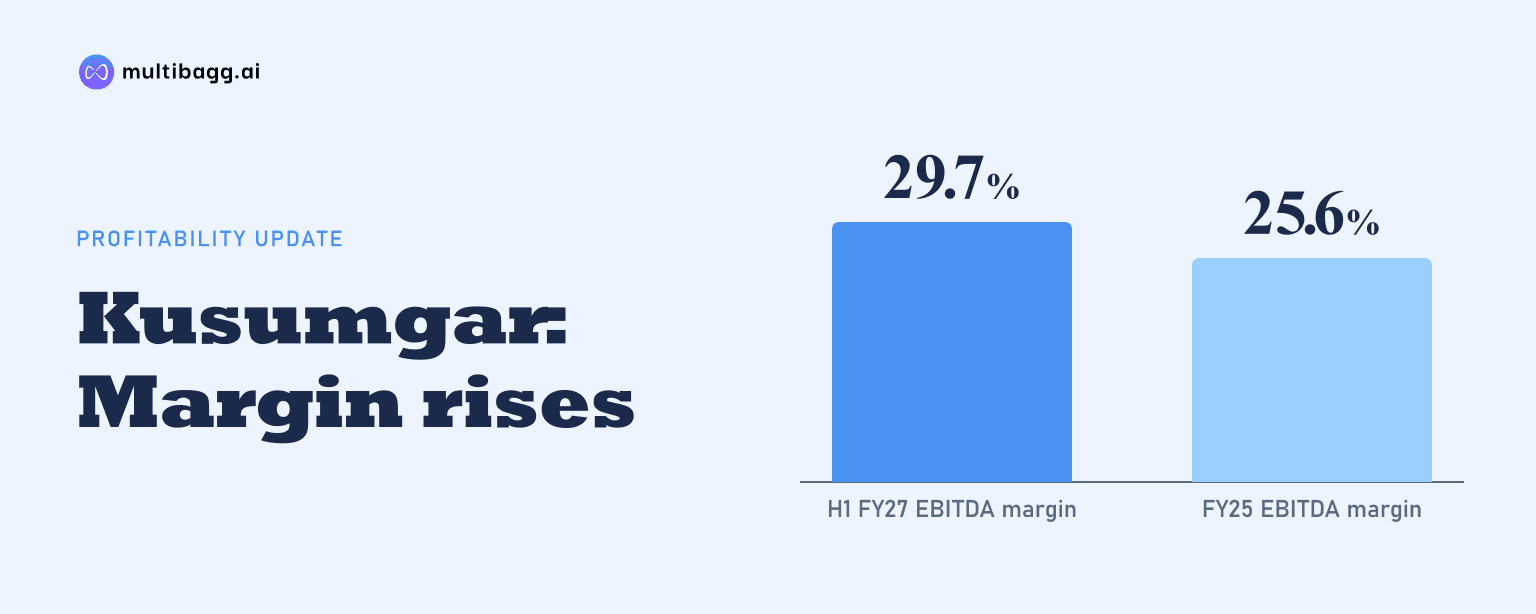
Kusumgar Limited reported a 29.7% earnings before interest, tax, depreciation and amortisation (EBITDA) margin for H1 FY27, excluding other income, after a richer product mix lifted profitability from 25.6% in FY25; the margin nevertheless declined sequentially to 28.4% in Q2 FY27 as product mix and higher raw-material costs affected the quarter.
Know Kusumgar inside out
Results, valuation, peers and who's buying, in one view.
How did Kusumgar's H1 FY27 margin compare with earlier periods?
Kusumgar's H1 FY27 EBITDA margin was 29.7%, excluding other income, compared with 30.0% in FY26, 25.6% in FY25 and 29.6% in FY24. The H1 FY27 figure was therefore 4.1 percentage points above FY25 but 0.3 percentage points below the full-year FY26 result. Management said the recent improvement in profitability came from a richer product mix.
Kusumgar does not provide a sustainable-margin range or formal margin guidance. Instead, it identifies product mix, operating leverage and raw-material prices as the main variables. That framing matters because the reported H1 FY27 result covers six months, while the FY24, FY25 and FY26 comparators cover full financial years; the company also says tender timing can make quarterly performance vary.
Why did Kusumgar's Q2 FY27 margin decline from Q1?
Kusumgar's Q2 FY27 EBITDA margin, including other income, fell to 28.4% from 31.1% in Q1 FY27, a sequential decrease of 2.7 percentage points. Management attributed the movement to changes in product mix and higher raw-material costs, while stating that the Q2 margin remained above the 22.2% recorded in Q2 FY26.
The quarterly measure is not presented on the same basis as the FY24-to-H1 FY27 margin series: Kusumgar explicitly says the quarterly figures include other income, while the annual and H1 figures exclude it as in its prospectus. On the disclosed bases, Q2 FY27 was 6.2 percentage points above Q2 FY26, even after the sequential retreat from Q1 FY27.
What supported Kusumgar's revenue and profit growth in Q2 and H1?
Kusumgar said continued execution of aerospace and defence solutions contracts was the main source of growth, alongside steady demand in its other businesses. Revenue from operations reached Rs 250.9 crore in Q2 FY27, up 81% year on year from Rs 138.8 crore and broadly level with Rs 247.2 crore in Q1 FY27. Management characterised that near-sequentially stable revenue as a more even pace of execution than in the previous year.
For H1 FY27, Kusumgar reported revenue of Rs 498.2 crore, against Rs 261.2 crore in H1 FY26, and profit after tax (PAT) of Rs 83.2 crore, against Rs 17.6 crore. Q2 FY27 PAT was Rs 40.6 crore, compared with Rs 10.9 crore in Q2 FY26, while Q2 EBITDA was Rs 71.3 crore. The source does not disclose quarterly revenue by product line, geography or separate operating segment because it reports financially as a single segment.
The H1 PAT figure also includes an expected credit loss (ECL) provision of Rs 6.7 crore related to government receivables. Kusumgar said the provision follows its ECL policy and will be reversed when the amount is collected. The company says a large part of its business is with defence and government customers, where payment timing depends on customer inspection and acceptance, and its normal full-year working-capital cycle is around 100 to 120 days.
Got a follow-up? Ask IRIS
How does Kusumgar manage raw-material inflation?
Kusumgar says it can usually pass most increases in polyester yarn, nylon yarn and coating-chemical prices to customers, although with a lag. This stated mechanism explains why higher raw-material costs could weigh on the Q2 FY27 margin even as revenue was near the Q1 FY27 level and Q2 margin remained higher than the 22.2% level a year earlier.
The company reported that imported materials were 38.91% of materials consumed in FY26, up from 27.92% in FY25. Fabric development, manufacturing, fabrication, integration and testing are performed in India at Kusumgar's facilities, but some specialised inputs are imported when domestic suppliers do not meet customer specifications. Kusumgar said it is building domestic sources for critical inputs and plans critical materials against confirmed orders.
For current execution, Kusumgar said it faces no supply-chain constraints. Its approach includes qualified suppliers in more than one geography and internal risk-mitigation plans. On currency, management said it usually operates as a net exporter, providing a natural hedge between international sales and imported inputs, while its treasury team manages currency exposure.
What does Kusumgar say could affect margins next?
Kusumgar says timely execution, customer product qualifications and working-capital control are its priorities for the second half of FY27. The company disclosed H1 FY27 capital expenditure of Rs 44.1 crore, saying existing capacity supports the current business and that spending is principally for maintenance and debottlenecking. It continues to evaluate investments in new technologies and capabilities, with significant capex to be disclosed when relevant.
Management identifies the timing of product approvals and military tenders, trade policy including export-market tariffs, and the ability to retain specialised technical talent as key risks. It does not disclose an order book, tender pipeline, win rates or expected tender shares, arguing that orders can range from formal purchase orders to letters of intent and customer projections, making a single number unreliable. Product qualification cycles can take years, according to Kusumgar, which adds uncertainty around the timing of future revenue.
Conclusion
Kusumgar's disclosed margin history shows that H1 FY27 profitability remained close to the 30.0% FY26 EBITDA-margin level excluding other income and was materially above FY25's 25.6%. The Q2 FY27 decline from 31.1% in Q1 to 28.4%, on a separate including-other-income basis, shows that the richer mix did not remove sensitivity to raw-material costs and quarter-to-quarter product composition.
The next items to watch are the company's stated second-half priorities of contract execution, product qualifications and working-capital management, particularly given the Rs 6.7 crore ECL provision on government receivables. Investors also have no disclosed order-book figure to measure near-term visibility, while Kusumgar says tender and approval timing can affect quarterly results and that price increases can be passed through only with a lag.