










Kusumgar Limited's imported-material share rose to 38.91% FY26
Key highlights
- Kusumgar's imported-material share was 38.91% of FY26 consumption, versus 27.92% in FY25.
- Kusumgar's imported-material share increased by 10.99 percentage points between FY25 and FY26.
- Kusumgar says fabric development, manufacturing, fabrication, integration and testing are conducted in India.
- Kusumgar reported Rs 44.1 crore of capital expenditure in H1 FY27, mainly for maintenance and debottlenecking.
powered by IRIS
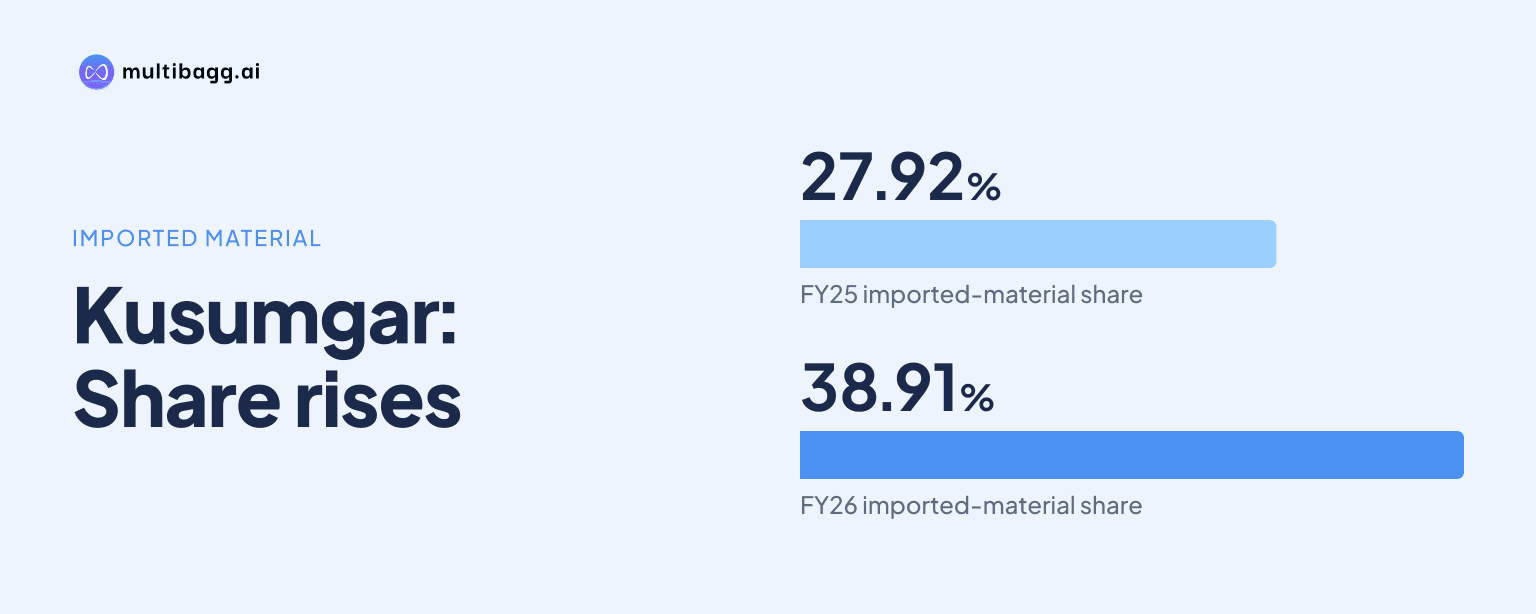
Kusumgar Limited said imported materials accounted for 38.91% of materials consumed in FY26, up from 27.92% in FY25, although fabric development, manufacturing, fabrication, integration and testing take place in India at its own facilities. The 10.99-percentage-point rise shows that specialised overseas inputs remained material to its supply chain.
Know Kusumgar inside out
Results, valuation, peers and who's buying, in one view.
How much did Kusumgar's imported-material share rise in FY26?
Kusumgar's imported-material share rose by 10.99 percentage points in FY26, reaching 38.91% of materials consumed from 27.92% in FY25. The company did not disclose the absolute value of materials consumed, the imported-material categories behind the increase or the volume purchased from overseas suppliers.
The FY26 result means imported inputs represented more than three-eighths of Kusumgar's material consumption, compared with less than three-tenths in FY25. That movement occurred while the company described itself as a textile-forward materials and solutions business focused on aerospace and defence, with control over underlying materials, chemistry and process know-how.
The disclosure measures the origin of materials consumed, rather than the location of product development or finished-goods production. Kusumgar has not stated that the FY26 increase reflected a particular defence programme, customer, technology partner, raw-material price movement or disruption at a domestic supplier.
Which Kusumgar production stages are carried out in India?
Kusumgar says fabric development, manufacturing, fabrication, integration and testing are carried out in India at its own facilities. These are the operational stages the company identifies in answering how indigenous its products are, and they cover work from fabric development through final testing.
The India-based activities do not mean all yarns, chemicals or other materials are locally sourced. Kusumgar separately says some specialised inputs are imported, making a distinction between domestic manufacturing and the origin of materials consumed in FY26.
The company describes its business as one in which product qualifications can take years and create high switching costs after approval. That qualification mechanism is relevant to the use of inputs because a change in material source may need to meet a customer's specifications before it can be used in an approved product, although Kusumgar has not set out individual qualification procedures.
Why does Kusumgar use imported specialised inputs?
Kusumgar says it imports specialised inputs when domestic supply does not yet meet its customers' specifications, sourcing those inputs from qualified overseas suppliers. It has not named the suppliers, the relevant customer specifications, the materials affected or the countries from which those inputs are obtained.
The company's main inputs are polyester yarn, nylon yarn and coating chemicals. Management says raw-material prices affect margins and that it is usually able to pass most price increases to customers, although with a lag, linking the material mix to the timing of cost recovery.
Kusumgar reported an earnings before interest, tax, depreciation and amortisation margin, excluding other income, of 30% in FY26, compared with 25.6% in FY25 and 29.6% in FY24. Management attributed margin movement primarily to product mix, operating leverage and raw-material prices, rather than identifying imported materials as a separate cause.
The company also says much product development is conducted jointly with customers and global technology partners against specific operational requirements. Its dedicated technology team and in-house laboratories support rapid prototyping, application simulation and testing, but the presentation does not connect a specific laboratory project to replacement of an imported input.
Got a follow-up? Ask IRIS
Is Kusumgar developing domestic sources for critical materials?
Kusumgar says it continues to build domestic sources for critical inputs, but it has not disclosed an import-reduction target, a completion date or a list of materials being localised. Management's stated condition is that domestic supply must meet the specifications required by customers before it can substitute for a qualified overseas source.
The rise from 27.92% in FY25 to 38.91% in FY26 shows that imported inputs gained a larger share of material consumption during that period. It does not establish that Kusumgar stopped developing domestic sources, because management explicitly says that work continues, but it does show that the FY26 material mix moved towards overseas sourcing.
Kusumgar's stated development model can affect the pace of substitution. The company says it commercialises new products every year across its solution families, while qualification cycles may take years, but it does not say whether any domestic-source qualifications were completed in FY26.
Are imported inputs affecting Kusumgar's current execution?
Kusumgar says no supply-chain constraints are affecting current execution. Management says it plans critical inputs against confirmed orders, works with qualified suppliers in more than one geography and has risk-mitigation plans for supply challenges.
The company does not disclose an order book, bid pipeline, tender win rate or expected share of tenders. It says orders can be at stages including formal purchase orders, letters of intent and customer projections, and that a single order-book number would not be reliable because of differing stages and customer confidentiality.
Kusumgar says its treasury team manages currency exposure on international sales and imported inputs. It is usually a net exporter, according to management, which provides a natural hedge between foreign-currency sales and imported-material costs; however, the company does not disclose the value of that exposure or the extent of hedging.
Execution is also exposed to military tender timing and product approvals, which management identifies as sources of quarter-to-quarter variation. In H1 FY27, Kusumgar reported revenue of Rs 498.2 crore and profit after tax of Rs 83.2 crore, compared with Rs 261.2 crore and Rs 17.6 crore respectively in H1 FY26, as aerospace and defence solutions contracts were executed.
What does Kusumgar's capex plan indicate about supply sourcing?
Kusumgar reported capital expenditure of Rs 44.1 crore in H1 FY27. Management says existing capacity supports the present business, so the reported spending was mainly for maintenance and debottlenecking rather than an announced project to replace imported materials.
The company continues to evaluate investments in new technologies and capabilities and says it will disclose significant capital expenditure when relevant. It has not linked the Rs 44.1 crore H1 FY27 spend to domestic sourcing, a new materials plant, an input qualification programme or a reduction in the 38.91% imported-material share.
Kusumgar says its normal working-capital cycle is around 100 to 120 days over a full year, though it can move quarter to quarter. Its planning of critical inputs against confirmed orders therefore sits alongside payment timing from defence and government customers, where inspection and acceptance processes can affect quarter-end receivable balances.
Conclusion
Kusumgar's FY26 disclosure separates domestic execution from domestic material sourcing. The company conducts fabric development, manufacturing, fabrication, integration and testing in India, but imported materials represented 38.91% of FY26 consumption, up 10.99 percentage points from FY25. Specialised inputs sourced overseas remained necessary where domestic supply did not meet customer specifications.
The next disclosure to watch is progress on management's plan to build domestic sources for critical inputs, particularly any identified qualification milestones, targets or future change in the imported-material share. Management also says it will disclose significant new technology or capability investments when relevant, while tender timing and product approvals remain unresolved variables for execution.