










Kwality Pharma expects Rs 300 crore Unit 7 revenue in FY29
Key highlights
- Kwality expects Unit 7 to contribute Rs 300 crore of revenue in FY29.
- Unit 7 is planned across FY28, FY29 and FY30 and is designed for 200 BE-approved products.
- Kwality expects Rs 80 crore to Rs 100 crore of FY28 BE revenue from its existing facility.
- Management estimates Rs 500 crore to Rs 600 crore of three-year spending for Unit 7 and around 200 new bioequivalences.
powered by IRIS
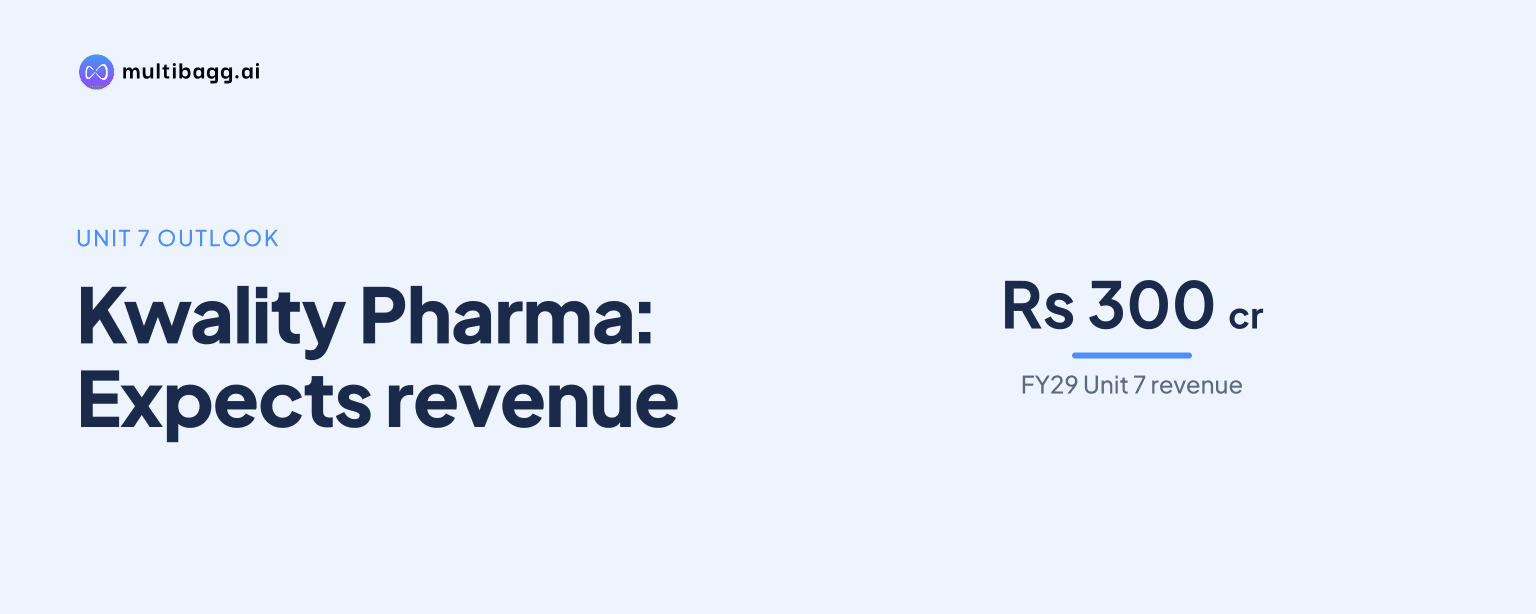
Kwality Pharma expects Unit 7 to contribute Rs 300 crore of revenue in FY29, after beginning a three-phase build across FY28, FY29 and FY30. Management said the adjacent facility is designed to commercialise up to 200 bioequivalence-approved products, while FY28 bioequivalence revenue of Rs 80 crore to Rs 100 crore is expected from the existing facility.
Know Kwality Pharmaceuticals inside out
Results, valuation, peers and who's buying, in one view.
When will Kwality start earning revenue from Unit 7?
Kwality expects Unit 7 revenue to begin in FY29, rather than FY28. Management said the new facility will be completed in three phases across FY28, FY29 and FY30, making FY29 the first stated period for a revenue contribution from the project.
The company placed that initial Unit 7 contribution at Rs 300 crore in FY29. This is management's expectation during the phased rollout, not a disclosed estimate for the facility at full use after all three phases are completed through FY30.
Bioequivalence, or BE, products are expected to generate Rs 80 crore to Rs 100 crore in FY28 from the old facility. The distinction means the existing site is intended to support early BE sales before Unit 7 becomes a separate manufacturing contributor.
Management's schedule separates construction timing from commercial revenue. While Unit 7 is planned to be built across three financial years, the company did not state that every production line or all 200 potential products would be operating in FY29.
What will Kwality manufacture at Unit 7?
Kwality plans to use Unit 7 to commercialise the bioequivalences it has completed. Management said the infrastructure will be sufficient to commercialise 200 BE-approved products and described the site as a high-volume manufacturing facility.
The new unit will be adjacent to the existing facility, and management said it could potentially use the same operating model and systems. That location is relevant because the company expects current operations to continue generating FY28 BE sales while the new site is developed through FY30.
Management illustrated the possible economics by saying one BE study could generate at least Rs 20 crore to Rs 30 crore of revenue across 20 to 30 countries. On that basis, it said revenue potential from 200 studies could exceed Rs 2,000 crore and potentially reach Rs 3,000 crore or Rs 4,000 crore.
Those larger figures were conditional illustrations, not revenue guidance. Management said the outcome would depend on completing BE studies, filing dossiers in 20, 30 or 40 countries, obtaining registrations and potentially securing entry into European markets.
Got a follow-up? Ask IRIS
How much capital does Kwality expect to need for Unit 7?
Kwality estimates Unit 7 itself could require Rs 200 crore to Rs 250 crore of capital expenditure. Management added that developing around 200 new bioequivalences through FY30 could require another Rs 250 crore to Rs 300 crore.
Together, those estimates indicate Rs 500 crore to Rs 600 crore of expenditure over three years for the Unit 7 and BE programme. Management said it would provide investors with clearer visibility on capital expenditure in a future presentation, so it did not disclose a phase-by-phase allocation.
The company also expects additional working capital of Rs 60 crore to Rs 80 crore over two or three years. An analyst asked whether Rs 50 crore to Rs 60 crore would be needed over and above internal accruals, and management agreed.
Management said it could fund annual expansion of Rs 150 crore to Rs 160 crore from internal cash generation if profit after tax reaches Rs 170 crore to Rs 180 crore on Rs 1,000 crore of revenue. It also said bank funding could supplement retained earnings, while stating that it had no current plan for equity dilution.
What capacity does Kwality have before Unit 7 contributes?
Kwality has already begun operating a third shift on oral-solid lines and some injectable lines. Management said six or seven lines are still working with a third shift, but it does not yet need to introduce that shift across all production lines.
Management expects the generics facility to be about 80% saturated when company revenue reaches Rs 1,000 crore to Rs 1,200 crore. At that stage, it said a third shift may be required on all lines, linking wider shift deployment to revenue scale and utilisation.
This provides a contrast between the current and planned facilities. The existing plant is expected to deliver Rs 80 crore to Rs 100 crore of BE revenue in FY28, while Unit 7 is expected to deliver Rs 300 crore in FY29 and provide infrastructure for as many as 200 BE-approved products.
Management also said expansion is presently more necessary on the generics side than in biologics. Its biologics infrastructure has space for at least six or seven contract development and manufacturing organisation, or CDMO, projects, according to management, whereas 10 or 20 such projects would saturate that infrastructure.
Conclusion
Kwality's Unit 7 plan is a phased expansion intended to turn a substantially larger BE pipeline into commercial manufacturing output. Management expects no Unit 7 revenue in FY28, followed by Rs 300 crore in FY29, while describing infrastructure sufficient for 200 BE-approved products and a broader three-year spending requirement of Rs 500 crore to Rs 600 crore.
The next points to watch are completion of the FY28, FY29 and FY30 phases, the promised fuller capital-expenditure disclosure, and progress in BE studies, country filings and registrations. Management's revenue illustrations above Rs 2,000 crore depend on product development and approvals across multiple markets, rather than on manufacturing capacity alone.