










Kwality Pharmaceuticals Targets Rs 300 Crore From 19 Products
Key highlights
- Kwality Pharmaceuticals expects around Rs 300 crore of FY29 revenue from 19 bioequivalence products.
- The first seven or eight bioequivalence products could generate Rs 80 crore to Rs 90 crore in FY28.
- Kwality Pharmaceuticals reported Q2 FY27 consolidated revenue of Rs 181 crore, up 63% from Rs 111 crore.
- Management expects Mexican cephalosporin registration in Q4 FY27 and Brazilian and European registrations around Q2 FY28.
powered by IRIS
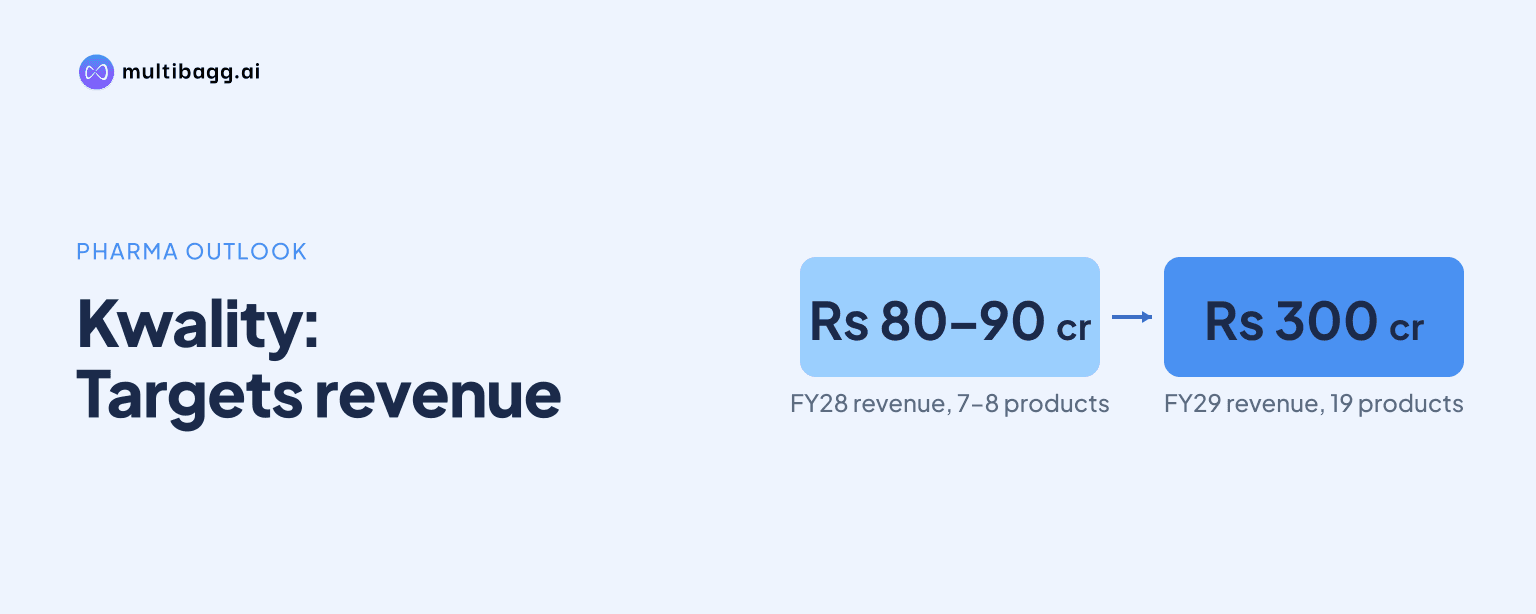
Kwality Pharmaceuticals Limited expects 19 bioequivalence products to generate around Rs 300 crore in FY29, following commercialisation of seven or eight initial molecules in FY28 that management expects to contribute Rs 80 crore to Rs 90 crore. The rollout depends on registrations and launches, particularly in South Asian and Latin American markets.
Know Kwality Pharmaceuticals inside out
Results, valuation, peers and who's buying, in one view.
How much revenue does Kwality Pharmaceuticals expect from bioequivalence products?
Kwality Pharmaceuticals expects around Rs 300 crore of FY29 revenue from 19 bioequivalence products. Management said the first seven or eight molecules should be commercialised in FY28 and generate Rs 80 crore to Rs 90 crore, while the remaining 11 or 12 products would be commercialised by FY29.
The company had completed bioequivalence studies for 19 of 40 molecules targeted for global filing by the Q2 FY27 call on November 13, 2026. Management also said 19 dossiers were ready and a further 21 dossiers were expected by early 2027, although the Rs 300 crore estimate specifically relates to the 19 completed-study products.
Management described the FY29 number as an expectation from the product pipeline rather than reported revenue. It did not disclose the names of the first seven or eight molecules, country-level sales assumptions, or a revenue split between South Asia and Latin America.
When will Kwality Pharmaceuticals begin commercial launches?
Kwality Pharmaceuticals expects first revenue from some completed dossiers by Q1 FY28, after submitting five or six dossiers across 40 to 50 countries for molecules completed in Q4 FY26. Management said the initial seven or eight products would be commercialised in FY28, with the full 19-product set expected to contribute in FY29.
The timetable is driven by regulatory review cycles. Management said Latin American filings in Colombia, Peru and Chile typically require eight to 10 months of evaluation, followed by queries and additional screening that can extend the total process to 13 to 14 months. Mexico was said to take about 14 to 18 months.
This means completing a bioequivalence study does not itself establish a launch date. Revenue requires dossier filing, approval by the relevant authority and commercial supply, and management did not give a separate post-approval shipment timeline for each of the 19 products.
Which registrations and markets underpin Kwality Pharmaceuticals' plan?
Kwality Pharmaceuticals identified South Asia and Latin America as the first markets for seven or eight bioequivalence launches in FY28. Separately, it has filed cephalosporin registrations in Mexico, Brazil and Europe, with management expecting Mexico in Q4 FY27 and Brazil and Europe around Q2 FY28.
Management characterised Mexico as the least profitable of those three cephalosporin markets. The cephalosporin approvals are not presented as a separate component of the Rs 300 crore bioequivalence target, but they show the regulatory timing that applies to the company’s expansion in international markets.
The company said newer marketing authorisations, or MAs, are held by Kwality Pharmaceuticals rather than commercial partners. Management said that under a possible Rs 1,000 crore revenue model in FY28 or FY29, Rs 800 crore could come from company-owned MAs and Rs 200 crore from partner-owned registrations.
Management cited earnings before interest, tax, depreciation and amortisation, or EBITDA, margins of 24% to 26% for exports through partners and 28% to 32% for products sold under its own registrations. These are portfolio-level ranges that vary by molecule, not a margin forecast for the 19 bioequivalence products.
Got a follow-up? Ask IRIS
How does the pipeline fit Kwality Pharmaceuticals' wider targets?
Kwality Pharmaceuticals’ bioequivalence programme is incremental to its existing operations, which reported consolidated Q2 FY27 revenue of Rs 181 crore, up 63% from Rs 111 crore in Q2 FY26. First-half FY27 revenue was Rs 343 crore, while Q2 FY27 profit after tax doubled year on year to Rs 29 crore.
Management raised FY27 revenue guidance to more than Rs 720 crore and said Rs 720 crore to Rs 750 crore was achievable. For FY28, it said revenue could be Rs 950 crore to Rs 1,000 crore or more if it receives additional European registrations and one expected Brazilian registration.
Management has also targeted 200 bioequivalence studies by 2029 and 2030, with further batches of 40 molecules planned. It said research and development expenditure would begin increasing from Q1 FY28 once hormonal and oncology expansion costs are completed, as the number of bioequivalence studies and research products rises.
What could affect Kwality Pharmaceuticals' FY29 target?
Kwality Pharmaceuticals’ Rs 300 crore expectation depends on product registrations, regulatory reviews and commercialisation across all 19 molecules. Management’s cited review periods of 12 to 18 months in Latin America demonstrate that the pace of approvals, ministry queries and country-specific clearance can change the timing of supplies.
The company did not provide molecule-specific launch dates, approval probabilities, pricing or country-level revenue for the 19 products. It also said products can face competition, although management’s stated response is to keep adding molecules rather than stop at 20 or 40 bioequivalence studies.
A United States project remains outside the disclosed FY29 bioequivalence estimate. Management said it was working with a US-based company on a potential abbreviated new drug application, or ANDA, filing by FY28, but described the initiative as premature and said filing timing was uncertain.
Management said it could commercialise one or two cephalosporin products in the US in FY30, subject to the ANDA process and US Food and Drug Administration clearance. That potential project should therefore not be treated as a disclosed contributor to the FY29 Rs 300 crore target from 19 products.
Conclusion
Kwality Pharmaceuticals has attached a phased revenue expectation to its completed bioequivalence work: an FY28 contribution from the first launches followed by broader FY29 commercialisation. The plan also supports management’s stated shift toward company-owned registrations, which it says can offer different economics from partner-held registrations.
The next disclosed milestones are potential Mexican cephalosporin registration in Q4 FY27, expected Brazilian and European registrations around Q2 FY28, and first revenue from some completed bioequivalence dossiers in Q1 FY28. Management also said its Q4 FY27 presentation would outline capital expenditure through FY30, after completing Rs 20 crore to Rs 25 crore of remaining planned capital expenditure by April 2027.