










Kwality sees registered mix support 27%-28% EBITDA margin
Key highlights
- Kwality expects a 27%-28% FY27 EBITDA margin at revenue of Rs 720 crore to Rs 750 crore.
- Kwality linked Q2 year-on-year growth of 63% to registrations in MENA, Mexico and Colombia.
- Kwality said Indian API prices rose about 4%-5%, which higher-margin registered products absorbed.
- Kwality estimated Rs 500 crore to Rs 600 crore of capital expenditure over three years for Unit 7 and bioequivalence expansion.
powered by IRIS
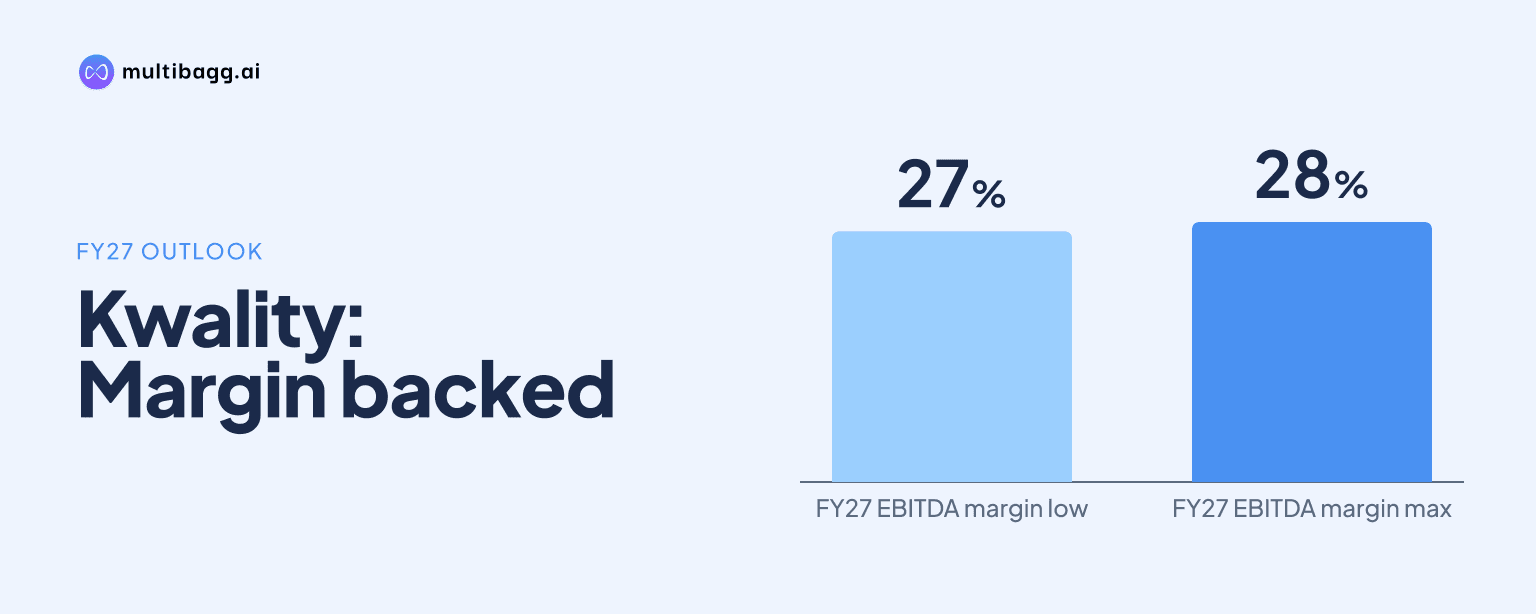
Kwality Pharma expects a 27%-28% EBITDA margin in FY27 at revenue of Rs 720 crore to Rs 750 crore, with management attributing the outlook to higher-gross-margin registered products in Latin markets and the Middle East and North Africa (MENA). Kwality said these products are displacing older unregistered sales and can absorb a 4%-5% rise in active pharmaceutical ingredient prices.
Know Kwality Pharmaceuticals inside out
Results, valuation, peers and who's buying, in one view.
Why does Kwality expect a 27%-28% EBITDA margin?
Kwality expects a 27%-28% EBITDA margin at FY27 revenue of Rs 720 crore to Rs 750 crore, according to management. The company raised its revenue guidance to more than Rs 720 crore, and management confirmed that the margin range was achievable at that scale. EBITDA means earnings before interest, tax, depreciation and amortisation.
Management said the margin could rise to 29%-30% if revenue exceeds Rs 1,000 crore while operating costs remain at the same level. At the lower FY27 revenue range, however, its stated expectation remains 27%-28%. The comparison identifies operating-cost absorption from larger sales, rather than a forecast increase in finished-product pricing, as the route to further margin expansion.
Kwality said the FY27 range also allows for operating costs at its hormone plant before commercial sales begin. Management described 27.5%-28% as a possible outcome but kept Rs 720 crore as its conservative revenue reference because export markets are affected by December holidays and closures extending to 15 January.
What is changing in Kwality's sales mix?
Registered products in Latin markets and MENA are the main drivers of Kwality's margin outlook because they have higher gross margins, management said. It linked Q2 year-on-year growth of 63% specifically to new registrations in Algeria, Morocco and Tunisia, along with Mexico and Colombia, while declining to provide a volume-versus-value split during the call.
Kwality said products previously supplied to unregulated markets or sold without registrations are depleting each quarter. Those lower-margin sales are being replaced by registered products that management said command higher prices and gross margins. It added that the registrations supporting the 63% growth could have arrived in FY26 but were received in FY27 instead.
The transcript does not quantify revenue, gross profit or EBITDA by Latin market, MENA or product. It does, however, make the mechanism clear: registrations enable Kwality to sell into these geographies, and management expects additional registrations to increase sales beyond the FY27 contribution from Algeria, Morocco, Tunisia, Mexico and Colombia.
Can Kwality absorb higher API costs and currency movements?
Kwality said it absorbed a 4%-5% increase in Indian active pharmaceutical ingredient, or API, prices without increasing finished-product prices. Management attributed that ability to newly registered, higher-priced products replacing low-margin products, which it said created enough margin room to cover the input-cost increase.
The company said 85% of API procurement is from India and 10%-15% from China. For the next set of bioequivalence and peptide products, management said about 98% of inputs would come from India, apart from one or two possible excipients or APIs. Bioequivalence studies compare whether a product performs comparably with a reference medicine.
Kwality also said currency moves had not materially affected its costs or sales realisation. Management explained that a US dollar product price is set using an Indian-rupee basis, giving an example of a $0.50 price based on Rs 89-Rs 90 that could change to $0.48 if the dollar rises. It characterised that pricing arrangement as protection against the cited currency effect, without providing a margin sensitivity.
Got a follow-up? Ask IRIS
Which facilities and markets could affect margins next?
The hormone facility is the next identified variable for Kwality's margin profile. Management said the facility is expected to go live in Q3 FY28 and that adding hormone sales to the existing business could lift overall EBITDA margin to roughly 28%-29%. That outcome depends on generating Rs 100 crore to Rs 150 crore of hormone revenue in the following year.
If that Rs 100 crore to Rs 150 crore hormone-revenue range is not achieved, management said margins would remain at 27%-28%. This distinguishes the FY27 margin expectation from a potential FY28 benefit: the FY27 range includes hormone-plant operating costs, while the higher 28%-29% scenario depends on commercial contribution after the planned Q3 FY28 start.
Kwality identified Latin America and Europe as priority regions, rather than Iran, Iraq and Saudi Arabia, where it has registrations but described sales as slow-moving. It said Rs 60 crore to Rs 70 crore of Middle East receivables were stuck in Q4 FY26 but were collected in Q1 and Q2. Management also said it is not currently selling a large quantum to those countries.
How does expansion spending connect to Kwality's plan?
Kwality estimated capital expenditure of Rs 500 crore to Rs 600 crore over three years, including Rs 200 crore to Rs 250 crore for Unit 7 and Rs 250 crore to Rs 300 crore for around 200 new bioequivalences through FY30. Management also estimated additional working-capital needs of Rs 60 crore to Rs 80 crore over two or three years.
Management said Unit 7 would be completed in phases across FY28, FY29 and FY30, with revenue from the new facility expected in FY29. It said the facility would be sufficient for 200 bioequivalence studies, but its eventual revenue depends on completing the studies and obtaining registrations across 20, 30 or more countries.
Management said it expects retained earnings and some bank borrowing to fund the programme and has no current plan for equity dilution. It also said revenue of Rs 1,000 crore could support profit after tax of Rs 170 crore to Rs 180 crore, but presented that as a prospective estimate dependent on cash flows and expansion execution rather than confirmed guidance.
Conclusion
Kwality's 27%-28% FY27 EBITDA-margin expectation depends on a documented change in mix: registered products in Latin markets and MENA are replacing older unregistered sales and are said to deliver higher gross margins. Management also cited this mix shift as the reason a 4%-5% increase in Indian API prices has not required higher finished-product prices.
The next milestones are the planned Q3 FY28 hormone-facility start, management's target of Rs 100 crore to Rs 150 crore in hormone revenue in the following year, and expected Q2 FY28 clarity on peptide and amphotericin B liposomal registrations. Brazil commercialisation of one product is targeted by Q2 FY28, while the larger Unit 7 programme depends on bioequivalence studies, registrations and funding execution.