










Landmark Cars Limited Reports Record Q2 EBITDA, PAT Up 1,133%
Key highlights
- Landmark Cars reported Q2 FY27 revenue from operations of ₹1,452 crore, up 19.9% year on year.
- Q2 FY27 net profit was ₹18.5 crore, up 1,133.3% year on year.
- After-sales revenue grew 11%, with revenue per service exceeding ₹30,300.
- Landmark Cars has projected FY27 capital expenditure of ₹80 crore.
powered by IRIS
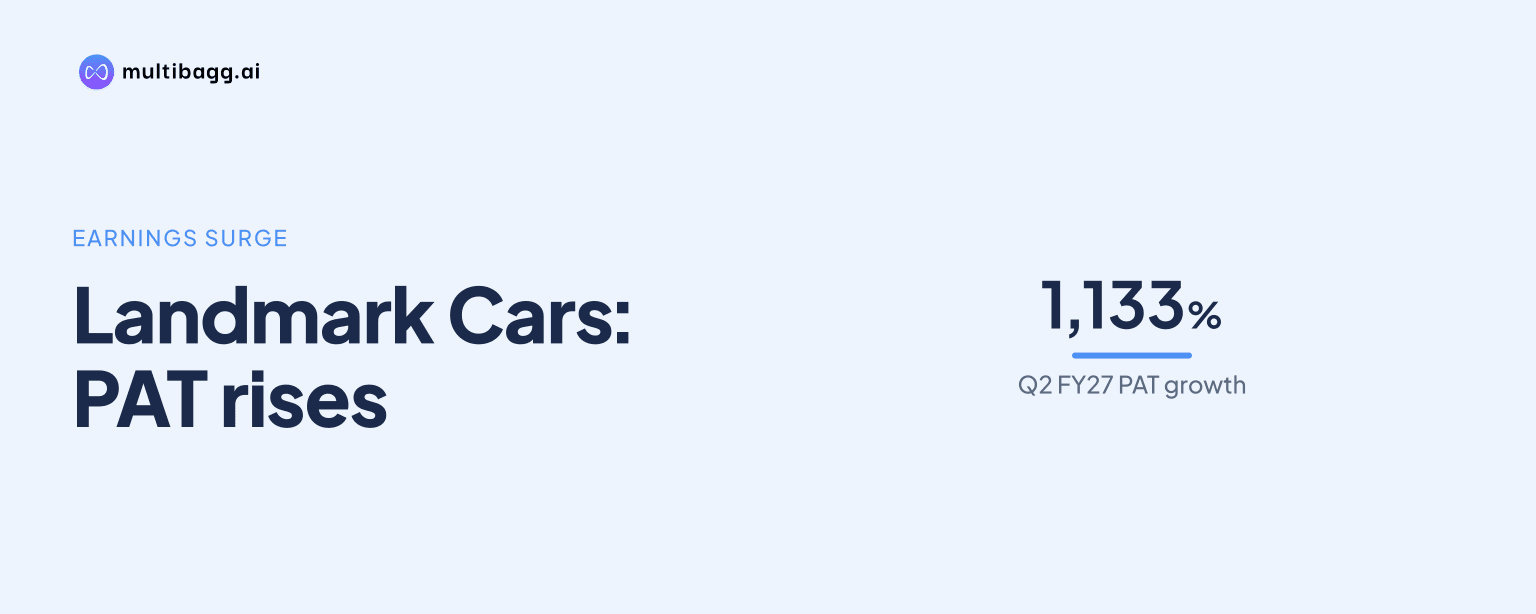
Landmark Cars Limited reported its highest-ever quarterly EBITDA in Q2 FY27, while revenue from operations rose 19.9% year on year to ₹1,452 crore and net profit reached ₹18.5 crore, up 1,133.3%. Management attributed the result to after-sales growth and contributions from newer vehicle brands despite weather disruption in Gujarat.
Know Landmark Cars inside out
Results, valuation, peers and who's buying, in one view.
What did Landmark Cars report in Q2 FY27?
Landmark Cars Limited said Q2 FY27 delivered its highest-ever EBITDA and highest-ever EBITDA from new-car sales. New-car sales accounted for 40% of total EBITDA during the quarter, according to management's earnings call comments on November 13, 2026.
The company reported revenue from operations of ₹1,452 crore, a 19.9% increase from the year-earlier period. Net profit was ₹18.5 crore, compared with a low base in the corresponding quarter, resulting in year-on-year growth of 1,133.3%. A separate pro forma measure cited during the call placed revenue at ₹1,945.7 crore, up 17.4%, and EBITDA at ₹86.2 crore, up 45.7%.
Management said the quarter faced disruption from heavy rain and flooding in Gujarat, which affected workshop activity. It indicated that margins could have been higher without this disruption, but said strong performance in other parts of the business helped offset the impact.
How did after-sales and new brands support earnings?
After-sales was a key driver of Landmark Cars' quarterly performance, with revenue in the segment growing 11% year on year. Management described service revenue as a record and said revenue per service exceeded ₹30,300, the highest level reported by the company.
The business said its after-sales operations have approximately 40% gross margin and 18% EBITDA margin. This service-led income is important for an auto dealer because it provides recurring revenue beyond vehicle deliveries, including maintenance, repairs and accident-related work.
Landmark Cars also cited BYD, MG and Mahindra as newer brands that contributed strongly during the quarter. Management said these brands had moved into leading revenue positions within its portfolio. New-car sales EBITDA reaching 40% of the total also indicates that vehicle sales made a larger contribution alongside the established after-sales business.
The company discussed strong demand for electric and premium models. Mercedes-Benz GLC Electric orders were sold out for the next four months, while Mercedes-Benz CLA EV orders were sold out until March 2027. Management also said BYD's Denza models were sold out for the following quarter before their India launch.
Got a follow-up? Ask IRIS
What is Landmark Cars' investment and operational plan?
Landmark Cars has projected FY27 capital expenditure of ₹80 crore. Management had earlier referred to capex above ₹50 crore and explained that the outlay includes workshop assets, vehicle-related assets and the relocation of existing workshops.
The company said relocating existing workshops can allow capacity to transition without the gestation period associated with a completely new facility. It also noted that new-car returns from the incremental investment are expected to be low, at around 3% to 4%, which highlights the importance of service capacity and other operating benefits from these projects.
Landmark Cars has also signed an agreement with OLX India for a phased rollout of pre-owned vehicle operations across selected cities and brands. Management said the initial rollout would not require meaningful capital from Landmark Cars and that capital allocation would be shared between the two organisations.
Inventory was around 35 days during the period, reflecting festive-season preparation. Management flagged this level as higher than industry norms. It said pricing benefits associated with inventory were expected to materialise in January, without providing a quantified financial estimate.
What does the quarter mean for investors and the auto retail sector?
The Q2 outcome shows the significance of after-sales revenue in Landmark Cars' earnings mix. The 11% growth in after-sales and the ₹30,300-plus revenue per service supported profitability when weather-related disruption affected Gujarat workshops. For investors, this provides context for why EBITDA performance can differ from vehicle-delivery trends in any one quarter.
The company's second half has historically contributed 55% to 60% of annual profit, management said. Festive demand, order visibility in select electric models and inventory build-up are therefore relevant factors for the remaining FY27 periods. However, demand trends, vehicle availability and the operational effects of weather disruptions remain important variables.
Management also identified possible regulatory changes to motor insurance commissions as a factor to monitor. The company did not quantify the potential impact. This issue matters because insurance-related services can form part of the broader dealer ecosystem around vehicle sales and ownership.
At an industry level, management referred to continuing passenger-vehicle demand and a growing shift towards electric vehicles and plug-in hybrids. Landmark Cars' plans to expand workshop capability and its reported demand for Mercedes-Benz and BYD models place its strategy within this changing product mix, although the company does not provide volume guidance.
Conclusion
Landmark Cars delivered record quarterly EBITDA in Q2 FY27, supported by higher-margin after-sales operations and stronger contributions from BYD, MG and Mahindra. Revenue from operations grew 19.9% to ₹1,452 crore and net profit reached ₹18.5 crore, while the quarter also demonstrated the effect of weather disruption on workshop operations.
The next areas to watch are execution of the ₹80 crore FY27 capex plan, the phased OLX India pre-owned vehicle rollout, service-business momentum and second-half profitability. Management has noted that the second half historically contributes 55% to 60% of annual profit, while demand visibility for selected electric models extends into the coming quarters.