










Landmark Cars Limited says EV use can lift workshop revenue
Key highlights
- Landmark said aftersales revenue grew nearly 11% despite rain disrupting four workshops.
- Landmark reported revenue per service of nearly Rs 30,300, an all-time high.
- Landmark said a 7,500-kilometre EV service interval could arrive in 4.5 months versus six months for an ICE vehicle.
- Mercedes EV penetration at Landmark was just under 10%, while the GLC EV was sold out for four months.
powered by IRIS
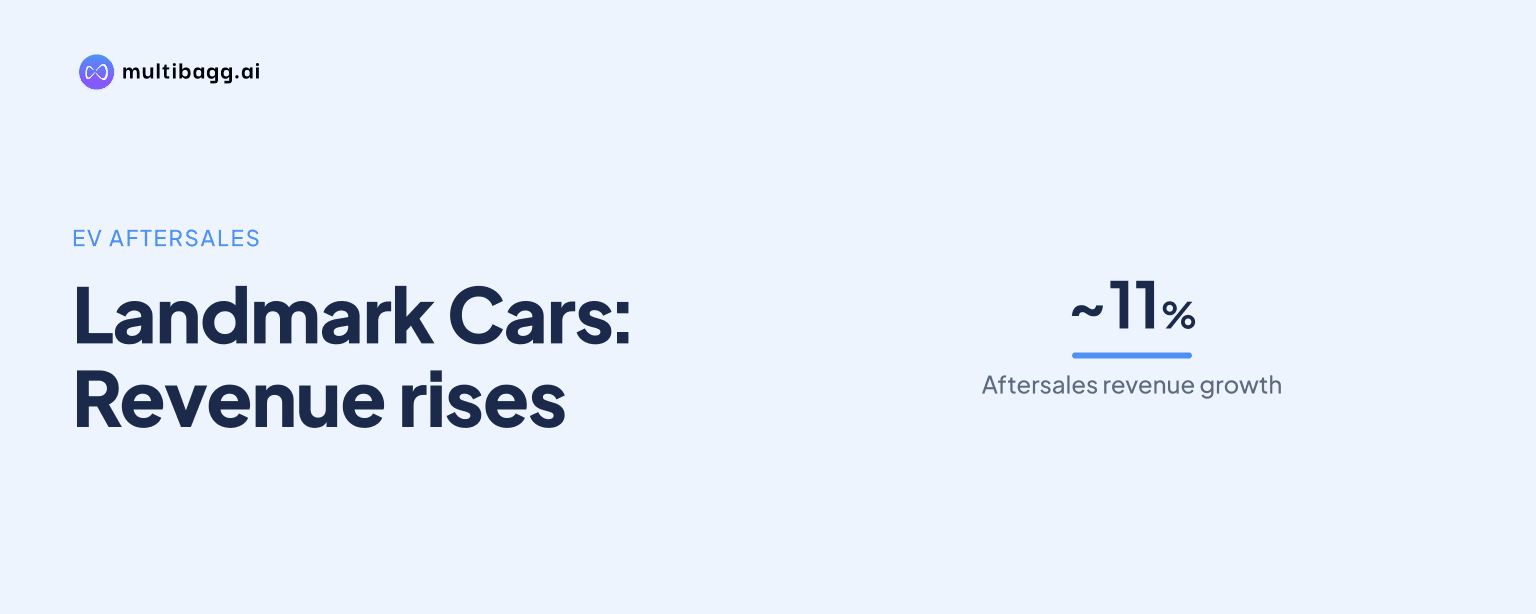
Landmark Cars Limited said on November 13, 2026 that electric vehicles, or EVs, can generate comparable or higher workshop revenue than internal-combustion-engine, or ICE, vehicles because lower running costs increase kilometres travelled, accelerate service visits and raise accident exposure. Landmark’s aftersales revenue grew nearly 11%, while revenue per service reached nearly Rs 30,300.
Know Landmark Cars inside out
Results, valuation, peers and who's buying, in one view.
Why does Landmark say EVs can lift workshop revenue?
Landmark says EVs can lift workshop revenue because customers drive them more than ICE vehicles when their running costs are lower. Management said its review of data from two brands found that EV users accumulated more kilometres, principally because EVs do not carry fuel costs. The company waited for what it considered a decent sample size before drawing this conclusion.
More annual kilometres can shorten the time between distance-based workshop visits. Landmark gave an illustrative 7,500-kilometre service interval: an ICE vehicle could reach it in six months, while an EV with higher usage could reach it in 4.5 months. The maintenance interval itself does not change, but the calendar time needed to reach it falls, increasing the number of annual visits.
Landmark also identifies accident repairs as a contributor to EV workshop revenue. Management said a vehicle driven for more kilometres spends more time on the road and therefore has a greater probability of an accident. It described faster EV acceleration as a smaller issue, while saying higher road exposure was the main driver of accident-related repair work.
Why do EV repairs return to Landmark workshops?
Landmark says EV repairs are more likely to return to authorised workshops because local garages are largely unable to repair EVs. Management said most, or potentially all, EV repair work therefore comes back to authorised facilities. This channel effect combines with earlier distance-based servicing and accident repairs to support workshop revenue.
Management said the result initially surprised it because a widely held expectation was that EV repair costs would be materially lower. It referred to commentary from Penske in the United States a few years earlier that reached a similar conclusion on service revenue. Landmark also noted that EV insurance premiums are higher than ICE premiums in the United States and some Western markets because repair costs are higher.
Landmark did not disclose a rupee-per-job comparison, accident rates, the number of EVs in its two-brand sample or the precise revenue difference between EV and ICE vehicles. Its comments therefore explain the operating mechanisms behind comparable or higher EV workshop revenue rather than providing a quantified EV aftersales forecast.
Got a follow-up? Ask IRIS
What do Landmark’s aftersales results show?
Landmark reported nearly 11% aftersales revenue growth even though rain disrupted four workshops in Gujarat, South Gujarat and Ahmedabad. Management said some affected sites were unavailable for more than a month, across brands including Honda, Volkswagen and MG. Revenue growth despite that disruption points to higher value per service rather than a stated increase in workshop volume.
Revenue per service reached nearly Rs 30,300, which management called an all-time high. Landmark said it can offset lower service volume with higher revenue per job and may avoid lower-paying work simply to raise throughput. Management said workshop infrastructure is expensive, and it focuses on the value of service work rather than disclosing a service-volume target.
Landmark describes aftersales as an approximately 40% gross-margin and 18% earnings before interest, tax, depreciation and amortisation, or EBITDA, margin business. The 17.6% EBITDA margin cited in the call was below that approximately 18% framework. Management attributed part of the difference to costs incurred while four workshops were in transition and said annual bonuses in December or March can affect quarterly margins.
How could EV availability affect Landmark’s workshop mix?
Landmark said EV penetration for Mercedes in the year would be just under 10%, with vehicle availability the main constraint. Management said the GLC EV, launched during the period, was sold out for the next four months, while the CLA was also sold out. It characterised the limitation as a supply issue rather than a demand issue for those products.
Management said EV volumes would clearly increase from their current level as availability improves, but it did not forecast the ultimate mix of EV and ICE sales. It expects the market to find a balance among powertrains, including plug-in hybrids and other technologies, over the next two to three years. That outcome matters for Landmark because more EVs on the road could enlarge the population requiring authorised EV servicing and repair.
Landmark also said it is the largest partner for BYD and the third-largest partner for JSW MG Motors. Management described its infrastructure and workforce as fungible, allowing staff and capital to move between businesses where demand and profitability support investment. The company did not give a separate EV aftersales revenue target for either newer brand.
Conclusion
Landmark’s comments indicate that EV adoption does not necessarily reduce dealer aftersales revenue. Higher vehicle usage can bring forward kilometre-based maintenance and increase accident exposure, while limited independent EV repair capability directs work to authorised workshops. The nearly 11% growth in aftersales revenue, despite rain-related disruption at four workshops, also shows the importance Landmark places on revenue per job.
The next points to watch are the availability of Mercedes EVs, the GLC EV order book sold out for four months, and how the powertrain mix develops over the next two to three years. Management also expects a three-to-one workshop consolidation in Mumbai to be completed within two to three months, while it continues to monitor whether aftersales EBITDA margin moves toward its approximately 18% framework.