










Laxmi Dental's FY26 digital lab penetration exceeded 75%
Key highlights
- Laxmi Dental's domestic laboratory digital unit penetration rose to 75.5% in FY26 from 28.1% in FY22.
- Laxmi Dental's international laboratory digital unit penetration reached 75.2% in FY26, up from 12.4% in FY22.
- Laxmi Dental launched iScope 360 in FY27 and made a 49% AI Dent joint venture investment in FY26.
- Laxmi Dental's dental laboratory revenue increased to Rs 166.77 crore in FY26 from Rs 140.89 crore in FY25, excluding scanner sales.
powered by IRIS
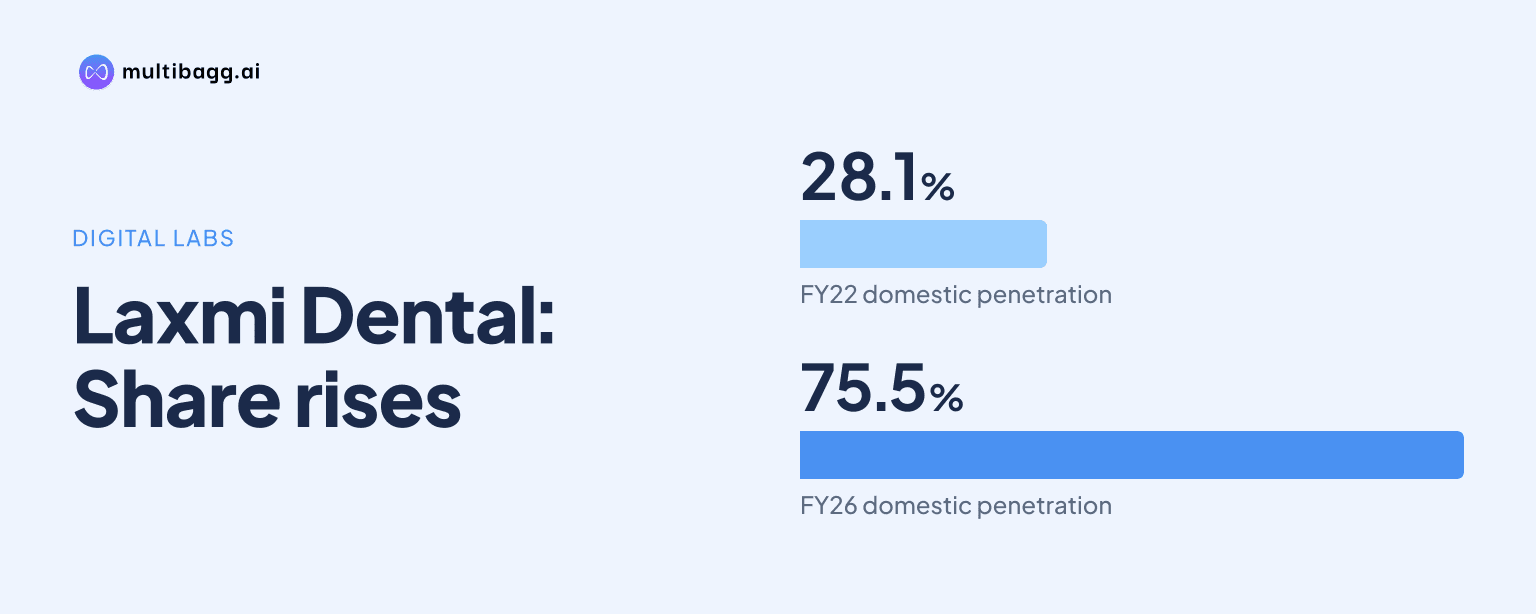
Laxmi Dental Limited reported FY26 digital unit penetration of 75.5% in its domestic laboratory and 75.2% in its international laboratory, as iScanPro removed physical collection, shipping and conversion steps before production. Laxmi Dental also launched the smartphone-paired iScope 360 platform in India in FY27 and held a 49% joint venture investment in AI Dent from FY26.
Know Laxmi Dental inside out
Results, valuation, peers and who's buying, in one view.
How far has Laxmi Dental digitised its laboratory workflow?
Laxmi Dental digitised about three quarters of units in both laboratory operations by FY26, with domestic digital unit penetration reaching 75.5%, up from 64.0% in FY25 and 28.1% in FY22. The domestic increase was 47.4 percentage points over four years. Laxmi Dental identifies iScanPro as its digital dentistry solution and says scanners support both its dental laboratory and aligner businesses.
International laboratory digital unit penetration reached 75.2% in FY26, compared with 63.2% in FY25 and 12.4% in FY22. International adoption was 15.7 percentage points below domestic penetration in FY22, but the gap narrowed to 0.3 percentage points in FY26. Laxmi Dental separately reports digital penetration of about 99% for the aligner business, above the level in either laboratory segment.
How does Laxmi Dental's iScanPro workflow change case processing?
Laxmi Dental says iScanPro sends a digital impression file to the laboratory immediately, rather than requiring a physical impression to be collected by a sales or logistics team and shipped to the laboratory. In the conventional process, the physical impression is converted into a digital impression through a six-step process. The digital workflow removes one-way logistics and redundant processes, according to the presentation.
Design and manufacturing take 24 to 48 hours based on case complexity in both the conventional and digital workflows shown by Laxmi Dental. The stated time benefit therefore occurs before production, through the removal of collection, shipping and conversion stages. The company lists real-time scan verification, higher accuracy and precision, and reduced errors, rework and repeat appointments as scanner benefits, but does not disclose a measured reduction in total turnaround time.
What are iScope 360 and AI Dent at Laxmi Dental?
Laxmi Dental launched iScope 360 in FY27 as an artificial intelligence-enabled remote dental platform that pairs with a smartphone. Its disclosed uses include aligner monitoring, oral-health assessment and virtual consultation. The platform complements intraoral scanners and has been introduced in India, while international introduction is still being evaluated.
AI Dent is Laxmi Dental's FY26 strategic investment through a 49% joint venture in IDBG AI Dent Global Pvt. Ltd. The venture's disclosed artificial intelligence applications include X-ray analysis, aligner monitoring and virtual consultation. The tools were introduced to key opinion leaders, or KOLs, for feedback, while Laxmi Dental's internal artificial intelligence use remained at the pilot stage.
Laxmi Dental also launched Teen Aligners and personalised early orthodontic treatment, or PEOT, in FY26. PEOT is designed for paediatric patients, while the broader products serve orthodontists, general dentists and paediatric dentists. The company says these products expanded the Illusion Aligners portfolio beyond conventional orthodontic treatments.
Got a follow-up? Ask IRIS
How does laboratory growth support Laxmi Dental's digital strategy?
Laxmi Dental's dental laboratory revenue rose to Rs 166.77 crore in FY26 from Rs 140.89 crore in FY25, excluding scanner sales. Domestic laboratory revenue increased by Rs 8.20 crore to Rs 88.40 crore, while international laboratory revenue increased by Rs 17.70 crore to Rs 78.40 crore. International revenue generated the larger absolute increase, although domestic revenue remained higher in FY26.
Laxmi Dental says its network covers more than 22,000 dental clinics, dental companies and dentists across more than 320 Indian cities and over 95 export countries. The United States accounts for about 25% of laboratory business, according to the company. That compares with a 19.4% US share of FY26 geographic revenue for the company as a whole, which is reported separately from laboratory revenue.
Why is scanner adoption relevant to Laxmi Dental's other businesses?
Laxmi Dental identifies scanner penetration among general dentists as an enabler of aligner treatment that was previously handled by orthodontists. Illusion Aligners revenue was Rs 39.38 crore in FY26, compared with Rs 39.48 crore in FY25, while Taglus and Vedia revenue rose to Rs 33.79 crore from Rs 28.90 crore. Laxmi Dental therefore presents the scanner as a workflow tool for restorations and aligner cases rather than a laboratory-only product.
The Illusion Aligners city mix shifted beyond Tier I cities in FY26. Tier I cities represented 43.35% of revenue, down from 54.72% in FY25, while Tier III cities rose to 20.75% from 11.35%; Tier II cities increased to 35.90% from 33.93%. Laxmi Dental's stated aligner strategy includes cross-selling through long-standing domestic dental laboratory relationships and offering upfront and pay-as-you-go payment options for dentists.
Conclusion
Laxmi Dental's FY26 figures show that its laboratory digitisation reached similar levels in domestic and international operations after starting from materially different FY22 bases. The operational change is specific: digital impressions can reach the laboratory immediately, removing physical collection, shipping and a six-step conversion process before the 24-to-48-hour design and manufacturing stage. The company also links scanner adoption to its laboratory and aligner businesses.
What to watch next is execution across products at different stages. iScope 360 was introduced in India in FY27, but international availability remains under evaluation. AI Dent had been shown to KOLs for feedback and Laxmi Dental's internal use was at the pilot stage in FY26, leaving adoption and commercial deployment of its X-ray analysis, monitoring and virtual consultation tools as disclosed next milestones.